


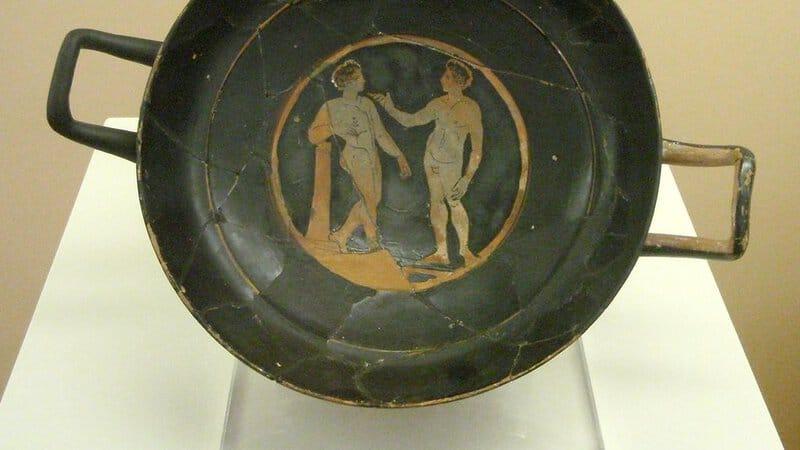
Around 450 BCE, on the sun-bleached colonnades of an Athenian gymnasium, a teenager walked beside an older citizen who had taken a particular interest in him — quizzing him on Homer, pressing him on the nature of courage, and shaping, with deliberate patience, the kind of man the city would eventually need. This was not a secret. It was not even unusual. It was, by the standards of Athenian elite society, exactly how a boy was supposed to become a man.
One Practice, Two Irreconcilable Worlds
The practice that structured that gymnasium encounter — pederasty in ancient Greece — is among the most misunderstood subjects in classical history, and the misunderstanding runs in both directions. Some writers rush to condemn it wholesale by modern standards; others rush to sanitize it into a comfortable mentoring arrangement. Both moves betray the history.
The basic facts are these: adult men pursued adolescent boys, this pursuit was woven into the social fabric of some of the ancient world’s most celebrated cities, and ancient sources treated it not as a transgression against civic life but as a cornerstone of it — a mechanism through which virtue was transmitted, political networks were forged, and boys were prepared for citizenship. Understanding why requires sitting with a tension that does not resolve cleanly, and following the evidence rather than the comfort of a predetermined verdict.
The Social Architecture: Erastes, Eromenos, and the Rules of Pursuit

Ancient Greek pederasty operated inside a strict social vocabulary with defined roles, expectations, and limits. The adult male in the relationship was called the erastes — the lover or pursuer, typically a man in his twenties or thirties. The younger male, the eromenos or “beloved,” was typically an adolescent boy drawn from the propertied class. This was overwhelmingly an elite phenomenon. The gymnasium, the symposium, and the political networks that gave pederastic relationships their structure and meaning were inaccessible to poor families. Pederasty in ancient Greece was, at its core, an aristocratic institution.
The relationship came with an expected choreography. The erastes was supposed to pursue — with gifts, with sustained attention, with the visible demonstration of his admiration. The eromenos was supposed to yield slowly and never appear eager. Desire without dignity was shameful for both parties, and an eromenos who surrendered too quickly or for mercenary reasons was considered to have degraded himself. The entire social performance was governed by a concern for honor that ran in both directions.
Crucially, the relationship had a built-in expiration date anchored to the boy’s youth. When he reached full manhood — marked in ancient sources by the growth of a beard — the erotic dimension was expected to dissolve. What often remained was a lasting bond of friendship, civic mentorship, and political patronage. The young man who had once been an eromenos would, in time, become an erastes himself, and the cycle would continue across generations.
More Than Romance: The Civic Logic Behind the Practice
To read pederasty purely as a sexual arrangement is to miss most of what the Greeks understood themselves to be doing. Academic research indexed by PubMed underscores that pederasty functioned as a formal mechanism for leading a boy into manhood and full participation in the polis — not merely political participation in the narrow modern sense, but the full suite of civic, military, and moral duties a free male citizen owed his city. The erastes was, in effect, a second educator, one who modeled courage, rhetorical skill, and political judgment in ways that formal schooling did not address.
This made sense inside the Greek philosophical framework. The Greeks believed that virtue — arete — was not something absorbed from a text; it was something transmitted through proximity to someone who already possessed it. The pederastic relationship was, among other things, an apprenticeship in being a particular kind of person. As Big Think’s examination of the subject notes, older men genuinely served as mentors to young boys in a way that was socially expected and institutionally reinforced across the Greek world.
The specifics varied significantly by city-state. Sparta formalized a version of the practice through the agoge, the rigorous state education system that organized Spartan boys into age cohorts under adult male supervision. Crete maintained its own distinct traditions, described by later ancient writers as involving ritualized abduction. Athens left the arrangements more informal but no less expected among the propertied class. The underlying civic logic, however, was broadly pan-Hellenic: a city needed citizens of demonstrated character, and character required transmission through sustained human relationship.
But reducing pederasty to professional mentorship is also a distortion. The erotic element was acknowledged openly by ancient writers — not hidden, not euphemized — and that acknowledgment is essential to understanding the practice honestly. Collapsing it into something resembling a modern internship is its own kind of falsification.
The Sexual Question: What Ancient Sources Actually Say

This is where the history becomes genuinely complicated, and where honest engagement demands careful attention to what the evidence actually supports. The Inquiries Journal’s examination of Greek pederastic relationships confirms what a direct reading of ancient texts also reveals: these relationships could involve both intellectual and sexual dimensions, and the ancient sources themselves argue vigorously about where the honorable line was, and what crossing it meant.
Plato, in the Symposium and the Phaedrus, argues for an idealized version of eros in which desire between erastes and eromenos is ultimately sublimated — transformed into a philosophical pursuit of beauty and truth rather than physical consummation. In Plato’s telling, the highest form of the relationship is the one that burns away its own physical fuel and rises toward wisdom. But it is essential to remember that Plato is making an argument, not describing universal practice. He insists on this ideal precisely because the more mundane reality available to him was something considerably less elevated.
Other ancient sources — comedic playwrights, legal speeches, passing references in Thucydides and Plutarch — treat physical relations between erastes and eromenos as common and largely unremarkable. The debates in these texts are not about whether bodies were involved but about who behaved with appropriate dignity and who did not. The honest scholarly position is that we cannot recover the statistical reality of what happened in private across centuries and dozens of city-states. What we can know is that the ancient Greeks themselves argued about it strenuously — which tells us simultaneously that the sexual dimension existed and that it was considered morally complicated even within the culture that normalized it.
Pederasty and Homosexuality: A Distinction the Greeks Insisted On

One of the most consequential and most consistently overlooked facts in this history is that the Greeks understood pederasty and adult male homosexuality as two distinct practices, not overlapping or interchangeable categories. This distinction is not a modern scholarly invention — it was alive in ancient moral thought, and collapsing it produces serious anachronism.
Greek sexual categories were organized less around the biological sex of one’s partner and more around the social role one occupied in the encounter. The active, dominant position carried honor; the passive, submissive position carried stigma when occupied by a free adult male citizen. Inside the pederastic structure, this asymmetry was built in by age and social role: the erastes was always the socially active party, the eromenos the passive, and this was considered appropriate to their respective stages of life. The age difference was not incidental to the moral logic — it was load-bearing.
Adult male relationships outside this age structure attracted suspicion for an entirely different reason: if both parties were adult male citizens, one of them was playing a role considered incompatible with the dignity of full civic standing. The concern was not about same-sex desire as such, but about the violation of social hierarchy and the dishonor it implied.
This is why importing the modern term “homosexuality” — a 19th-century psychological and legal category — onto ancient Athens scrambles the ancient moral logic rather than illuminating it. History Extra’s overview of pederasty and homosexuality in ancient Greece navigates these distinctions with particular care, and is worth reading alongside the primary sources for anyone who wants to move past the common conflations.
The Scholarly Debate: Why Historians Still Disagree

The academic argument over how to interpret and evaluate ancient Greek pederasty has been running for decades and shows no sign of resolution. A Penn State honors thesis on the subject argues that pederasty should not be classified as pedophilia but understood as a distinct romantic, educational, and philosophical institution characteristic of ancient Greece — a position that gained significant traction after the 1980s, particularly following Michel Foucault’s influential work on the history of sexuality in classical antiquity.
The counter-argument, pressed with equal seriousness by other historians and ethicists, is that power asymmetry and age difference constitute a form of harm regardless of how elaborately a culture frames and justifies the arrangement. Historical normalization, on this view, is not the same as historical innocence. The eromenos‘s apparent consent cannot be evaluated outside the coercive social structures that shaped it: in a world where elite male identity was organized around these relationships, the space available to a teenager to genuinely refuse was considerably narrower than the ritualized performance of reluctance might suggest.
A third position — associated most closely with Foucault and developed by scholars including David Halperin — holds that both the “it was mentorship” and “it was abuse” framings ask the wrong question entirely. Applying modern concepts of consent, sexual orientation, or childhood to a world that had no equivalent categories, this camp argues, generates anachronism rather than understanding. We end up learning more about our own moral architecture than about ancient Athens.
What serious scholars broadly agree on is this: flattening pederasty into a simple modern analog — in any direction — does historical violence to a practice that was densely embedded in a specific social, political, military, and philosophical world that no longer exists. The practice cannot be cleanly absolved by its cultural context, and it cannot be straightforwardly prosecuted by modern legal standards without distorting the history beyond recognition. Both moves close off understanding rather than advancing it.
The Voices the Record Does Not Contain
One fact deserves particular emphasis and rarely receives it: the eromenos did not write the histories, the philosophical dialogues, the legal speeches, or the comedies. He is almost entirely voiceless in the ancient record. What survives is overwhelmingly the perspective of adult men describing, theorizing, celebrating, or occasionally criticizing a practice from which they derived social advantage. The absence of the boy’s own account is not a minor gap — it is a structural feature of the evidence that should inform how confidently anyone interprets what these relationships meant to the people most directly subject to them.
The ancient Greeks were not, however, unanimous in their endorsement. Socrates is depicted in several Platonic dialogues as conspicuously and deliberately resisting the physical dimension of pederastic relationships — a portrait that only makes sense against a backdrop of common expectation. Legal orators in Athens attacked men they accused of exploiting the convention for crude purposes rather than civic ones. The argument was alive in antiquity. The discomfort that modern readers feel when confronting this history is not entirely a modern projection — it has ancient roots of its own, even if those roots grew in soil shaped by different values.
Why Precision Here Matters Beyond Classical Studies
Understanding ancient Greek pederasty with precision matters for reasons that extend well beyond the classical curriculum. It reveals how radically human societies can organize desire, power, and the transmission of knowledge inside entirely different moral frameworks. That is genuinely illuminating for anyone thinking seriously about the history of ethics, the sociology of childhood, or the cultural construction of sexuality across time.
It also serves as a warning that should not be softened. The fact that a practice was normalized, celebrated by major philosophers, and woven into elite civic life tells us nothing reliable about whether it was harmless. Powerful societies have always been extraordinarily productive at generating elaborate justifications for arrangements that served the powerful. The history of pederasty in ancient Greece is, among other things, a case study in exactly that productivity.
The most honest takeaway is also the most uncomfortable: pederasty in ancient Greece was real, institutionalized, philosophically theorized, hotly contested within antiquity itself, and irreducible to any single modern category — whether that category is “mentorship,” “abuse,” or “homosexuality.” Sitting with that complexity, rather than resolving it prematurely into something cleaner and more manageable, is not moral evasion. It is what responsible history actually requires.

 English
 Arabic
 French
 Spanish
 Portuguese
 Deutsch
 Turkish
 Italiano
 Russian
 Romaian
 Portuguese (Brazil)
 Greek
Greek