


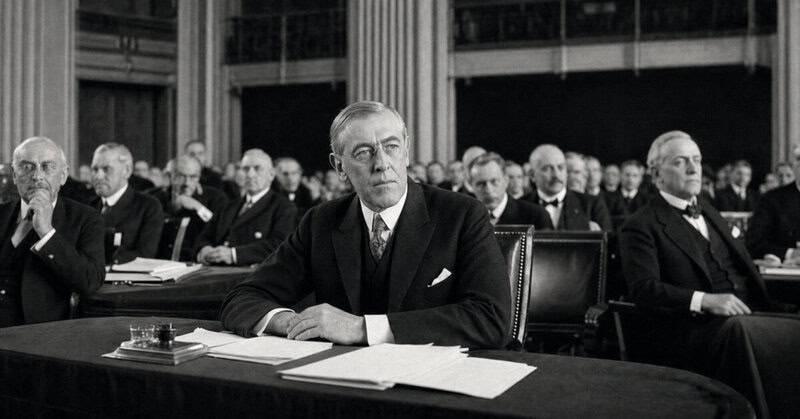
On the morning of January 10, 1920, diplomats from across the globe filed into a grand hall in Geneva, Switzerland, convinced — or at least desperately hoping — that humanity had finally grown wise enough to stop destroying itself. The League of Nations was open for business. The first worldwide intergovernmental organisation built specifically to prevent war between nations had drawn its first breath. And the man most responsible for willing it into existence was an ocean away, broken in body, watching his own country refuse to walk through the door.
Woodrow Wilson’s Vision: A World Reborn from the Trenches

To understand why the League of Nations mattered — and why its collapse still resonates — you have to stand in Woodrow Wilson’s position in January 1918, when he delivered his Fourteen Points speech to the U.S. Congress. Europe was still consumed by industrialised slaughter. An entire generation of young men had been fed into the machinery of the Western Front. Wilson, a former university president with the bearing of a Presbyterian minister and the stubbornness of one too, looked at this catastrophe and proposed something radical: a permanent international body where nations would talk instead of fight, arbitrate instead of mobilise.
The fourteenth point was the keystone — a “general association of nations” that would guarantee political independence and territorial integrity to great and small states alike. It was visionary. It was also, to the exhausted realists of Europe, somewhat alarming in its optimism.
When Wilson sailed to Paris for the Peace Conference in late 1918, crowds lined the streets of European cities to greet him with extraordinary enthusiasm. He arrived with his idealism intact and walked directly into negotiations with Georges Clemenceau of France and David Lloyd George of Britain — two men who had just survived the war from the inside and wanted Germany punished, not partnered. The negotiations were brutal. Wilson traded, compromised, and occasionally capitulated on other points, all to protect his League. He won. The League of Nations was written directly into the Treaty of Versailles, making it impossible to accept the peace without accepting the organisation. It was Wilson’s masterstroke, and it would become his trap.
Back home, the Republican-controlled U.S. Senate had no intention of signing what it saw as a blank cheque for collective security. Led by Senator Henry Cabot Lodge, they refused to ratify the treaty without reservations that Wilson found unacceptable. Rather than accept the Senate’s amendments and negotiate, Wilson chose to take his case directly to the American people, launching a gruelling cross-country speaking tour in the autumn of 1919. Somewhere in Colorado, his body gave out. He suffered a devastating stroke and never fully recovered. In 1919, he was awarded the Nobel Peace Prize for his work on the League. He never saw the United States join it. The architect of the building was locked outside on opening day.
How the Machine Was Built: Geneva, 1920

The League’s official birth on January 10, 1920 — the same day the Treaty of Versailles came into force — was the culmination of an idea that had been gestating through four years of catastrophic industrialised conflict. Geneva was chosen for its tradition of neutrality, a small Swiss city that would host the world’s first great experiment in collective diplomacy, first at the Palais Wilson and later at the grand Palais des Nations, which still stands today as the European headquarters of the United Nations.
The organisational structure was relatively straightforward in design, if ambitious in scope. An Assembly gave all member countries an equal voice. A Council served as the inner circle, dominated by the permanent great-power members. A Permanent Secretariat handled the administrative machinery, and a Permanent Court of International Justice was established to adjudicate legal disputes between states. The League also created the International Labour Organization to address workers’ rights across borders — a genuinely progressive institution for its era, and one that survives to this day.
At its peak, the League counted around 58 member states — a remarkable roster that included new nations carved from the collapsed ruins of the Ottoman, Austro-Hungarian, and Russian empires. For a brief, hopeful window in the early 1920s, the organisation produced real results. It helped resolve the Åland Islands dispute between Finland and Sweden in 1921, defusing a territorial argument that might otherwise have festered into armed conflict. It helped stabilise the Greek-Bulgarian border crisis in 1925. It coordinated refugee flows and fought disease outbreaks across multiple continents. These were not negligible achievements. They were genuine demonstrations of what multilateral cooperation could accomplish in an era when such things were almost entirely unprecedented.
But the structural fault lines were visible from the start. As historians have long observed, the League had no standing army of its own. Its primary enforcement mechanism was economic sanctions — and those only functioned if enough member states actually applied them consistently. The United States, the world’s largest economy, was absent entirely. Germany, the largest continental power and the nation most likely to disturb European peace, had been excluded as a defeated aggressor. Soviet Russia, convulsed by revolution and civil war, was also outside the room. The League of Nations opened its doors claiming to represent the world, and several of the world’s most consequential actors were not in the building.
The Three Crises That Broke It

The first great test came not in Europe but in Asia. In September 1931, Japan invaded Manchuria in northeastern China — a naked act of imperial aggression against a fellow League member. The League condemned it, dispatched the Lytton Commission to investigate, and ultimately declared Japan the aggressor in 1933. Japan’s response was to withdraw from the organisation entirely. There were no consequences beyond diplomatic censure. The lesson was not lost on ambitious leaders watching from Rome and Berlin.
In October 1935, Benito Mussolini ordered the invasion of Ethiopia — one of only a handful of independent African nations and a full League member. Here, the organisation actually voted to impose economic sanctions against Italy. It was a meaningful moment, the most assertive collective action the League had yet taken. And then Britain and France, terrified of pushing Mussolini into Hitler’s orbit, quietly ensured that oil — the one commodity that would have genuinely strangled the Italian war machine — was excluded from the sanctions list. Ethiopia fell. Mussolini eventually left the League. The organisation had demonstrated it could make noise. It had also demonstrated, definitively, that it would not pay a real price to back up that noise.
Germany’s remilitarisation of the Rhineland in March 1936 drew virtually no meaningful response from the League at all. By the late 1930s, member states were cutting bilateral deals, rearmament was accelerating across Europe, and the League of Nations had become, in practical terms, decorative. A beautiful idea that the nations who had created it were no longer willing to pay to uphold.
The same fatal pattern ran through every crisis: moral condemnation without enforcement capacity, and major powers consistently choosing short-term national interest over the collective security commitments they had pledged to honour. As diplomatic historians have observed, the absence of the United States compounded every other weakness — removing both the economic leverage and the political credibility that might have given potential aggressors genuine pause.
Why Did the League of Nations Fail? An Honest Autopsy

The question of why the League of Nations failed has occupied historians for nearly a century, and the honest answer is that it failed on multiple levels simultaneously, each weakness reinforcing the others.
Structurally, the organisation had no independent enforcement capacity. It depended entirely on the willingness of its members to act, which meant that when the members most capable of acting declined to do so, the League was impotent. The requirement for unanimous decisions in the Council made bold collective action nearly impossible; any great power could effectively veto a response it found inconvenient.
Politically, America’s absence was a wound that never healed. Britain and France, the two democracies left holding the organisation together, were genuinely exhausted nations still haunted by the staggering human losses of the First World War. Their populations had no appetite for another conflict. That understandable human reluctance translated into a foreign policy of appeasement that the League’s architecture did nothing to counteract and, in certain respects, actively enabled by providing a forum for endless negotiation in place of firm response.
Philosophically, the League’s deepest flaw was its founding assumption: that nations share a rational, common interest in peace, and that given a proper forum for dialogue, they will consistently pursue it. That assumption functions reasonably well among states with stable democratic governments and substantially overlapping interests. It had no answer for a leader like Adolf Hitler, who believed that war was not a catastrophe to be avoided but an instrument of national greatness to be embraced. The League was designed for a world of cautious, rational actors operating in good faith. It was destroyed by ideologues who rejected the entire premise on which it rested.
The result was the Second World War — a conflict that killed an estimated 70 to 85 million people, more than twice the devastating toll of the First. The League of Nations had been created precisely to prevent such a catastrophe, and its failure to do so was total.
Legacy: How a Failed Experiment Built a Better Successor
The League of Nations formally dissolved on April 19, 1946. Its final act — and there is something quietly dignified about this — was to transfer its assets, its archives, and the animating spirit of its mission to a new organisation that the catastrophe of the Second World War had made politically achievable in ways the first war never had: the United Nations.
The comparison between the League of Nations and the United Nations is instructive precisely because the UN was designed in direct response to the League’s documented failures. The Security Council gave great powers both a genuine stake in the system and a standing mechanism for collective action. Peacekeeping forces gave the organisation a physical presence in conflict zones that the League had entirely lacked. The United States, whose Senate had torpedoed the League, was this time a founding member and the host nation of the new body’s headquarters. The painful lessons of Geneva had been absorbed, however imperfectly, into the architecture built in New York.
Meanwhile, the League’s quieter functional achievements proved far more durable than its dramatic political failures. Its health coordination bodies laid essential groundwork for what eventually became the World Health Organization. The International Labour Organization survived the League’s dissolution entirely intact and continues to operate today. The approach to refugee protection pioneered by the League’s High Commissioner for Refugees in the 1920s established the conceptual and operational foundations for the modern UNHCR. The infrastructure of international humanitarian cooperation that much of the world now takes for granted was, in significant part, first assembled in Geneva during those hopeful, structurally flawed years between 1920 and 1939.
Woodrow Wilson’s central idea was not wrong. It was premature, underfunded, structurally naive about the realities of power, and ultimately betrayed by the very nations that had created it — nations that wanted the prestige of international cooperation without accepting its obligations or its costs. The gap between visionary institutional design and the political will required to sustain it is one of the oldest recurring tragedies in the history of governance. The League of Nations demonstrated that gap on a world-historical scale, at a price measured in tens of millions of lives. That warning — that grand international institutions are only ever as strong as the resolve of powerful nations to actually uphold them — has not aged a single day.

 Arabic
 French
 Spanish
 Portuguese
 Deutsch
 Turkish
 Dutch
Dutch
 Italiano
 Russian
 Romaian
 Portuguese (Brazil)
 Greek
Greek