


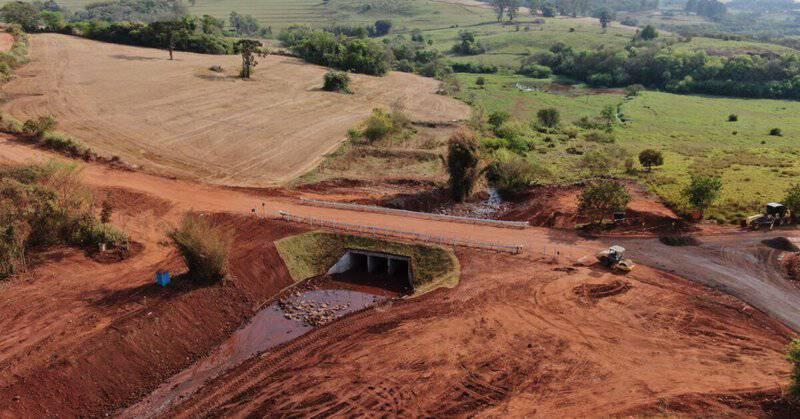
The excavator’s steel teeth were supposed to bite through dirt and rock, clearing the way for a wider, faster BR-101 — Brazil’s great Atlantic spine, a highway stitching the country’s northeastern coast together kilometer by kilometer. Instead, somewhere along those 78 kilometers of red northeastern soil, the machinery found something that didn’t belong to the modern world at all.
The Machines Bit Into the Ground — and History Bit Back

It is the central irony of what happened during the duplication works on the BR-101: an engineering project designed to move people faster through the present accidentally tore a window open into thousands of years of the past. Construction crews working under COMSA’s duplication of lots 4 and 5 of the BR-101 federal highway — a major infrastructure undertaking covering 78 kilometers across Brazil’s Northeast — did not expect to become, in any sense, archaeologists. And yet that is precisely what the earth demanded of them.
By the time the project reached completion, 142 distinct archaeological sites had surfaced along the highway’s path. One hundred and forty-two. Spread across roughly 78 kilometers, that works out to nearly two sites for every single kilometer of road — a density of discovery so extraordinary that it stunned the researchers called in to make sense of it. The Northeast of Brazil, a region already layered with colonial memory, Indigenous suffering, and pre-Columbian civilizations that mainstream history has long rendered invisible, had been quietly holding its secrets in the ground all along. It took a fleet of heavy excavators to pry them loose.
The Road That Was Already There — in a Different Form

The BR-101 is one of Brazil’s longest federal highways, a north-to-south artery that hugs the Atlantic coastline for thousands of kilometers, connecting cities, ports, and agricultural heartlands. But roads like this do not emerge from nowhere. The colonial-era tracks that eventually became paved highways often followed paths that Indigenous peoples had walked for millennia — trade routes, seasonal migration corridors, connections between water sources and settlement sites. The road, in a profound sense, was already there. It just ran through a different world.
The duplication project — the widening of the existing highway to accommodate a second carriageway, improving freight flow and relieving chronic congestion across the northeastern corridor — was an engineering challenge of genuine scale. Drainage systems, overpasses, reinforced embankments, and kilometers of new asphalt demanded that the ground be opened, shifted, and reshaped. That process of opening is precisely what made discovery possible.
It also made discovery legally mandatory. Brazilian federal law requires that major infrastructure projects conduct archaeological surveys before and during construction — a safeguard embedded in environmental licensing requirements and overseen by IPHAN, the Instituto do Patrimônio Histórico e Artístico Nacional, the federal body responsible for protecting Brazil’s historical and cultural heritage. Without that legal framework, without archaeologists stationed alongside construction crews to monitor what the machines unearthed, the 142 sites along the BR-101 corridor might simply have been destroyed — and no one would ever have known what was lost.
What 142 Sites Actually Means — and What Was Found

Numbers can flatten astonishment if you let them. So consider what 142 archaeological sites actually represents: not 142 isolated artifacts, not 142 stray potsherds in the soil, but 142 distinct concentrations of human evidence — places where people lived, worked, made things, buried their dead, and left enough of themselves in the earth to be recognized, thousands of years later, as a site worth recording and protecting.
The types of evidence uncovered along the BR-101 corridor reflect the rich material culture of pre-Columbian northeastern Brazil. Ceramic fragments — pieces of fired clay vessels that once held water, food, or ritual significance — appeared with striking frequency. Lithic tools, shaped from stone by hands that understood its properties intimately, emerged from the soil alongside traces of ancient settlements: post holes, hearth remnants, the subtle staining of earth that archaeologists learn to read like a language. Together, these fragments describe communities that farmed, traded, and built durable social worlds across this landscape long before a European ship ever crossed the Atlantic.
The choreography required to extract this knowledge without halting construction entirely was delicate and demanding. Archaeologists worked in parallel with construction crews — a constant negotiation between the engineering timeline and the archaeological one, between the kilometer markers on a project schedule and the centuries compressed into a single stratum of red soil. Every new excavation trench was a potential time capsule, and the teams monitoring the work had to be ready to respond the moment something surfaced.
What the finds suggest about the region’s pre-Columbian past is perhaps more significant than any individual object. The Northeast’s semi-arid interior — the Sertão, with its thorny Caatinga vegetation and its cycles of devastating drought — has long been treated by researchers as a marginal environment, sparsely populated and archaeologically thin. The BR-101 discoveries challenge that assumption directly. This corridor was not marginal. It was inhabited, persistently and densely, by people who understood it well enough to build communities that endured for generations.
The People Who Were Here First: A Pre-Columbian World Beneath the Asphalt

Before the highway, before the colonial cattle trails it eventually followed, before the Portuguese caravels that arrived on the northeastern coast in the early 1500s, the landscape now crossed by the BR-101 belonged to diverse Indigenous groups who had developed sophisticated and intimate relationships with one of the harshest biomes in South America. The Caatinga — a word from the Tupi language meaning “white forest,” a name for the pale, desiccated vegetation that dominates the northeastern interior in dry seasons — is not a forgiving environment. But it is not an empty one, and it never was.
The archaeological record of northeastern Brazil is far richer than its institutional neglect might suggest. Rock art traditions reaching back thousands of years decorate sandstone outcrops across the region. Shell mounds known as sambaquis — ancient refuse heaps that are also, in their way, monuments — mark coastal and riverine sites where communities gathered and grew. Ceramic cultures with complex decorative traditions predate European contact by millennia. The BR-101 sites fit into this broader picture, adding new data points to a map of pre-Columbian life in the Northeast that researchers are still, painstakingly, learning to read.
Why did so many of these sites remain buried and unknown for so long? The answers are uncomfortable. Colonial violence disrupted and destroyed Indigenous communities across the Northeast with particular ferocity. Centuries of land transformation — cattle ranching, sugar cultivation, later industrial agriculture — reshaped the surface of the earth and buried its evidence deeper. Institutional research funding for Brazilian archaeology has historically been concentrated in the South and Southeast, leaving the Northeast’s past chronically understudied. And the sheer vastness of the Brazilian interior conspired with all of these factors to keep history underground — literally.
It is worth pausing to remember that the people whose traces the BR-101 excavations exposed were not abstractions. They were communities with languages, kinship systems, ritual calendars, trade networks, and histories of their own — histories that colonial conquest interrupted but did not erase entirely, because the earth kept holding the evidence. A highway crew’s excavator, biting through centuries of accumulated soil, gave those histories a chance to surface again.
Infrastructure vs. Ancestry: Brazil’s Uncomfortable Collision

There is no clean resolution to the tension at the heart of this story. Brazil genuinely needs modern infrastructure. The Northeast, in particular, has borne the costs of underdevelopment and inadequate transport networks for generations — poor roads that isolate communities, slow freight movement, inflate prices, and deepen economic inequality. The BR-101 duplication project was not an act of carelessness toward the past. It was an attempt to address real and pressing needs in the present.
But that need does not dissolve the problem of what lies underground. And Brazil is not alone in facing it. Major construction projects worldwide — highway expansions across the American Southwest, dam projects in Southeast Asia, high-speed rail corridors cutting through ancient European landscapes — have repeatedly collided with buried cultural heritage, forcing the same uncomfortable negotiation between development and preservation. Infrastructure projects of this scale routinely carry costs that extend far beyond construction budgets, and the archaeological dimension is one that planners are still learning to account for adequately.
Brazilian law attempts to navigate this collision through environmental impact studies — the Estudo de Impacto Ambiental — that include archaeological components as a mandatory element of the licensing process for major federal projects. The BR-101 duplication is, in many respects, a success story for that framework: the law required monitoring, monitoring produced discovery, and discovery produced at least a partial recovery of irreplaceable knowledge. But enforcement and outcomes vary widely depending on project oversight, institutional capacity, and the willingness of contractors to treat delays caused by archaeological finds as legitimate rather than as obstacles to be minimized.
The question that the 142 sites forces into the open is a harder one: how many other expansions — in Brazil and elsewhere, on roads built before modern safeguards existed, or on projects where those safeguards were ignored or inadequately enforced — plowed straight through sites that are now lost forever? There is no way to know. That unknowing is itself a kind of loss.
From Destruction to Discovery: How the Finds Are Being Preserved

When construction work surfaces an archaeological site that cannot be preserved in place — and in a highway duplication project, most sites cannot be left intact beneath the new road — the response is what archaeologists call rescue or salvage archaeology. It is a second-best outcome, and researchers are honest about that. The ideal is always preservation in situ: leaving a site undisturbed, in the ground, for future generations and future technologies to study with methods that do not yet exist. But when the highway must be built, rescue archaeology is the difference between partial recovery and total loss.
Along the BR-101 corridor, the rescue process involved emergency documentation of every site as it was uncovered — detailed stratigraphic recording of soil layers and material evidence, systematic collection of artifacts, and photographic and technical documentation that transforms a fragile, perishable site into a durable archive. IPHAN, the federal heritage agency, oversaw the legal and scientific framework governing the response, ensuring that the discoveries generated by the project fed into the permanent record of Brazilian cultural heritage rather than disappearing into a contractor’s spoil heap.
The recovered material — ceramic fragments, lithic tools, stratigraphic data — enters museum collections and research archives, where it becomes available to scholars working to reconstruct the pre-Columbian past of the Northeast. Some of that research will eventually reach the public, whether through academic publication, regional museum exhibitions, or the modest but meaningful gesture of heritage interpretation markers along the road itself: small signs that tell passing drivers, in a few words, that the ground beneath their wheels was once someone’s home.
None of this is fully satisfying. Rescue archaeology is triage. But without the legal requirement that made archaeological monitoring mandatory on the BR-101 project, even this partial recovery would never have happened. The 142 sites would have been erased without a name, without a record, without a trace.
The Wider Lesson: Every Road Is Also a Time Machine
The story of the BR-101 and its 142 archaeological sites is, at its core, a story about what the ground remembers when people forget. Modern development tends to treat the earth as raw material — as substrate for foundations, aggregate for concrete, space to be cleared and reshaped according to engineering requirements. What the northeastern Brazilian soil revealed, when the excavators opened it, is that this approach fundamentally misunderstands the nature of the ground.
The earth beneath Brazil — beneath any country with a deep human past, which is to say every country — is not empty space waiting to be developed. It is an archive. It holds the compressed record of every civilization, every community, every individual life that came before, layer by layer, century by century, waiting for the right question — or the right excavator — to bring it to the surface. The 142 sites along the BR-101 corridor are not anomalies. They are evidence of how much history is still out there, in the ground, across a country that has barely scratched the surface of its own past.
The real lesson from the BR-101 duplication is not the disruption to construction timelines. It is the opportunity that large-scale infrastructure projects represent, when they are properly monitored and legally governed: the chance to conduct, almost inadvertently, some of the most ambitious archaeological surveys a country has ever undertaken. Every kilometer of new road is a transect through human history. Every excavation trench is a borehole through time. The question is whether the people designing these projects — and the governments funding them — are willing to treat that fact as a resource rather than a complication.
Picture the completed highway now: 78 new kilometers of asphalt rolling through the northeastern landscape, carrying trucks loaded with goods, families on long journeys, the ordinary commerce of a country moving through the present. COMSA completed the duplication, the lanes are open, and the freight moves faster. And just inches below the wheels — below the asphalt, below the compacted base course, below the thin membrane that separates the modern world from the ancient one — 142 chapters of a forgotten world sleep on, holding what the ground has always held: everything that came before.

 English
 Arabic
 French
 Spanish
 Portuguese
 Deutsch
 Dutch
Dutch
 Italiano
 Russian
 Romaian
 Portuguese (Brazil)
 Greek
Greek