


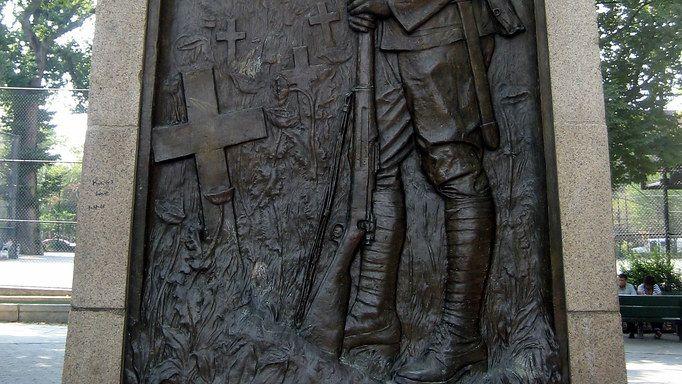
On the morning of November 11, 1920, two nations held their breath over pine coffins containing men no one could name. In London, a gun carriage bore its burden through streets lined with hundreds of thousands of silent mourners; at Arlington, across the Atlantic, preparations were underway for an unknown soldier who would be interred the following year in a tomb that would become one of the most visited sites in America. The near-synchronicity was not accidental — it was the answer to a question that had haunted governments and grieving families for two years: when the dead are too numerous, too scattered, and too obliterated to bring home, how do you mourn them?
Before the War: What Mourning Looked Like, and Why the Western Front Shattered It

For the Victorian and Edwardian generations, grief followed a comprehensible script. When soldiers died in imperial campaigns — in the Boer War, in colonial skirmishes across Africa and Asia — their numbers, though painful, were manageable. Bodies came home when possible. Regimental colors hung in parish churches. A village might lose a handful of men, their names added quietly to a churchyard stone. Public mourning was intimate, local, and anchored in the physical presence of a grave that family members could visit, weep beside, and tend.
The Western Front destroyed that model in a matter of months. Artillery barrages of a scale previously unimaginable did not simply kill men — they erased them. Mud, gas, and industrial firepower reduced human beings to fragments or swallowed them entirely into the churned earth of Flanders and the Somme. Military policy in Britain and France initially forbade the repatriation of remains, reasoning that allowing families to retrieve individual bodies would produce chaos across hundreds of miles of active front. The result was a catastrophe not just of death but of the rituals surrounding death: over ten million military personnel killed, the majority with no marked grave, no coffin, no physical anchor for the grief of those left behind.
Historians have given this condition a name — the missing problem — and it is the engine behind almost everything that followed. Governments recognized the danger in this void early. A population denied any focal point for its grief is an unstable population. Even before the armistice of November 1918, officials in Britain and France were commissioning remembrance structures, understanding that visible, touchable stone could serve as a surrogate grave for a generation that would never stand beside a real one.
The Unknown Soldier: One Body Carrying the Weight of Millions

The genius of the Unknown Soldier concept was its deliberate, painstaking anonymity. In Britain, the selection ritual was almost theatrical in its care. Several sets of unidentified remains were gathered from different sectors of the Western Front; a blindfolded officer made the final choice, ensuring that no human being could ever claim — or prove — that the selected soldier was theirs. That impossibility was precisely the point. The unknown had to belong to everyone, or he belonged to no one.
The procession through London on November 11, 1920 — the second anniversary of the armistice — gave the nation a piece of theater equal to the scale of its grief. A plain pine coffin on a gun carriage moved through streets where hundreds of thousands stood in silence. King George V walked behind, as did a guard of holders of the Victoria Cross. The coffin passed the newly unveiled Cenotaph on Whitehall, designed by Edwin Lutyens in a stripped-classical style that managed to feel both ancient and modern, before arriving at Westminster Abbey, where it was interred in the nave, among kings.
The concept spread with extraordinary speed because it solved the missing problem at a symbolic level. France interred its unknown soldier beneath the Arc de Triomphe on that same day, November 11, 1920. Belgium and Italy followed in subsequent years. The American Unknown Soldier was laid to rest at Arlington in 1921, with the tomb receiving its familiar sentinel guard — changed with ritual precision, every hour of every day — a demonstration of how WWI grief calcified, across a century, into permanent ceremony. The logic was always the same: if the soldier cannot be identified, then every family with a missing son has permission to believe, privately and without contradiction, that he is theirs.
The Poppy and the Calendar: How Remembrance Day Became a Ritual

In May 1915, a Canadian lieutenant colonel named John McCrae wrote a poem beside a dressing station near Ypres, Belgium. “In Flanders fields the poppies blow / Between the crosses, row on row.” The image was not purely literary invention. Poppies genuinely thrived on the Western Front, their seeds dormant in undisturbed soil for decades and suddenly activated by the churning of artillery and the loosening of chalky subsoil — the same catastrophic disturbance that killed the men whose graves the flowers were now marking. The poppy was nature’s own memorial, growing from the wound.
The poem crossed the Atlantic and found a reader in Moina Michael, an American academic and activist who encountered it in 1918, began wearing a silk poppy as a personal act of remembrance, and lobbied American veterans’ organizations to adopt the flower as a national symbol. French and British charities took up the idea with practical energy, manufacturing millions of paper poppies through the 1920s as both a fundraising mechanism for wounded veterans and a visible, wearable act of commemoration. By the middle of the decade, the red paper poppy had become inseparable from November 11.
The architecture of that day was assembled with similar speed. The two-minute silence was first observed in Britain in 1919, the idea reputedly proposed by a South African journalist named Percy Fitzpatrick, who had witnessed a similar practice in Cape Town. The laying of wreaths, the reading of Laurence Binyon’s “Ode of Remembrance” — “They shall grow not old, as we that are left grow old” — the march of veterans: each element was invented or formalized between 1918 and 1925, yet within a generation the whole liturgy felt ancient, as though it had always existed. That feeling of antiquity was not accidental; it was the goal. Rituals that feel timeless create obligations that feel permanent.
The poppy has not traveled without controversy. In parts of Ireland, some former British colonies, and corners of continental Europe, it carries associations not just with grief but with empire, with a particular national narrative about the war’s meaning. The debates around the symbol are a reminder that remembrance rituals do not simply record history — they argue about it.
Stone Across the World: The Monument-Building Effort of the 1920s

The scale of what was built in the decade after the armistice is almost impossible to absorb. In Britain alone, more than 54,000 war memorials were erected between 1919 and 1939 — on village greens, in railway stations, in school chapels, on factory floors, in hospital corridors. The sheer concentrated volume of public sculpture produced in those years is arguably unmatched in modern history.
What distinguished these memorials from their predecessors was democratic in the deepest sense. Victorian monuments honored generals on horseback, admirals in marble. The WWI memorial typically listed every man by name — private and corporal alongside officer — in an implicit acknowledgment that ordinary deaths mattered equally. A bronze tablet on the wall of a Shropshire parish church, naming seven men from a single farming community, carried the same moral weight as a great stone arch in a capital city. This was new. This had not happened before at anything approaching this scale.
The forms varied as widely as the cultures that produced them. Lutyens’s Cenotaph in London — the word means “empty tomb,” a definition that carries its own quiet weight — favored a stripped geometry that avoided overt religious or patriotic symbolism, allowing mourners of different faiths and different feelings about the war to stand before it together. At Verdun, the Douaumont Ossuary holds the remains of more than 130,000 unidentified French and German soldiers, visible through small windows set into the base of the building — a confrontation with mortality so direct it borders on the unbearable. Across the United States, bronze tablets and stone monuments in towns and cities in every state honored local men and women who served, each one the center of a community’s particular grief.
In Kansas City, something more ambitious took shape. The Liberty Memorial was dedicated in 1926, with five Allied commanders present at the ceremony — a gathering of Allied military leadership that has never been replicated. Today the site is home to the National WWI Museum and Memorial, the only institution in the United States dedicated exclusively to sharing the stories of those who served during the First World War. Its tower remains visible across the Missouri skyline, its flame still burning, a civic anchor for a war that American memory has long struggled to hold in focus.
America’s Long Reckoning: From Kansas City to Pennsylvania Avenue

The United States entered the war in April 1917 and left it early in spirit. American casualties, though devastating to the families who bore them, were proportionally far smaller than those suffered by France or Britain. The Depression consumed national attention almost immediately after the memorials were dedicated; the Second World War arrived before the grief of the first had fully settled; and the Great War slid into the peculiar commemorative shadow it has occupied in American memory ever since — acknowledged, technically, but not felt in the way it is felt in a French village or a Welsh town where the memorial stone carries a surname borne by half the living residents.
For decades, Washington lacked a proper national memorial to WWI on its ceremonial axis. Pershing Park on Pennsylvania Avenue — adjacent to the Treasury Department — was a pleasant urban space, but not a monument. Veterans’ groups and historians advocated for change across many years. The arguments were not merely sentimental: every other major American conflict had a dedicated memorial on the National Mall or its approaches; the absence of a WWI memorial was itself a statement, and not an intentional one.
Congress eventually authorized a proper memorial, and construction in Pershing Park proceeded toward completion. The World War I Memorial on Pennsylvania Avenue, administered by the National Park Service, was opened to the public in April 2021. Its central sculptural element — a long bronze frieze by sculptor Sabin Howard, depicting American soldiers moving through the chaos and mud of the Western Front — does not flinch from the reality of what the war was. The site is open 24 hours a day, so that any visitor at any hour, in any weather, can stand before it. The planning and design process, overseen in part by the National Capital Planning Commission, stretched across years precisely because the question of how to memorialize something this large, this distant, and this insufficiently mourned in American culture was genuinely difficult to answer.
Together, Kansas City and Washington now form a two-part national memorial architecture — one site dedicated to artifacts, documents, and stories; the other to ceremony and stone on the axis where American civic life is performed. Europe answered that question a century ago. America is still, in important ways, catching up.
What the Monuments Are Really Saying

WWI memorials did not simply record the past — they shaped how nations understood what had happened to them. In Britain and France, the dominant language of the memorials emphasized sacrifice and honor, framing the dead as men who gave rather than men who were taken. That framing was not dishonest, exactly, but it was selective; it made the loss bearable at the cost of some of its horror. In Germany, the problem became exponentially more complicated after 1945, when a nation had to reckon with the fact that memorials celebrating the courage of the First World War had fed a nationalism that produced the second — a reckoning that created radically different memorial cultures emerging from the same original catastrophe.
The rituals invented in the 1920s became the template for all subsequent war commemoration in the Western world. The eternal flame, the unknown soldier, the national moment of silence, the wreath-laying ceremony — every Veterans Day observance, every Memorial Day service carries the DNA of decisions made by grieving governments between 1918 and 1925. We perform WWI grief every year without always knowing it.
What was left out of the stone record is also telling. Colonial soldiers from India, East Africa, West Africa, the Caribbean, and the Pacific died in large numbers in a war fought partly for the empires that ruled them. Their names appear on relatively few of the major memorials, their sacrifice absorbed into a narrative of national loss that was, in practice, a narrowly defined national loss. Contemporary historians, descendants’ groups, and some governments are working to correct this — adding names, erecting new plaques, revising the story carved into century-old stone. The memorials are not finished. They never were.
The impulse behind every one of them — from the tower in Kansas City to the parish tablet in a Shropshire church to the bronze frieze on Pennsylvania Avenue — is finally identical: to insist that the disappeared were real, that they had faces and names and people who loved them, and that the sheer, incomprehensible scale of what the war consumed is not an excuse for forgetting any single one of them. The stone does not explain what happened. It simply refuses to let you look away.

 English
 Arabic
 French
 Spanish
 Portuguese
 Deutsch
 Turkish
 Italiano
 Russian
 Romaian
 Portuguese (Brazil)
 Greek
Greek