


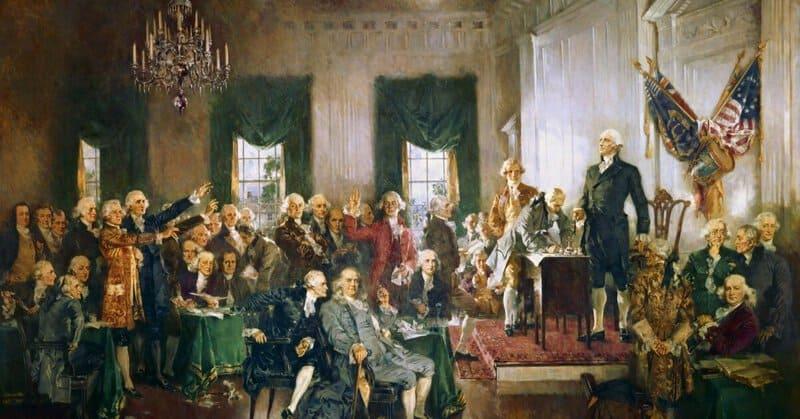
Imagine a Virginia planter in 1760, bowing low before a titled English gentleman — hat in hand, eyes averted, performing the ritual of deference that had structured society for centuries. Now cut to 1800, and picture his grandson in the same room, hat firmly on his head, meeting any man’s gaze without apology. No lord, no patron, no inherited rank could compel him to bend. Something seismic had happened in the interval — and it was not simply that a new flag flew over the statehouse.
A Revolution That Remade Everything — or Just the Flag?

Most Americans learn the Revolution as a political story: taxation without representation, a declaration signed in Philadelphia, a constitution hammered out in sweltering summer heat, and a new nation born from the wreckage of colonial rule. It is a satisfying narrative, clean and constitutional. But what if the real revolution was stranger, deeper, and more total than any of that? What if the most radical thing the founders did had nothing to do with Parliament or parchment, and everything to do with tearing apart the very fabric of how human beings related to one another?
That is the question at the heart of one of the most consequential arguments in American historical writing. For decades, two camps dominated the debate. Conservatives — drawing on thinkers like Hannah Arendt and Daniel Boorstin — insisted the Revolution was a modest, orderly affair, a defense of existing English liberties rather than a leap into the unknown. On the other side, historians influenced by Marxist frameworks saw the Revolution as an incomplete bourgeois uprising, one that shuffled elites without redistributing power to those who truly lacked it. Both camps, in their own ways, agreed on one thing: this was not a genuinely radical event.
Then came Gordon Wood, and the argument changed.
The Book That Reframed the Debate: Wood’s 1991 Masterwork

The Radicalism of the American Revolution, published by Alfred A. Knopf in 1991, arrived not as a quiet academic monograph but as a cultural intervention. Its author, Gordon S. Wood, was already one of America’s most respected historians of the founding era — his earlier work The Creation of the American Republic, 1776-1787 had established him as a commanding voice in the field. But this book was different in ambition: a sweeping reinterpretation of what the Revolution actually did to American society, from the drawing rooms of Philadelphia to the taverns of the backcountry. It won the Pulitzer Prize, forcing a genuine reassessment across university history departments and among general readers who suddenly found themselves arguing about deference and patronage at dinner tables.
Wood’s central claim, stated with calm force, is this: the American Revolution was radical not despite its lack of guillotines and class terror, but because it dismantled an entire social order from the inside out. You can read the book in full to follow every thread of that argument, but the core of it can be stated plainly — the Revolution transformed a society saturated with monarchical assumptions into a democratic one, and it did so with a speed and thoroughness that has no real parallel in the Atlantic world of that era.
The World That Had to Die: Monarchy, Patronage, and Deference

To understand why Wood’s argument is so striking, you have to first see colonial America the way he sees it — not as a proto-democracy straining toward its destiny, but as a society built on monarchy-adjacent habits and assumptions. This was a world of patronage networks, where a young man’s future depended on catching the eye of a powerful benefactor. It was a world of inherited status, where the expectation that “better men” would govern lesser ones was not mere snobbery but the organizing principle of political and social life.
Consider what deference actually looked like in practice. Tenant farmers routinely voted as their landlords expected them to. Ministers opened correspondence with elaborate honorifics that mapped the exact social distance between writer and recipient. Young men seeking advancement in law, commerce, or public life needed a great patron’s favor the way later generations would need a college degree — it was the entry ticket to a recognizable future. This was not mere formality or politeness. It was a near-feudal web of dependencies that structured everyday existence, shaping who ate at whose table, who stood when another man entered the room, who spoke and who listened.
Wood argues that the Revolution’s first and most radical act was not signing a declaration — it was imagining, seriously and with revolutionary intensity, that this entire architecture of human relationships could be torn down. The idea that no man owed another man deference simply because of birth or connection — that ordinary people were the equals of lords and gentlemen in some fundamental and politically consequential sense — was not a gentle reform. It was a social earthquake dressed in the language of natural rights.
What “Radical” Actually Meant: The Social Revolution Inside the Political One

Wood’s thesis tracks the transformation through the texture of ordinary life. The collapse of deference was not just philosophical — it was visible, almost day by day, in the way people dressed, spoke, associated, and voted. Voluntary associations exploded across the new republic, as ordinary men joined together in groups that owed nothing to aristocratic sponsorship. Common men flooded into commerce, into local politics, into pulpits and newspapers. The very idea of aristocratic pretension — the notion that birth or connection should determine a man’s place, his voice, his future — was rapidly delegitimized, not by law alone but by a democratic culture that treated it as an insult.
What makes Wood’s account so compelling, and so controversial, is his insistence on speed. This was not a slow evolutionary drift toward equality. It happened fast — within a generation — driven by a revolutionary ideology that ordinary people took seriously and acted on with startling literalness. When the Declaration announced that all men are created equal, it was not read as a polite abstraction by the farmers, artisans, and sailors who had fought the war. It was read as a permission slip, even an obligation, to remake their world.
The rejection of nobility as a social category extended far beyond the formal titles that America never adopted. It reached into manners, into the language of everyday address, into the way children were raised and servants were treated. By the early nineteenth century, visitors from Europe — Alexis de Tocqueville chief among them — described American society as something they had never encountered before: a country where a genuine, practiced, sometimes aggressive equality of condition had taken root in ways that no European nation could claim. Wood’s book explains why Tocqueville was so astonished. He was looking at the downstream consequences of a truly radical event.
The Founders’ Dilemma: They Summoned Forces They Couldn’t Control

One of the most gripping threads in Wood’s narrative is the story of what the Revolution did to its own architects. George Washington, John Adams, Thomas Jefferson — these were gentlemen, men of standing who believed in republican virtue and imagined a world led by what they called a natural aristocracy of talent and character. They expected the new republic to be governed by men like themselves: educated, propertied, capable of rising above mere self-interest. What they got instead was a democratic tornado.
Common men took the language of equality not as a compliment but as a literal description of their standing, and they acted accordingly — rejecting elite claims to govern, asserting their own judgment in markets and meetinghouses, refusing to defer to men who expected deference as their due. Adams’s famous despair in his later years, and Jefferson’s more complicated and uneasy celebration of the democratic energies he had helped unleash, both make sense within Wood’s framework. The Revolution succeeded beyond what its architects intended or, in many cases, wanted. It was radical enough to swallow its own founders.
This internal tension — between the founding generation’s vision of an orderly republic led by virtuous gentlemen and the chaotic democratic reality that the Revolution produced — gives Wood’s narrative its dramatic engine. It is not a story of triumph or failure but of unintended consequences so vast that they reshaped a continent.
The Three-Part Structure of Wood’s Argument
It is worth pausing to note how Wood builds his case, because the architecture of the argument is itself part of its persuasive force. He divides the book into three sections — Monarchy, Republicanism, and Democracy — each tracing a distinct phase in the transformation of American society. The first establishes just how thoroughly monarchical colonial life was, correcting the common assumption that the colonists were already primed for self-government. The second shows how the founding generation’s republican idealism — its faith in virtue, disinterestedness, and natural leadership — briefly took hold and then began to buckle under the weight of popular pressure. The third documents the democratic explosion that followed, a world of individualism, commerce, and egalitarian manners that the founders had not anticipated and often found alarming.
This three-act structure is not merely organizational tidiness. It allows Wood to show that radicalism was not a feature of the Revolution’s opening moments but its ultimate product — something that emerged from the collision between revolutionary ideology and the aspirations of ordinary people over decades. The argument is cumulative, and readers who engage with all three sections come away with a picture of transformation that piecemeal accounts of the founding cannot provide.
Why Critics Pushed Back — and Why Wood’s Argument Survived
No Pulitzer Prize-winning book on American history escapes without serious challenge, and Wood’s book has attracted some of the sharpest criticism the field can offer. The most substantial objection, pressed forcefully by historians like Gary Nash and later by scholars working in the tradition of the “new social history,” is that Wood’s Revolution is largely a revolution for white men. Enslaved people, women, Native Americans, and the propertyless poor gained little from the great social upheaval Wood describes — or gained only the cruel irony of watching equality proclaimed in a society built on their bondage and exclusion. If this was the most radical social transformation in the Atlantic world, the critics ask, why did it leave so much of the old order’s violence intact?
A related criticism concerns Wood’s relative inattention to economic conflict. Historians working from the bottom up have documented real class tensions within the revolutionary movement — disputes over debt, land, and economic power that Wood’s ideological framework tends to smooth over. The Revolution looked different from inside a debtor’s prison or a frontier settlement than it did from the Philadelphia drawing rooms that receive so much of Wood’s attention.
Wood’s defenders respond that he is analyzing the ideological and social revolution in its own terms — tracing what the ideas did to the people they were meant for — rather than writing a comprehensive history of all the Revolution’s exclusions and betrayals. That is a distinction worth holding in genuine tension rather than resolving too quickly in either direction. Both things can be true: the Revolution was a radical rupture in the history of social hierarchy, and it was also a catastrophic failure for millions of people who were explicitly left outside its promises. The most intellectually honest reading of Wood acknowledges both the power of his central argument and the legitimacy of the challenges that surround it.
The fact that the debate continues, more than three decades after the book’s publication, is itself evidence of its importance. Scholars do not argue this hard about works they consider trivial. The book has remained a touchstone precisely because its central question — how radical was the American Revolution, really? — refuses to stay settled. Those who prefer to encounter Wood’s argument by ear will find that the audiobook version brings his measured, authoritative prose to life in a different register entirely.
Why It Still Matters: The Revolution’s Radical Promise in the Present Tense
The question of whether the American Revolution was radical is not merely a puzzle for academics. It shapes how Americans argue about equality, democracy, and the founding’s unfinished promises right now. If the Revolution was a conservative event — a defense of the status quo by men of property — then the founding offers thin resources for those demanding more equality today. If it was genuinely radical, if it planted an idea so explosive that its own architects couldn’t contain it, then the story is different and the stakes are higher.
Wood’s book insists on the second reading. The Revolution planted an idea — that ordinary people are the equal of any king or lord, in fact and not just in theory — and American history ever since has been the story of one group after another demanding that the promise be honored for them too. Women’s suffrage, the abolition of slavery, the civil rights movement, and ongoing struggles for equal standing all draw, however indirectly, on the same revolutionary logic that Wood traces from its colonial origins. The radical seed was real, even if the tree that grew from it was twisted and uneven and slow to bear fruit for everyone.
Close the loop on that Virginia planter’s grandson, hat on his head, unwilling to bow. He was not simply being rude. He was living out a philosophy, acting on an idea that the Revolution had made thinkable and then unavoidable. The next time someone argues that the founders were cautious men preserving the status quo, Gordon Wood’s answer is ready: they didn’t preserve anything. They burned the old world down, and then discovered, to their delight and their horror, that the fire had a mind of its own.
The Radicalism of the American Revolution remains essential reading for anyone who wants to understand not just what the founders did, but what they unleashed — and why the argument about America’s founding promises has never, not for a single generation, gone quiet.

 English
 Arabic
 French
 Spanish
 Portuguese
 Deutsch
 Turkish
 Italiano
 Russian
 Romaian
 Portuguese (Brazil)
 Greek
Greek