


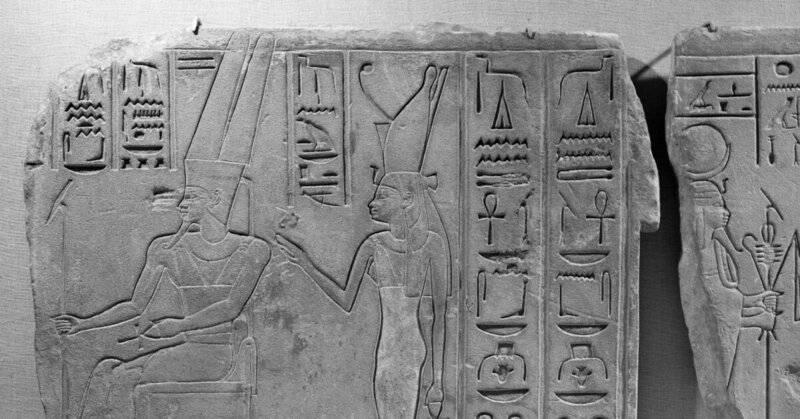
In the summer of 1799, French soldiers digging defensive fortifications near the town of Rosetta — known in Arabic as Rashid — on the Egyptian coast struck something hard beneath the rubble. They hauled up a dark granodiorite slab, roughly the size of a tabletop, and stared at its face: three dense bands of text, none of them immediately legible to European eyes, carved into stone that had been waiting, patient and silent, for nearly two thousand years.
A Stone That Broke 1,400 Years of Silence

The slab the soldiers uncovered was not merely old. It was a key to a locked room containing the entire written life of one of history’s greatest civilizations. For more than a millennium, ancient Egypt’s hieroglyphs had been a dead language — carved into temple pylons, painted across tomb walls, pressed into the gold of royal jewelry — beautiful, omnipresent, and completely opaque. Scholars could see that the symbols were meaningful. They could not hear a single word.
What made the Rosetta Stone extraordinary was its structure. The text ran in three registers: hieroglyphic script at the top, the cursive Demotic script in the middle, and Ancient Greek along the bottom. It was a priestly decree — issued in 196 BCE honoring the pharaoh Ptolemy V — written three ways for three audiences. A code-breaker, hiding in plain sight, wrapped in stone.
The emotional weight of that silence is worth sitting with. For roughly three thousand years, ancient Egyptians had been writing — recording their prayers, their harvests, their grief, their love poems, their tax disputes — and then, gradually, the knowledge of how to read that writing died with the last trained scribes, sometime in the late fourth century CE. Everything they had said was still there, carved into monuments that outlasted Rome itself. No one alive could hear it.
Not an Alphabet — A Living Picture-Language

The first misconception most people carry about ancient Egyptian hieroglyphs is that they work like a simple alphabet — one picture, one letter. The reality is far more layered and, frankly, more impressive. The system blends three distinct types of signs operating simultaneously: logograms, where a picture represents the word for the object shown; phonetic signs, where a picture represents a sound regardless of what it depicts; and determinatives, silent signs appended to a word to clarify its category of meaning. Reading a hieroglyphic text means holding all three registers in mind at once.
The phonetic signs, drawn from the Egyptian hieroglyphic alphabet, are where the system becomes genuinely vivid. A vulture carries the sound “A.” A human foot stands in for “B.” A hand signals “D.” A horned viper renders “F.” A twist of flax produces “H.” Everyday objects — the things an Egyptian scribe saw every morning of their life — were conscripted into phonetic service, turned into the building blocks of sound itself. There is something startlingly intimate about that: the most mundane items of an ancient world pressed into the architecture of eternity.
Direction, too, carries meaning. Hieroglyphs can run left to right, right to left, or top to bottom, and the system provides its own internal compass: the faces of human figures and animals always look toward the beginning of the line. To know which way to read, you simply watch which way the figures are watching.
The scale of the system grew almost exuberantly over time. Egyptologists have catalogued over 700 hieroglyphic signs in classical Middle Egyptian — the literary standard used roughly between 2000 and 1300 BCE — and that number swelled to more than 6,000 signs by the Greco-Roman period, as scribes grew increasingly elaborate in their visual inventions, adding signs the way a language adds vocabulary: organically, prolifically, sometimes just for the pleasure of formal complexity.
Symbols That Carried the Weight of Eternity

Within this vast visual vocabulary, certain ancient Egyptian symbols rose to a prominence that transcended ordinary writing. They became theological statements, protective forces, and declarations of cosmic order — all compressed into a single carved image.
The Ankh is perhaps the most recognizable: a cross with a looped top, serving as the hieroglyph for life and immortality. In tomb paintings and temple reliefs, gods hold the Ankh to the nostrils of pharaohs — offering the literal breath of eternal life. It appears so consistently across three thousand years of Egyptian art that it functions almost as a visual signature of the entire civilization.
The Djed pillar (𓊽) is less familiar to modern eyes but was arguably more central to Egyptian religious life. A towering column of stacked horizontal bands, the Djed represented stability and endurance, and it was sacred to Osiris, god of the afterlife. Each year, in a ceremony designed to reassure the cosmos that order would hold, priests ritually raised the Djed pillar — a physical enactment of the hieroglyph’s meaning, as if the symbol needed to be performed as well as written to remain true.
The Was Scepter — a staff topped with a stylized animal head — completed a visual grammar of divine power. When a god or king appeared in a scene carrying a Was Scepter, no ancient Egyptian reader needed a caption. The symbol announced authority as clearly as a crown.
The Eye of Horus, known as the Wedjat, deserves equal attention. Representing the eye of the falcon-headed sky god Horus — said to have been wounded by the god Set and then restored — it became one of the most widely used protective amulets in ancient Egypt. It appeared on coffins, jewelry, and papyri as a symbol of healing, protection, and royal power. Its six component parts were later associated by scribes with fractions used in measuring grain, weaving mathematics into mythology in a single symbol.
The Scarab, the dung beetle rendered in faience, stone, and gold, carried equally potent meaning. Egyptians observed the beetle rolling its ball of dung across the ground and saw in it an image of the sun being rolled across the sky — associating it with Khepri, the god of the rising sun, and therefore with rebirth and regeneration. Scarab amulets were placed over the hearts of mummies, and heart scarabs inscribed with spells from the Book of the Dead were intended to prevent the deceased’s own heart from testifying against them during judgment in the afterlife.
What matters most about all of these symbols is that they were not decorative. Carved into tomb walls, stamped onto amulets worn against the body, woven into the spells of funerary papyri, they were understood as active forces. A correctly rendered Ankh did not merely represent life — it was believed to participate in sustaining it.
Writing for the Gods and the Grain Harvest

It would be a mistake to imagine hieroglyphs as exclusively the language of temples and tombs. Ancient Egyptian writing served a dual world with remarkable range. Monumental inscriptions on temple walls praised Amun-Ra in verses of soaring religious poetry. On papyrus scrolls, written in faster hands using the related Hieratic script, the same underlying language recorded bread rations, land surveys, legal contracts, and love poems of startling tenderness — one ancient Egyptian love poem describes a beloved with a directness that reads as modern as anything written today.
The very word “hieroglyph” comes from the ancient Greeks, who coined it from hieros (sacred) and glyphein (to carve) because they encountered the script mainly on temple walls and assumed religious purpose was the whole story. They were only partially right. Egyptian scribes had long since invented their own shorthand for earthly business: Demotic script, a cursive, rapidly written descendant of Hieratic, was in common use for commerce and legal documents by roughly 650 BCE. It is Demotic that fills the middle band of the Rosetta Stone — the working language of administrators, not priests.
Behind every text, monumental or mundane, stood the scribes: a class apart, shaped by years of schooling, copying texts by lamplight, grinding pigment into ink, training their hands to reproduce signs with ritual exactness. In a society where perhaps only one to three percent of the population could read and write, being a scribe was a gateway to power and prestige that few other professions could match. Egyptian texts record scribes boasting about their vocation with barely concealed delight — one well-known satirical text called the Satire of the Trades methodically mocks every other profession to elevate the scribe above them all.
The Race to Decode: Champollion Versus Young

When the Rosetta Stone reached European scholars after Napoleon’s Egyptian campaign, the race to unlock it became one of the great intellectual rivalries of the nineteenth century. Two figures dominated the contest: the British polymath Thomas Young and the French linguist Jean-François Champollion.
Young made the first decisive move. He correctly identified that the oval frames called cartouches, which appear repeatedly in the hieroglyphic text, enclosed royal names spelled phonetically. By matching signs to the Greek name “Ptolemy” appearing in the Greek section of the stone, he demonstrated that hieroglyphs were at least partly phonetic — not, as many scholars had assumed, a purely symbolic or allegorical code. It was a genuine breakthrough, and Young knew it.
But it was Champollion who crossed the finish line. In September 1822, working with a cartouche from an inscription on the Philae obelisk alongside the Rosetta Stone text, he confirmed the phonetic spelling of “Cleopatra,” then used both names as a grid to reconstruct the entire phonetic system with systematic precision. The accounts of his reaction — that he reportedly declared something close to “I have it!” before collapsing from excitement — may be embellished in the retelling, but the emotional register rings true. He had just heard a language speak for the first time in over a thousand years.
The crucial advantage Champollion held over Young was a living sonic bridge. He had studied Coptic — the language still used in the liturgy of Egyptian Christians in his own time, itself a late descendant of the ancient Egyptian tongue. By knowing Coptic, he could hear the approximate vowels and rhythms of ancient Egyptian, something no purely analytical approach to the stone’s symbols could have provided. The living language reached back and unlocked the dead one.
What the Symbols Actually Said — Surprises From the Texts

Once the code broke open, what poured out confounded expectations in the best possible way. The human texture of ancient Egypt turned out to be recognizable across every distance of time. The world’s earliest documented labor strike — workers on the royal tombs at Deir el-Medina who downed tools demanding unpaid rations, around 1170 BCE — was recorded in Hieratic script on papyrus. Love poems spoke of longing with an immediacy that no amount of scholarly distance can fully neutralize.
The religious depths embedded in Egyptian hieroglyphs proved equally striking. The Book of the Dead, painted across tomb walls and unrolled on papyri buried with the deceased, used hieroglyphs as literal spells. Each correctly rendered sign was understood to carry active magical power — the ability to protect the soul navigating the dangerous passages of the afterlife. Accurate writing was not merely a clerical virtue; it was a matter of cosmic survival.
The political weaponization of the script was equally revealing. When pharaohs wished to erase a predecessor from history — as Thutmose III did with Hatshepsut’s monuments — they did not merely tear down statues. They sent workers to chisel names from every inscription. In Egyptian belief, to destroy a name written in hieroglyphs was to annihilate that person’s existence for eternity. The name was the person, and the carved name was the name made permanent. Erasure was a form of murder stretched across time.
Perhaps the strangest and most poetic discovery was this: signs depicting dangerous animals — cobras, lions, crocodiles — were sometimes deliberately drawn incomplete or literally stabbed through with a carved knife in burial contexts. Even a hieroglyph, if it represented something powerful enough, might be considered dangerous in its own right. The image was not merely a symbol. It was, in some essential sense, the thing itself.
Why Ancient Egypt’s Symbols Still Speak to Us
The decipherment of hieroglyphs did not merely unlock one civilization. It demonstrated, for the first time with scientific rigor, that dead languages could be systematically recovered from inscriptions — that silence was not necessarily permanent. It founded the academic discipline of Egyptology and directly inspired the later decipherments of Linear B, the Mayan glyphs, and cuneiform, each one a civilization recovered from its own long silence.
The symbols themselves have refused to stay inside the academy. The Ankh appears on jewelry in shopping malls. The Eye of Horus peers from tattoos on every continent. The Scarab turns up on luxury goods whose buyers may have only a vague sense of what it once meant. Stripped of their original theology, these images have nonetheless lodged themselves with extraordinary tenacity in the human imagination — which may itself say something about how well the ancient Egyptian visual language was constructed. Good symbols survive their context.
What the full system reveals, now that we can read it, is a civilization that encoded theology, politics, agriculture, medicine, and grief into a single visual language — and trusted that future eyes, human or divine, would read it correctly. They were not wrong. The Rosetta Stone now stands in the British Museum, examined by millions of visitors each year. Most of them pass close enough to touch it, standing inches from a text that was silent for fourteen centuries, now speaking again in three scripts at once, patient as stone, waiting to be read.

 English
 Arabic
 French
 Spanish
 Portuguese
 Deutsch
 Turkish
 Dutch
Dutch
 Italiano
 Romaian
 Portuguese (Brazil)
 Greek
Greek