


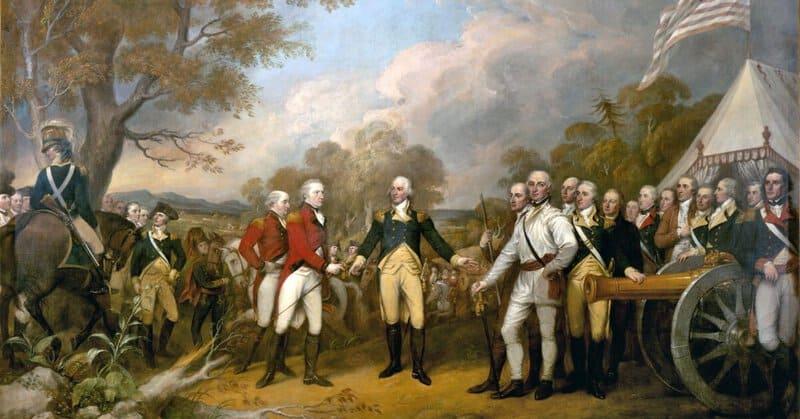
On a raw October morning in 1777, a portly, bespectacled general in a Continental blue coat stood on a muddy field near Saratoga, New York, and accepted British General John Burgoyne’s surrender — a scene that electrified the American cause, delivered France as an ally, and crowned Horatio Gates as the greatest military hero the young republic had yet produced. It would not last.
A Red Coat Before the Blue: Gates’s British Origins

The central irony of Horatio Gates’s life is that the man celebrated as America’s “Hero of Saratoga” was, by birth and long habit, entirely British. Born on July 26, 1727, in Maldon, Essex, England, he spent his formative decades in the service of the Crown before becoming one of the Revolution’s most important — and most contested — generals.
At twenty-two, Gates crossed the Atlantic for the first time not as a rebel but as a volunteer accompanying Edward Cornwallis, the new governor of Nova Scotia, in 1749. He would spend roughly two decades in a British officer’s uniform, earning campaign experience that most of his future Continental Army colleagues could only envy. His most formative trial came during the disastrous Braddock expedition of 1755 in the French and Indian War, where he was wounded in an ambush in the Pennsylvania wilderness — and where he first encountered a tall, composed Virginia colonel named George Washington. The two men who would later circle each other as rivals were already, in some sense, shaped by the same catastrophe.
By 1769, Gates had sold his commission and settled in Virginia, carrying with him a deepening resentment. The rigid British class system had capped his advancement with brutal efficiency — a capable, experienced officer repeatedly passed over because his lineage was insufficiently distinguished. That grievance, simmering for years, would eventually make the choice between Crown and colony feel less like treason and more like relief.
Switching Sides: From British Officer to Continental General

When revolution came, Gates’s decision to join the American cause was sharpened by both principle and opportunity. The Continental Army desperately needed men who actually knew how armies worked — how to organize supply lines, draft orders, and enforce discipline — and Gates had learned all of it the hard way. In 1775, he was appointed Adjutant General of the Continental Army, and he moved quickly to build the organizational skeleton of an institution that was, at that moment, barely more than an armed crowd.
What Gates understood instinctively, and what made him both effective and dangerous, was that in a republic, military careers were built as much in committee rooms as on battlefields. He cultivated relationships with members of Congress with a skill that bordered on manipulation, positioning himself among allies who might one day decide who commanded what. Alongside other major Continental generals — Washington, Nathanael Greene, the volatile Benedict Arnold — Gates was already regarded in certain congressional circles as a serious rival to Washington for supreme command. He wanted that command and made little secret of it.
Saratoga: The Battle That Saved a Revolution

The strategic stakes of the autumn 1777 campaign could hardly have been higher. British General John Burgoyne — “Gentleman Johnny,” a flamboyant soldier-playwright who believed this campaign would break the rebellion’s spine — was driving south from Canada with roughly 8,000 troops, aiming to seize the Hudson River corridor and split the colonies in two. If he succeeded, the Revolution might simply suffocate.
Gates took command of the Northern Army in August 1777, inheriting a force that had been bloodied and demoralized but was swelling as militia flooded in from across New England. What followed — two engagements at Freeman’s Farm on September 19 and Bemis Heights on October 7, together known as the Battles of Saratoga — proved to be the turning point of the American Revolution.
The command controversy that haunts Gates’s greatest triumph has never been fully resolved. Benedict Arnold, fighting with reckless brilliance on the field, drove the tactical victories that broke Burgoyne’s army. Gates directed cautiously, even defensively, from his headquarters — and the two men despised each other by the campaign’s end, their quarrel so bitter that Gates effectively removed Arnold from command before the final battle. Arnold fought anyway, without orders, charging into the action at Bemis Heights and sustaining a severe leg wound in what many historians regard as the decisive moment of the engagement. History has never quite settled whether the glory belongs more to the general who held the strategic ground or the subordinate who bled on it.
On October 17, 1777, Burgoyne surrendered nearly 6,000 troops — the largest British capitulation of the entire war. The victory convinced France to formally enter as America’s ally, transforming a colonial rebellion into a global conflict that Britain could no longer afford to treat as a police action. Gates received a congressional medal commemorating the victories of the 1777 Battles of Saratoga, and you can view that commemorative medal at the Smithsonian Institution — a gleaming relic of the absolute pinnacle of a career that had nowhere to go but down.
The Conway Cabal: When Ambition Turned Toxic

The glow of Saratoga barely had time to cool before Gates found himself at the center of one of the Revolution’s ugliest political scandals. The so-called Conway Cabal — a murky, disputed affair in which critics of Washington allegedly maneuvered to replace him with Gates as commander-in-chief — exploded into a months-long crisis that permanently poisoned Gates’s relationship with the man who would ultimately define how the Revolution was remembered.
A letter from General Thomas Conway to Gates, containing disparaging remarks about Washington’s fitness for command, leaked to Washington’s inner circle and detonated like a grenade. Gates’s handling of the affair was clumsy, evasive, and ultimately self-defeating — he denied, deflected, and wriggled, but the damage was done. In the eyes of Washington’s allies, Gates had been revealed as someone willing to maneuver against his commander-in-chief in the shadows. Whether the cabal was a genuine conspiracy or a loosely organized chorus of critics elevated into something more sinister by Washington’s partisans remains debated by historians. The political verdict, however, was swift and severe.
Congress appointed Gates president of the Board of War in late 1777 — a position that carried impressive-sounding authority but kept him away from field command. His arc had crested. He simply did not know it yet.
Camden: The Catastrophe That Erased a Legend

In 1780, with the war grinding south and the British seizing the initiative across the Carolinas, Congress made a decision that would end in catastrophe. Bypassing Washington’s recommendation of Nathanael Greene, Congress handed Gates command of the Southern Army — perhaps chasing the ghost of Saratoga. What they found instead was Camden.
On August 16, 1780, at the Battle of Camden in South Carolina, Gates faced the brilliant and ruthless Lord Cornwallis and suffered one of the worst American defeats of the entire war. The Continental lines collapsed with terrifying speed; the militia, which Gates had relied upon in numbers that alarmed his more experienced subordinates, disintegrated in panic almost before the firing began. The battle became a rout. And in the chaos, Gates rode hard away from the field — and kept riding. By the time he stopped, he had covered roughly 180 miles in three days, a fact his enemies found darkly comic and his defenders have struggled ever since to explain. Alexander Hamilton was among those who eviscerated him in writing.
The transformation from hero to object of ridicule was nearly instantaneous. Gates was relieved of command, and a court of inquiry was ordered. The inquiry was eventually dropped — not because Gates was exonerated, but because the war moved on and the Southern Army had more urgent problems than relitigating Camden. The damage, however, was permanent. The Hero of Saratoga had become, in the American imagination, something close to a coward whose nerve had collapsed at the worst possible moment.
Later Life and the Weight of a Contradictory Legacy

Gates spent his later years largely removed from public life, the long shadow of Camden falling across whatever remained of his Saratoga reputation. He eventually freed the people he had enslaved, remarried after his first wife’s death, and settled in New York City, where he died on April 10, 1806, having outlived both the glory and the disgrace.
The historical verdict on Gates remains stubbornly mixed, as it probably should be. The victory at Saratoga was real, consequential, and arguably the single most important American military achievement of the entire war — and Gates was the commanding general when it happened. Whether he deserves the lion’s share of credit, or whether Benedict Arnold and the men who bled at Freeman’s Farm and Bemis Heights deserve more, is a question historians have argued for two and a half centuries without resolution.
Three verdicts compete for dominance: Gates as a capable administrator who rose somewhat beyond his tactical gifts; Gates as a political schemer who dangerously overreached against Washington; and Gates as a commander whose nerve catastrophically abandoned him when the stakes were highest. All three contain truth. None is quite complete.
What his story ultimately illuminates is something important and uncomfortable about the American Revolution itself — that it was won not by marble heroes or men of unblemished virtue, but by flawed, ambitious, sometimes brilliant and sometimes catastrophically wrong human beings who were improvising under impossible pressure. Horatio Gates climbed higher than almost any of them and fell further than most. The line between legend and disgrace, as he discovered on a sweltering Carolina field in August 1780, could be crossed in a single afternoon.

 English
 Arabic
 Spanish
 Portuguese
 Deutsch
 Turkish
 Dutch
Dutch
 Italiano
 Russian
 Romaian
 Portuguese (Brazil)
 Greek
Greek