


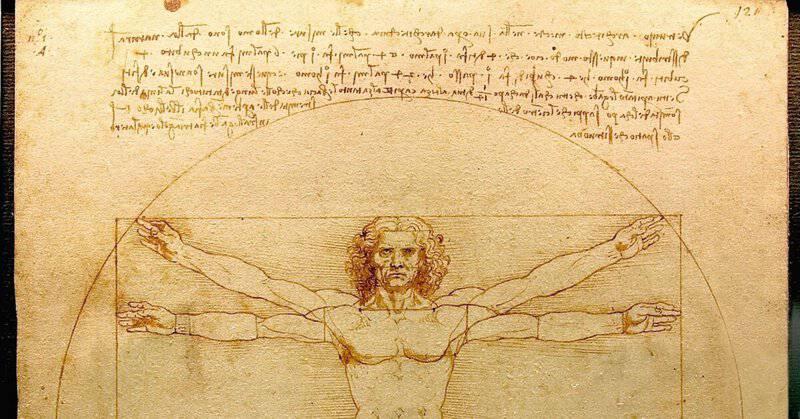
Somewhere around 1490, in a notebook no one was meant to read, Leonardo da Vinci drew a naked man and changed the way the world pictures itself. The ink is still visible on that page — brown and urgent, surrounded by dense mirror-script notes — and the figure it describes has spent five centuries refusing to be forgotten.
A Working Note That Became a Universal Symbol
The drawing arrived not as a commission, not as a religious devotion, not even as a finished artwork. It was a working note — the kind of page you fill when a problem has been keeping you up at night and you finally think you see the answer. A man stretches his arms wide and his legs apart, simultaneously inscribed within a circle and a square, two of his positions overlaid on a single body. The image looks inevitable now, the way all genuinely good solutions do in retrospect. In 1490, it was the resolution of an argument that had been running for fourteen centuries.
That is the paradox at the heart of the Vitruvian Man: it feels like pure Leonardo — the Renaissance polymath at his most dazzling — and yet it is equally the property of a Roman military engineer who died roughly a millennium and a half before Leonardo picked up his pen. Understanding the drawing means understanding that relay race across the centuries, and what was at stake in the final handoff.
The original sheet is now held at the Gallerie dell’Accademia in Venice, where it is almost never put on public display. Works on paper are destroyed by light, slowly but irreversibly, and so the image the whole world knows — printed on coins, reproduced on textbook covers, tattooed on forearms — is essentially a photograph of something very few living people have seen in person. That gap between the icon and the fragile reality makes the original stranger and more interesting than any reproduction manages to suggest.
Rome’s Master Builder and the Proportions of the Gods
Marcus Vitruvius Pollio was a Roman architect and military engineer who served under Julius Caesar and later under Augustus in the first century BC. He is not, by any measure, a household name. But he wrote a book — ten volumes, titled De Architectura — that turned out to be the only surviving architectural manual from classical antiquity. That accident of survival gave him an outsized hand in shaping how the Western world thought about buildings, bodies, and beauty for two thousand years.
Vitruvius’s central claim was elegant and ambitious: a well-designed temple must mirror the perfect proportions of the human body, because both had been shaped by the same underlying divine logic. He was precise about it. A foot is one-sixth of total body height. A head is one-eighth. The outstretched span of the arms equals the total height of the body. These were not decorative observations — they were meant as practical rules for architects determining column spacing, doorway dimensions, and room ratios, so that buildings would feel instinctively correct to the human bodies moving through them.
Then came the famous passage in Book III, the textual seed of everything that followed. Vitruvius wrote that a man with arms and legs extended fits perfectly into two ideal geometric forms: a circle centered on the navel, and a square whose baseline runs beneath the feet. Here was a claim about the deep geometry of the human figure — that it was not random, not fallen, not merely animal, but mathematically coherent in a way that connected it to the most perfect shapes in the universe.
There was just one problem. Vitruvius never drew it. He described the geometry in words and left no diagram. For more than a millennium, that absence would frustrate and inspire anyone who took his treatise seriously.
Lost, Found, and Fought Over: The Long Journey to the Renaissance
De Architectura survived the fall of Rome the way so much ancient knowledge did — by retreating into monastery scriptoria, copied by monks who preserved the text without necessarily grasping its full implications. It circulated in medieval Europe as a known title, occasionally cited, seldom studied with real urgency. The world it described — temples, colonnaded forums, the confident geometry of empire — had receded so far that the manual seemed almost archaeological.
That changed in 1414, when the Florentine humanist Poggio Bracciolini discovered a complete manuscript of De Architectura at the Abbey of St. Gall in Switzerland. The rediscovery sent ripples through the Italian intellectual world. Here was a direct line to the architectural thinking of antiquity — not a fragment, not a paraphrase, but the full text. Within decades it was being read, debated, and translated across Italy’s courts and workshops.
The Renaissance obsession that followed was not mere nostalgia. Thinkers like Leon Battista Alberti and the architect Filarete threw themselves at Vitruvius’s proportional man throughout the mid-fifteenth century, producing illustrated interpretations that tried and largely failed to resolve the geometric problem the Roman had posed. The difficulty was structural: the circle and the square, as Vitruvius described them, do not share the same center, and earlier illustrators who assumed they should were left with figures that looked stiff, compromised, and unconvincing. A body scaled to fit one geometry simply refused to sit cleanly inside the other.
The failure became famous in its own right. The so-called Vitruvian problem circulated through the workshops and learned academies of northern Italy as a standing challenge — the kind of open puzzle that would naturally reach a man like Leonardo, working in Milan in the late 1480s at the court of Ludovico Sforza, and constitutionally incapable of leaving an unsolved problem alone. At this level, the connection between Renaissance art and ancient Rome was not decorative borrowing. It was intellectual hunger: a belief that antiquity had possessed genuine secrets about beauty and proportion that the medieval centuries had lost, and that recovering those secrets was both a scholarly and a moral imperative.
Leonardo’s Notebook and the Breakthrough of 1490

Leonardo da Vinci’s notebooks are among the strangest documents in Western intellectual history — a sprawling, lifelong archive of observation, experiment, shopping lists, engineering sketches, anatomical studies, jokes, and argument, all written in the mirror script that ran from right to left across the page. They were never intended for publication. They were a private laboratory, the place where Leonardo thought out loud across decades, and the Vitruvian Man emerged from this intensely personal process rather than from any external commission.
The specific insight Leonardo brought to the Vitruvian problem was as much artistic as mathematical. Where earlier illustrators had drawn a single static figure and tried to force it into both geometries at once, Leonardo drew two positions of the same man overlaid on each other: arms horizontal and legs together for the square, arms raised and legs spread for the circle. By using one body to describe two distinct postures, he satisfied both geometries simultaneously without distorting either. The navel anchors the center of the circle; a separate point anchors the center of the square. The figures share a body but not a geometric center, and that willingness to let the solution be slightly more nuanced than a single fixed point was precisely the key that had eluded his predecessors.
The drawing is accompanied by dense handwritten notes in which Leonardo paraphrases and expands on Vitruvius Pollio’s original proportional measurements — the length of the foot, the width of the palm, the distance from chin to crown. These annotations make clear that the Vitruvian Man is first and foremost a work of architectural theory, grounded in its Roman source material, not a freestanding artistic statement. It is Leonardo doing homework — very brilliant homework, but homework nonetheless.
To situate the moment in Leonardo’s biography: around 1490 he was deep in simultaneous studies of anatomy, engineering, optics, and hydraulics. He was dissecting cadavers to understand the body from the inside, designing war machines for his patron, and filling notebook pages with the flight mechanics of birds. The Vitruvian Man is not a single eureka moment but a crystallisation of converging obsessions — the point where an architect’s problem, an anatomist’s curiosity, and a mathematician’s instinct all arrived at the same page at the same time. This detailed account of Leonardo’s working methods and intellectual sources explores that convergence further.
Reading the Image: What the Drawing Actually Shows and Argues

The symbolic architecture of the image is layered with meaning that Renaissance viewers would have understood immediately. The square, in the tradition Leonardo was drawing on, represents the earthly and the material — the body as measured, mortal, and bounded by the four directions. The circle, associated since antiquity with perfection, eternity, and the divine, represents something altogether more cosmic. Leonardo’s figure inhabits both at once, and that dual inhabitation is the argument the drawing makes without a single word of explanation: the human form is the bridge between earth and heaven, between the finite and the infinite.
For Renaissance humanism, this amounted to a manifesto. The medieval theological tradition had emphasised human smallness and sinfulness set against divine grandeur. The humanist recovery of classical thought pushed back, insisting — as the ancient philosopher Protagoras had phrased it — that man is the measure of all things. The Vitruvian Man gives that abstract claim a precise geometric form. Here is a body that contains both the square of the earth and the circle of the cosmos: not fallen, not base, not merely a temporary vessel, but proportioned, ordered, and structurally magnificent.
It is equally important to understand what the image is not. It is not a self-portrait of Leonardo — the figure is generic, idealised, a type rather than an individual. It is not a medical illustration, though anatomical drawings fill nearby pages in the same notebooks. And it was not created for public display; the thought that this private working note would one day become the most reproduced image of the Italian Renaissance would have struck Leonardo as improbable. Understanding what it was not clarifies what it was: a tool for builders, a hypothesis about proportion, and a philosopher’s sketch of the human place in the order of things.
From Private Page to Global Icon: The Drawing’s Afterlife

After Leonardo’s death in 1519, his notebooks scattered. They passed through a chain of owners across the following centuries, gradually surfacing and being catalogued as scholars began to grasp their scale and importance. For a long time the Vitruvian Man was known primarily to specialists — an important document in the history of architectural theory, but not yet the universal symbol it would become.
Its twentieth-century canonisation was rapid and thoroughgoing. The image appeared on the Italian lira coin and was adopted by medical associations, public health organisations, and technology companies seeking visual shorthand for rational, human-centred thinking. The figure that Leonardo had never named, never published, and never showed to a patron became one of the most recognised images on earth — which is itself a kind of argument about the persistence of compelling ideas.
The physical reality of the drawing remains oddly precarious for something so celebrated. Because works on paper are acutely sensitive to light damage, the Gallerie dell’Accademia rarely exhibits the original. In 2019, when Italy agreed to loan the drawing to the Louvre for a major Leonardo retrospective marking the 500th anniversary of his death, the decision triggered a legal challenge from Italian art conservationists who argued that exhibiting so fragile a work posed an unacceptable risk regardless of the cultural occasion. The case moved through the Italian courts before a temporary loan was ultimately permitted under strict conservation conditions. A 530-year-old notebook page, never intended for anyone’s eyes but Leonardo’s, was generating injunctions and counter-injunctions in the twenty-first century.
Why the Idea Refuses to Age
The Vitruvian Man is not, at its core, a portrait of human vanity. It is a hypothesis — that there is an underlying order connecting the human body, the natural world, and the built environment, and that careful observation combined with mathematical rigour can reveal that order. It proposes that art and science are not opposed methods but the same method applied with different tools, and that a drawing in a private notebook is as legitimate a form of inquiry as a published theorem.
The relay race that produced it — from a Roman engineer’s unillustrated text, through a millennium of manuscript preservation, through the humanist rediscovery of antiquity, through the failed attempts of Alberti and Filarete, to the page where Leonardo’s pen finally found the solution — follows a pattern that recurs throughout intellectual history. The greatest ideas rarely travel in straight lines. They survive through luck, through the devotion of anonymous copyists, through the creative misreadings of scholars who find something in an old text that its author never consciously placed there, and finally through the willingness of a later mind to take an old problem seriously enough to actually solve it.
The drawing itself remains the most concise version of its own argument: a man poised between a square and a circle, between the earthly and the infinite, between ancient Rome and the Renaissance — still perfectly balanced after five centuries, still open enough around its edges to make you stop and look, and look again.
Leonardo never published the drawing. He never titled it — the name L’uomo vitruviano came later, assigned by others. He never intended it for the world. Which means the world finding it anyway, and finding it inexhaustible, is itself a small vindication of everything Vitruvius and Leonardo believed: that proportion and beauty, once genuinely achieved, have a way of persisting long past any single person’s intentions for them.

 Arabic
 French
 Spanish
 Portuguese
 Deutsch
 Turkish
 Dutch
Dutch
 Italiano
 Russian
 Romaian
 Portuguese (Brazil)
 Greek
Greek