


From Cold War dread to lunar triumph, the space race remains one of history’s most astonishing chapters — a contest between two superpowers that pushed human beings beyond the atmosphere and all the way to the surface of the Moon.
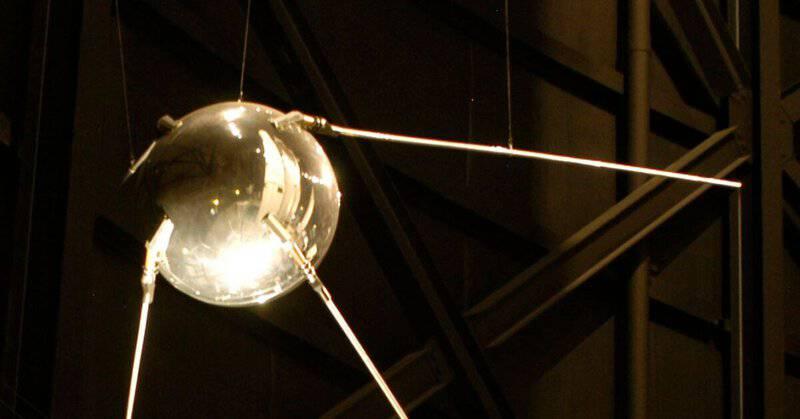
On the night of October 4, 1957, radio operators and backyard stargazers across the Western world pressed their headphones tight and heard something that made their blood run cold: a faint, rhythmic beep drifting down from the dark — the voice of a Soviet satellite, about the size of a basketball, circling the Earth every 96 minutes as casually as a hawk riding a thermal.
The Night the Sky Changed Forever

Sputnik wasn’t loud or complicated. It was a polished metal sphere trailing four antennae, bleating a radio signal that any amateur could track. But its meaning was deafening. If Moscow could place a machine in orbit above Kansas, what was stopping them from positioning a warhead there? The space race wasn’t born in wonder — not at first. It was born in dread, in the clenched-jaw recognition that the Cold War had just acquired a new and terrifying dimension: the sky itself.
Two superpowers. Two incompatible visions of human civilization. One sky. And a contest that would, almost despite itself, push human beings all the way to the surface of the Moon. This is the story of why the space race happened, how it unfolded across one of history’s most extraordinary decades, and why it still shapes the way we look up.
Why Did the Space Race Happen? The Cold War Pressure Cooker

To understand the Cold War space race, you have to understand the strange, suffocating logic of the years that preceded it. After World War II, the United States and the Soviet Union emerged from the rubble as the world’s two dominant powers — and immediately found themselves locked in an ideological standoff that neither could resolve with direct military conflict without risking mutual annihilation. Capitalism versus communism, individual liberty versus collective authority: each side was absolutely convinced that history was on its side and desperate to prove it to a watching world.
Space became the ultimate propaganda stage. A nation that could master orbit could inspire its allies, unsettle its enemies, and win the hearts of the newly independent nations of Asia and Africa that both superpowers were frantically courting. Every launch was a headline battle. Every milestone was a verdict delivered simultaneously to billions of people.
The technology underpinning all of it had a darker origin. Both superpowers had recruited German rocket engineers from the wreckage of the Nazi V-2 program — the world’s first operational ballistic missile, which had rained destruction on London and Antwerp. The Americans secured Wernher von Braun, the program’s brilliant and deeply compromised chief engineer, through Operation Paperclip. The Soviets acquired other personnel, technical documents, and hardware through their own equivalent effort. The space race was seeded in the same bombed-out German laboratories, which gave the whole competition an unsettling genetic kinship. The same rocket technology that could lift a satellite could carry a warhead, a fact that no general or politician on either side ever forgot.
The Soviet Head Start: Sputnik, Laika, and the Shock of Firsts

Through the late 1950s and into the early 1960s, the Soviet Union delivered blow after humiliating blow to American confidence. First satellite in orbit — Sputnik, October 1957. First living creature in orbit — Laika the dog, riding Sputnik 2 just a month later, on a mission from which she would not return. First photographs of the far side of the Moon, transmitted by Luna 3 in 1959. First probe to reach the vicinity of another planet. The list of Soviet firsts read like a systematic dismantling of American technological pride.
Then, on April 12, 1961, came the one that truly mattered. A 27-year-old foundry worker’s son from a village near Gzhatsk climbed into a spherical capsule called Vostok 1 and became the first human being to leave Earth. Yuri Gagarin’s 108-minute flight — one orbit, a fiery re-entry, and a parachute descent onto the Soviet steppe — made him overnight the most recognizable face on the planet. His wide, uncomplicated grin beamed from every newspaper on Earth. The history of space exploration had acquired its first genuine hero, and he was Soviet.
Behind all of it stood a ghost. The man running the Soviet space program was known in the West only as the “Chief Designer” — his real identity, Sergei Korolev, was a state secret, concealed because Soviet authorities feared a Western assassination attempt. Korolev was a genius of ferocious intensity who had survived years in Stalin’s Gulag labor camps and emerged still capable of dreaming at cosmic scale. He drove his engineers with a combination of visionary ambition and iron discipline that the Americans, with their congressional hearings and press conferences, could barely imagine. Every Soviet triumph in space was, in a very real sense, the triumph of one obsessive, anonymous man.
America Fires Back: NASA, Alan Shepard, and the Moon Bet

America’s early response was not inspiring. Rockets exploded on live television. The hastily assembled Project Mercury program lurched forward under the glare of cameras that captured every failure in excruciating detail. While Gagarin was completing his orbit, American engineers were still resolving fundamental engineering problems.
Alan Shepard flew on May 5, 1961 — a 15-minute suborbital arc that was celebrated with ticker tape and genuine national relief. It was brave, technically solid, and politically necessary. It was also, quietly, far less than Gagarin’s single orbit of the entire planet. The United States was losing the space race by almost every measurable standard.
Twenty days later, John F. Kennedy walked into a joint session of Congress and made one of the most audacious gambles in political history. Before the decade was out, he declared, the United States would land a man on the Moon and return him safely to Earth. It was a goal that, at that precise moment, no one at NASA actually knew how to achieve. The agency didn’t yet have the rockets, the spacecraft, the navigation systems, or the operational techniques required. Kennedy was, in effect, placing a bet with chips that didn’t exist yet.
But the strategic genius of the move was this: by choosing the Moon as the finish line, America reframed the entire competition. Instead of chasing Soviet firsts — a game it was losing — it drew a new finish line so far ahead that neither side had reached it. The race now had a single, unambiguous destination, 238,000 miles away.
The Brutal Middle Years: Tragedy, Competition, and Hard-Won Progress

The middle years of the space race were marked by a human cost that triumphant headlines often obscured. On January 27, 1967, a flash fire swept through the Apollo 1 capsule during a routine ground test at Cape Kennedy, killing astronauts Gus Grissom, Ed White, and Roger Chaffee in seconds. The race was consuming lives on the American side. It did the same on the Soviet side: cosmonaut Vladimir Komarov died in April 1967 when the parachute system of his Soyuz 1 capsule failed on re-entry. Both programs had demanded blood, and both had collected it.
What the public didn’t know — what was kept secret for decades — was that the Soviet Moon program was quietly falling apart. Sergei Korolev died during a surgical operation in January 1966, and without his singular authority holding it together, the program fractured into competing design bureaus. Their massive N1 Moon rocket, conceived as the Soviet equivalent of the Saturn V, failed catastrophically in all four of its test launches, producing some of the largest non-nuclear explosions in history. The Soviets were no longer genuinely in the lunar race, but they could not admit it publicly.
Meanwhile, the American Gemini program was doing something unglamorous but essential: systematically building competence. Spacewalks. Orbital rendezvous and docking. Long-duration missions testing human endurance in space. The techniques required to reach the Moon and return were rehearsed mission by mission, until NASA had transformed from a stumbling agency into something close to a precision instrument.
Christmas Eve, 1968: Apollo 8 carried Frank Borman, Jim Lovell, and Bill Anders around the Moon — the first human beings to leave Earth’s gravitational sphere of influence entirely. Anders pointed a camera at the lunar horizon and captured Earthrise: a fragile blue marble suspended in absolute blackness, impossibly vivid against the grey lunar surface. The image traveled around the world and quietly began doing something that no missile or ideology could accomplish — it made many people, for just a moment, feel like a single species on a single small island.
One Giant Leap: Apollo 11 and the Finish Line

July 20, 1969. An estimated 600 million people — roughly one fifth of the entire human population at the time — gathered around televisions, radios, and public screens to watch what happened next. Inside the lunar module Eagle, Neil Armstrong and Buzz Aldrin descended toward a surface no human being had ever touched, while Michael Collins orbited above in the command module Columbia. The onboard guidance computer began throwing program alarms sixty seconds from touchdown — errors that engineers in Houston had to evaluate and clear in real time. Armstrong took partial manual control, scanning for a landing site clear of boulders.
Then: silence. Stillness. Touchdown in the Sea of Tranquility, with roughly 25 seconds of descent propellant remaining. “The Eagle has landed.” Armstrong descended the ladder and stepped onto the surface. Aldrin followed and described what surrounded him as “magnificent desolation”: a grey, silent, utterly alien world, with Earth hanging in the black sky above them.
In Moscow, Soviet state media said almost nothing. There was no acknowledgment of what they had been competing toward for over a decade. Their lunar program was a classified failure, and the United States had just won the defining technological contest of the twentieth century in full view of the entire planet.
The paradox is almost too neat to be believed: a competition born from mutual nuclear terror, driven by propaganda and geopolitical calculation, had produced the most universally celebrated act of exploration any living person had ever witnessed. Rivalry had reached the Moon.
Legacy: What the Space Race Left Behind
The inheritance of the Cold War space race is embedded in daily life in ways most people never notice. Satellite communications, weather forecasting, GPS navigation, advances in miniaturized electronics, improvements in water purification technology, and the digital imaging sensors in modern cameras all trace significant parts of their development to research conducted under the pressure of that decade of competition. The race didn’t just go to the Moon; it rewired the infrastructure of modern civilization.
Culturally, the shift was subtler but perhaps more lasting. The Earthrise photograph gave the fledgling environmental movement its most powerful visual argument — an image, impossible to dismiss, that the planet was finite, alone, and worth protecting. The Apollo missions nudged humanity toward a new kind of self-awareness: not merely as competing nations on a globe, but as a single species sharing a single fragile world.
The space race never truly ended — it evolved. The Space Shuttle era, the International Space Station (a remarkable monument to former rivals choosing cooperation over competition), and now a new generation of contests involving China’s ambitious lunar program, commercial operators such as SpaceX and Blue Origin, and a renewed international scramble for lunar resources and strategic presence would feel recognizable to anyone who lived through the 1960s. The underlying pattern recurs; only the names and flags change.
What the original space race proved, finally, is both inspiring and unsettling: that existential rivalry — for all the fear, waste, and occasional tragedy it generates — can compel human beings to attempt things they would never have dared in calmer times. Whether the next great leap outward requires an adversary to drive it, or whether humanity has finally learned to reach for the stars without one, is the question that the age of space exploration has left unresolved, hanging in the dark, still waiting for an answer.

 English
 Arabic
 Spanish
 Portuguese
 Deutsch
 Turkish
 Dutch
Dutch
 Italiano
 Russian
 Romaian
 Portuguese (Brazil)
 Greek
Greek