


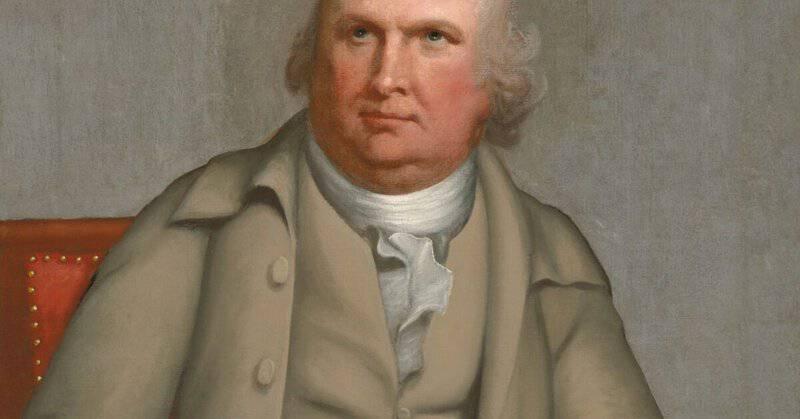
Two men named Robert Morris left marks on American history so different in kind that the shared name feels almost like a cosmic joke — one bankrolled the birth of a republic and died broke in its service; the other built a megachurch empire and walked out of a county jail on a spring morning in 2026, his legacy reduced to a guilty plea and a survivors’ reckoning that was years overdue.
The Financier: Revolution on Credit

He arrived in the colonies as a boy, crossing the Atlantic from Liverpool, England, where he had been born on January 20, 1734. The New World suited Robert Morris. He had a talent for numbers, a hunger for risk, and a gift for persuasion that would eventually make him the most consequential financial mind the American Revolution ever produced. By the time the Continental Congress was lurching toward independence, Morris was already a prosperous Philadelphia merchant — the kind of man whose handshake carried the weight of a bank note.
Serving as a Pennsylvania delegate to the Continental Congress and later as a United States Senator, Robert Morris looked at a bankrupt young nation and saw a problem he believed he could solve personally. The Continental Army’s finances were a catastrophe. Soldiers went unpaid. Supply lines collapsed. At Valley Forge during the brutal winter of 1777 to 1778, Washington’s men wrapped rags around frostbitten feet and prayed for relief that the empty treasury could not deliver. While those men shivered in Pennsylvania’s killing cold, Morris was in Philadelphia writing urgent letters, leveraging his personal credit, threading together foreign loans, and pledging his own fortune to keep the army alive. Benjamin Franklin, a man not known for dispensing praise carelessly, called him indispensable.
The title history eventually settled on — Financier of the American Revolution — captured something true. Without the system of credit Morris improvised from almost nothing, the Continental Army might have dissolved before Yorktown ever became possible. He was the man behind the curtain who made the revolution solvent, a founding father whose name belongs on the same list as Hamilton and Jefferson but somehow never lands there with quite the same force. He also served as Superintendent of Finance from 1781 to 1784, a role in which he reorganized the nation’s chaotic wartime accounts and founded the Bank of North America — the first chartered bank in the United States — to give the new government a functional financial spine.
History handed him a tragic coda. Morris accumulated enormous land holdings in western New York after the war, betting on postwar expansion that never materialized at the pace he needed. When the speculation collapsed, so did everything he had built. He spent three and a half years in Philadelphia’s Prune Street debtors’ prison — the same country he had helped finance now locking him away for the debts he had accumulated partly in its service. He died on May 8, 1806, nearly penniless, a ruin of a great man, but a ruin that had left a republic standing.
The University That Carries His Name
Spread across 230 scenic acres in Pittsburgh, Pennsylvania, Robert Morris University wears the Founding Father’s name as a declaration of purpose. A school built around business, professional education, and civic ambition could hardly have chosen a more fitting patron. The original Morris understood, at a bone-deep level, that money properly wielded could build things that outlast their builder — institutions, armies, nations. The university bearing his name was founded in 1921 as a small business school in downtown Pittsburgh and has grown into a comprehensive university offering degrees from nursing to engineering to the performing arts, enrolling more than five thousand students annually.
The Founding Father’s legacy is specific and earned: the story of a man who understood that the hardest kind of courage is not the kind displayed on a battlefield but the kind summoned when writing letters against despair, pledging a personal fortune to a cause that has not yet won and might not. That story deserves its campus and its plaque. But history keeps writing new chapters whether we invite it to or not, and in 2024 the name Robert Morris acquired a set of associations that no university branding committee could have anticipated.
The Pastor: A Church Built on One Man’s Authority

Robert Preston Morris was born on July 29, 1961, and grew into one of the most recognizable evangelical voices in American Christianity. He founded Gateway Church in Southlake, Texas, in 2000 and built it with the particular genius of the celebrity pastor: charisma magnified by media, theology packaged as self-help, and a personal brand so thoroughly woven into the institution that the two became nearly indistinguishable.
At its peak, Gateway drew tens of thousands of worshippers across multiple campuses in the Dallas-Fort Worth area. Stadium-scale worship services featured lights and music calibrated to move people emotionally; baptisms were counted in the thousands annually; sermons were broadcast to audiences across more than a hundred nations. Morris wrote books on financial blessing, spiritual authority, and Christian living that sold millions of copies. The parking lots of his church were full. The cameras were always rolling. The brand was immaculate.
That architecture of celebrity pastorship contained a structural weakness that institutions rarely acknowledge until it is too late. When everything is built around a single personality — when the cornerstone is a man rather than a mission — the entire structure becomes hostage to what that man actually is in private. At Gateway, that private reality was catastrophic.
The Reckoning: Indictment, Guilty Plea, and Six Months Behind Bars

The collapse arrived publicly in 2024. A survivor named Cindy Clemishire had spoken publicly years earlier about abuse she said Morris committed against her beginning when she was a child in the early 1980s, before Gateway existed. Other survivors came forward in the months that followed. An Oklahoma grand jury indictment, publicly available in court records, charged Robert Preston Morris with lewd or indecent acts with a child under 16, describing conduct placed in the 1980s. The charges described crimes committed while his future congregation had no idea he existed, let alone what he was capable of.
Morris resigned from Gateway in June 2024. He subsequently pleaded guilty to a charge related to the sexual abuse of a child. The confession arrived as a legal document, spare and unsparing, stripping away decades of carefully constructed spiritual authority in the language of a courtroom rather than the language of repentance. Thousands of congregants processed the news in a stunned quiet that no worship service had prepared them for, carrying the weight of a betrayal that reached back further than most of them had been alive.
He was sentenced to jail and served six months before walking free on March 31, 2026 — a sentence that survivors and advocates described as grotesquely lenient for crimes whose damage does not expire when a jail term does.
The Aftermath: Settlement, Silence, and Institutional Survival

Gateway Church did not simply grieve. It lawyered up. Even as survivors sought accountability and congregants wrestled with what their faith community had protected and concealed, the institution became entangled in a separate civil dispute over Morris’s retirement compensation — a multimillion-dollar legal battle between a church and the man it had built itself around, playing out in civil court while the criminal courts had already rendered their judgment.
On May 12, 2026, Morris and Gateway Church agreed to end the legal dispute in a settlement. The terms did not specify whether Morris would receive any compensation — a deliberate silence that felt, to many observers, like a final act of institutional self-protection dressed up as resolution. The Fort Worth Report, which covered the settlement in detail, noted that the agreement left unanswered the question that every person who had ever contributed to a Gateway offering was entitled to ask.
The pattern is not unique to Gateway. Across American religious institutions, the same sequence tends to repeat: revelation, denial, legal maneuvering, settlement with opaque terms, and a carefully managed attempt to return to normalcy that never quite feels normal. The survivors are left carrying what the settlement does not address — years of disrupted faith, broken trust, and damage that no dollar figure and no carefully worded legal agreement can fully contain.
What a Name Means: Legacy, Ruin, and the People Left Behind

Pull the two threads together and you have something that resists easy summary. The Founding Father who died in debtors’ prison but left a republic standing. The televangelist who walked out of a county jail with his church in ruins and his victims still living with damage he caused in private while his public reputation gleamed.
What cannot be complicated — what must remain at the center of any honest account of Robert Preston Morris — is not the settlement, not the sentence, not the institution’s legal maneuvering. It is the survivors. The people who were children when a powerful man decided his desires outweighed their safety, who grew into adults carrying something they were given no choice about, and who in many cases waited decades before anyone with institutional authority took them seriously.
We name universities and revolutions after men we admire. We build churches around men we trust. And then history presents its full accounting, and we discover that the most important names in any story are often the ones that never appear on a building at all.

 English
 Arabic
 French
 Spanish
 Deutsch
 Turkish
 Dutch
Dutch
 Italiano
 Russian
 Romaian
 Portuguese (Brazil)
 Greek
Greek