


Few historical figures have been as thoroughly mythologized — and as thoroughly misunderstood — as the Vikings. The gap between the horned-helmeted warriors of Hollywood and the people who actually sailed out of Scandinavia more than a thousand years ago is vast, and what lies in that gap is a story far stranger and more compelling than anything the movies have managed.
The Short Answer: Absolutely — But Not the Way Movies Show Them

Vikings were real. There is no serious historical debate on that point. What is very much up for debate is almost everything popular culture claims to know about them. The cinematic Viking — violent, helmet-horned, culturally simple — bears only a passing resemblance to the people documented in archaeological sites, Norse sagas, and the chronicles of the civilizations they encountered. Understanding who the Vikings actually were means stripping away roughly a century of Romantic-era invention and Hollywood embellishment before the real history can come into focus.
Who Were the Vikings, Really?

The Norse people who produced the Vikings were seafarers originally from Scandinavia, active during what historians call the Viking Age — roughly the late 8th to the late 11th centuries. But here is the detail that reshapes everything else: the word “Viking” described an activity, not an ethnicity or a nationality. To go “viking” in the Norse world was closer to going raiding or seafaring for profit than it was to claiming a national identity. Calling someone a Viking was, in that sense, more like calling someone a sailor or a mercenary than stamping them with a passport.
The broader Germanic peoples of northern Europe who produced Vikings eventually became the Danes, Swedes, and Norwegians — but those modern nations did not fully crystallize until the Viking Age was already closing. The homelands existed; the nation-states did not. This distinction matters enormously, because it means there was never a unified “Viking people” marching under a single banner. These were independent bands, chieftains, and communities who shared language, shipbuilding traditions, and seafaring culture — not a monolithic civilization with a central government or coordinated ambitions.
Whether Vikings constituted a people or a culture has been a productive area of historical discussion for decades. The short answer is that “Norse” describes the people and their culture; “Viking” describes what some of them did for a living.
What the Viking Age Actually Looked Like

From roughly 793 AD — when Norse raiders struck the monastery at Lindisfarne off the northeast coast of England — to approximately 1066 AD, the Norse peoples spread across an astonishing range of territory. They raided, traded, explored, and colonized from North America in the west to the edges of the Middle East in the east. The same longship that delivered warriors to a monastery could arrive the following season loaded with furs, amber, and trade goods bound for foreign markets.
Raiding was real, and it was genuinely brutal. But it was one thread in a much larger and more complex tapestry. Norse merchants established trade networks that connected Scandinavia to the Byzantine Empire. Norse settlers founded communities in Iceland, Greenland, and — briefly but verifiably — North America. The archaeological site at L’Anse aux Meadows in Newfoundland, Canada, confirms that Norse explorers reached the continent they called Vinland nearly five centuries before Columbus arrived in the Caribbean. Varangian Norse warriors traveled east through Russia to serve as elite guards for Byzantine emperors in Constantinople. In the west, Vikings seized large parts of England and Ireland, and the region of northern France they settled still carries their name: Normandy, meaning “land of the Northmen.”
What this geographic sweep reveals is a civilization defined not by violence alone but by an extraordinary capacity for movement, adaptation, and cross-cultural contact. Norse settlers in Iceland developed one of the earliest parliamentary assemblies in the world, the Althing, founded in 930 AD. Norse traders who reached Constantinople left runic inscriptions on the marble balustrades of the Hagia Sophia. These are not the traces of a people defined entirely by destruction.
The Biggest Viking Myths — Debunked

Norse history has accumulated a remarkable quantity of invented detail over the centuries. Some of the most persistent myths deserve direct attention.
- Horned helmets: Almost certainly a 19th-century Romantic invention, popularized by artists and later by opera costume designers. Actual Norse helmets that survive in the archaeological record are simple iron or leather caps — practical headgear for people who needed to stay alive in combat, not ceremonial props. The one well-preserved Norse helmet from the period, found at Gjermundbu in Norway, has no horns whatsoever.
- Pure barbarians: Vikings were also skilled craftspeople, farmers, merchants, poets, and legal thinkers. Their art was intricate, their shipbuilding technology was among the most sophisticated of the medieval world, and their legal assemblies — called things — were functioning governance structures that predated many European parliamentary traditions. The cultural and artistic legacy of the Vikings is considerably richer than the warrior-only image suggests.
- A unified Viking army or nation: There was no such thing. Independent chieftains and bands operated according to their own interests, sometimes cooperating and sometimes competing violently with one another. A raiding party from Denmark had no formal connection to a trading expedition from Norway.
- Reliable written records from the Viking Age itself: Almost everything written about Vikings during their own era was produced by their victims — primarily Christian monks whose monasteries had been raided. This created a portrait understandably skewed toward the most violent episodes. The Norse sagas were written down centuries after the events they describe, and archaeology has since added enormous nuance to both sets of sources.
- Vikings wore furs and carried axes exclusively: Norse warriors used a wide range of weapons including swords, spears, and bows. Swords were actually status symbols, expensive enough that most ordinary fighters carried spears. Clothing, meanwhile, ranged from practical wool to finely woven imported silks for those who could afford them — evidence of a trading culture, not an isolated one.
What Made the Viking Age Possible

The Viking Age was not an accident of temperament. It was enabled by specific technological, geographical, and political conditions that converged at a particular historical moment.
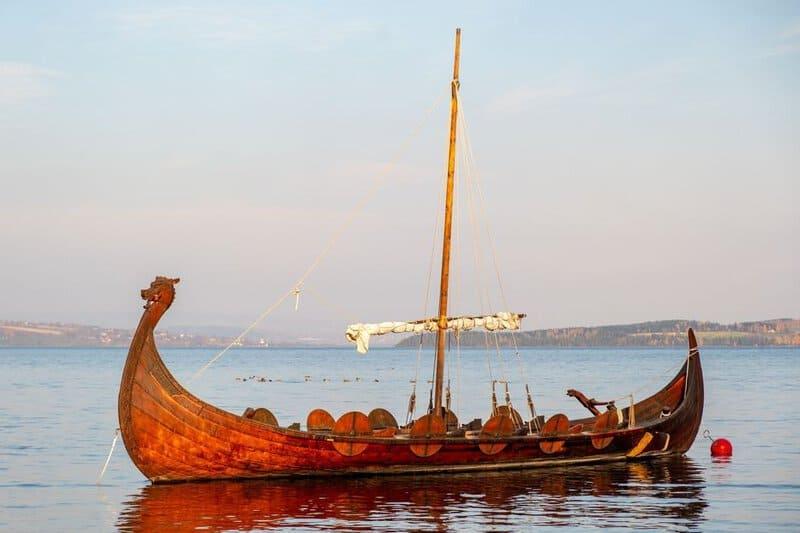
The longship was the central technology. Shallow in draft and flexible in construction — built using a clinker technique that gave the hull a degree of flex in rough seas — it could cross open ocean and penetrate deep into continental Europe via rivers, a combination no other contemporary vessel matched. Scandinavia’s geography of fjords and coastlines made seafaring a practical necessity from an early age, embedding maritime skill into Norse culture across generations. The same ships used for raiding were adapted for cargo, with broader hulls and deeper holds — evidence of a shipbuilding tradition that served commerce and exploration as readily as warfare.
At home, limited arable land, population pressure, and political fragmentation pushed many Norse men outward in search of wealth, land, or the kind of reputation that translated into social standing. Abroad, the collapse of Carolingian power in continental Europe during the 9th century left political vacuums that Norse raiders and settlers were uniquely positioned to exploit. The timing, in other words, was not random. The Viking Age began when internal Scandinavian conditions and external European vulnerability happened to align.
Norse Society Beyond the Raid

A complete picture of the Viking Age requires looking at what stayed home as much as what sailed away. Norse society was agricultural at its base. The majority of people who lived in Scandinavia during the Viking Age were farmers, craftspeople, and traders who never went raiding at all. Settlements were organized around family units and local chieftains. Women in Norse society held legal rights that were notably broader than those of women in many contemporary European cultures — including the right to own property, initiate divorce, and manage a household independently while their husbands were absent at sea.
Norse religion centered on a pantheon — Odin, Thor, Freya, and others — tied to cycles of nature, fate, and warrior honor. But the Viking Age also coincided with the gradual Christianization of Scandinavia, and many Norse people existed in a transitional space between old beliefs and new ones. The end of the Viking Age is often linked, at least in part, to this religious shift, which brought Norse kingdoms into closer alignment with the broader structures of Christian Europe and reduced the cultural legitimacy of raiding.
You can explore the seafaring culture that made the Viking Age possible in considerably more depth through dedicated historical and maritime resources that go well beyond the warrior image.
Why Getting Viking History Right Still Matters
The real Viking story — violent and creative, local and genuinely global, built on seafaring genius and ruthless opportunism in roughly equal measure — is considerably more interesting than the cartoon warrior version. Viking history encompasses migration, trade, legal innovation, artistic achievement, and one of the most remarkable periods of geographic expansion in the pre-modern world.
There is also a more urgent reason to insist on accuracy. In recent decades, Viking imagery and Norse symbolism have been appropriated by extremist movements seeking to claim a fictional “pure warrior heritage.” That appropriation depends entirely on the myth of Vikings as a racially unified people defined exclusively by violence. The historical reality — that “Viking” was a job description, not a racial category, and that Norse culture was defined as much by commerce, legal assembly, and cross-cultural exchange as by raiding — dismantles those claims at their foundation. Historians, archaeologists, and museum educators have increasingly made this point explicit precisely because the distortion carries consequences beyond academic accuracy.
The actual Norse history on offer is a story about people who moved across an interconnected world, adapted to what they found, shaped the cultures they encountered, and were shaped in return. They left their mark on the English language, on the place names of Britain and France, on the legal traditions of Iceland, and on trade routes stretching from the North Atlantic to the Black Sea. That is a history worth knowing accurately — both because it is genuinely fascinating and because the myths standing in its place have done real damage.

 Arabic
 French
 Spanish
 Portuguese
 Deutsch
 Turkish
 Dutch
Dutch
 Italiano
 Russian
 Romaian
 Portuguese (Brazil)
 Greek
Greek