


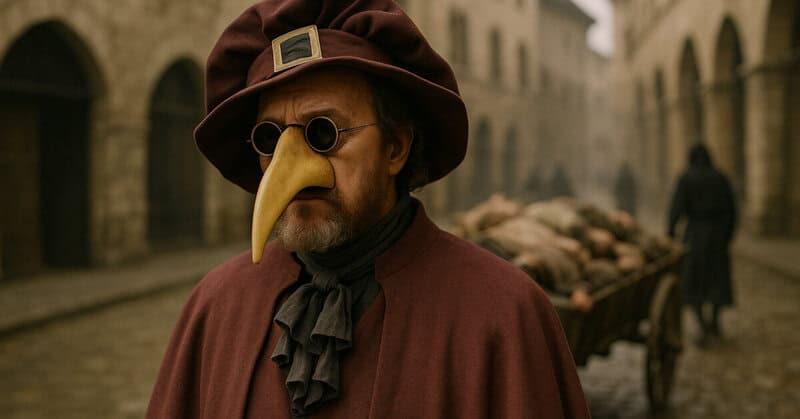
In the Florence of the 1340s, a merchant might stand at his window and watch the plague carts trundle past — bodies stacked like cordwood, the bells never quite stopping — and wonder if God had simply abandoned the project of humanity. A generation later, his grandson would commission a marble figure so charged with muscular life, so insistently present in the world, that anyone who saw it understood something irreversible had happened to the human imagination. The distance between those two moments — grief and defiant beauty, catastrophe and creation — is where the Renaissance was born.
The Moment the Middle Ages Cracked Open

The word itself comes from the French for “rebirth,” and for once a label earns its keep. What cracked open in fourteenth- and fifteenth-century Italy was not merely a new style of painting or a fashion for ancient ruins. It was a civilizational exhale — a slow, collective decision by merchants, scholars, and artists to ask a question that medieval Europe had largely set aside: what, exactly, can a single human being achieve?
For centuries, the dominant answer had been framed by Church doctrine. The individual soul mattered, but chiefly as a vessel in transit toward divine judgment. History was God’s story; human beings were supporting characters. Then the Black Death arrived, killed roughly one-third of Europe’s population between 1347 and 1351, and left the survivors with an unsettling thought: if divine order was meant to protect the faithful, the math was not working out. Grief cracked the old certainties open, and through the crack, something new began to grow.
What grew, in the city-states of northern Italy above all, was an obsession with ancient Greece and Rome — with the idea that a pre-Christian civilization had somehow managed to produce philosophy, architecture, rhetoric, and political thought of staggering sophistication. If they could do it then, the argument ran, we can do it now. That argument quietly rewired art, science, politics, and the very idea of the self. The process took about two centuries and changed the world more thoroughly than almost any event before or since.
What Caused the Renaissance — and Why Florence?

Three forces converged in late medieval Italy with unusual intensity. The first was the psychological shock of mass death. When a third of your neighbors are gone, inherited authority — ecclesiastical, political, intellectual — loses some of its grip. People began reaching for explanations and frameworks that the Church alone could not supply.
The second force was money, specifically the extraordinary wealth of Italian merchant-banking families. Florence was run not by hereditary lords but by guild merchants — a republic, of a sort, where commercial success and civic prestige were tightly braided together. The Medici family, whose banking network stretched across Europe, understood that funding scholars, architects, and painters was not mere generosity; it was politics, reputation, and genuine intellectual passion rolled into one. Lorenzo de’ Medici, who presided over Florence’s golden age in the late fifteenth century, funded humanist scholars the way a modern research institution funds its best minds — with money, access, and the expectation of world-altering results.
The third force arrived in 1453, when Ottoman armies took Constantinople and ended the Byzantine Empire. Greek scholars fled westward, bringing with them manuscripts of Plato, Aristotle, and other classical writers that Western Europe had not read in centuries. The effect was electric. Libraries filled. Debates ignited. A culture that had been working largely from Latin translations suddenly had access to the Greek originals, and the originals said things that did not quite match what the medieval Church had taught.
All of this produced humanism — not atheism, not anti-religion, but a philosophical shift that placed human reason, dignity, and potential at the center of inquiry. Humanists believed God had made humanity uniquely capable of understanding creation, and that studying the natural world and classical learning was an act of devotion, not defiance. It was a subtle reframing, but its consequences were anything but subtle.
The Art That Changed How We See

Early in the fifteenth century, a Florentine architect named Filippo Brunelleschi worked out the mathematics of linear perspective — the systematic method for representing three-dimensional space on a flat surface. This was more than an artistic technique. It was a declaration that the trained human eye could measure and master space, that the world had a rational geometry available to those patient enough to find it.
What followed over the next hundred years was one of the most concentrated explosions of visual achievement in history. Botticelli gave mythological figures a dreamy, golden sensuality. Leonardo da Vinci painted faces whose inner life you could almost hear thinking. Raphael composed scenes of such balanced harmony they looked inevitable. And Michelangelo — commissioned by a series of demanding popes, working under impossible deadlines, lying on his back for years on the Sistine Chapel scaffolding — painted the ceiling that still stops visitors cold five centuries later.
Michelangelo’s David, completed in 1504, is perhaps the era’s purest symbol: a human body rendered with such anatomical precision and psychological intensity that it seems about to step off its plinth. But it is worth remembering that behind the transcendence was grinding physical labor, genuine artistic risk, and the ever-present possibility of a patron’s displeasure. Renaissance genius was not a mystical gift. It was a cultural invention — and a demanding one.
That invention was codified by Giorgio Vasari, whose Lives of the Artists, published in 1550, essentially created the modern idea of the artist as a named, celebrated individual rather than an anonymous craftsman serving the Church. The concept of “genius” as a personal quality, residing in a particular human being, was itself a Renaissance creation. Every artist who has ever signed a canvas is working inside that idea.
Science Reborn: Observation Over Authority

Leonardo da Vinci’s notebooks are the Renaissance method made visible. Page after page of anatomical drawings made from actual dissected bodies, engineering sketches for machines that would not be built for centuries, studies of water in motion, bird wings, the geometry of shadows. The animating principle is simple and revolutionary: look at the actual thing, not at what the textbook says the thing should look like.
In 1543 — a pivotal year — two publications appeared that embodied this shift. Andreas Vesalius published his revolutionary anatomy atlas, correcting errors the ancient physician Galen had made fourteen centuries earlier simply by dissecting real human cadavers and trusting his eyes. In the same year, Nicolaus Copernicus proposed that the Earth orbits the Sun. Both men were doing the same thing: choosing careful observation over inherited doctrine.
The Renaissance did not produce instant scientific revolution. That would come a century later with Galileo, Newton, and the formal Scientific Revolution. But it planted the essential seed: evidence, recorded precisely and shared widely, could overturn any authority. And the technology for sharing widely had just arrived. Johannes Gutenberg’s printing press, developed around 1440, meant that ideas which had existed in single manuscript copies could now circulate in thousands of printed volumes within years. The combination of humanist curiosity and mechanical reproduction was, in effect, the first mass media.
Politics, Power, and the Birth of the Modern State

In 1513, a Florentine civil servant named Niccolò Machiavelli — recently tortured and exiled after a change of government — sat down to write a short book about political power. The Prince is the Renaissance’s coldest mirror. It describes how rulers actually maintain power, stripped of medieval piety and divine justification. Virtue, in Machiavelli’s world, is instrumental. The state is a human construction, maintained by skill, force, and strategic generosity, not by God’s blessing.
This was shocking not because it described something new, but because it said plainly what everyone knew and no one was supposed to say. The Italian city-states — Florence, Venice, Milan, Rome — had long functioned as laboratories for balance-of-power diplomacy, competitive statecraft, and the secular management of collective life. Machiavelli simply wrote the laboratory notes.
Meanwhile, the printing press was spreading Renaissance ideas northward with explosive speed. Erasmus of Rotterdam and Thomas More in England absorbed Italian humanism and bent it toward religious critique. The questions humanists had been asking about authority, evidence, and the individual’s relationship to inherited doctrine were almost tailor-made to fuel religious reform. Martin Luther published his Ninety-Five Theses in 1517, and the Protestant Reformation — inconceivable without the intellectual groundwork laid in Florence a century earlier — restructured the religious map of Europe permanently.
How the Renaissance Spread — and What It Cost

The High Renaissance in Italy ended with a convulsion. In 1527, Habsburg troops sacked Rome with appalling violence, scattering artists and scholars north and west across Europe. The catastrophe paradoxically accelerated what it seemed to destroy: refugees carried Italian ideas into France, England, Spain, and the Low Countries, where they took root in new soil and flowered in new forms.
England’s Elizabethan era — Shakespeare, Marlowe, the Globe Theatre, the sonnet sequences — is the Renaissance’s northern bloom, as rich and strange as anything Florence produced. Spain and Portugal, enriched by New World trade and conquest, became Renaissance patrons of their own kind. The movement had become, unmistakably, European.
But there is a cost to acknowledge honestly. The same humanist confidence that produced Michelangelo also underwrote European colonialism. The conviction that rational, “civilized” man had the right — even the duty — to reshape the wider world in his image was not a distortion of Renaissance thinking. It was an application of it. And the Renaissance’s celebrated “universal man” was almost always literally a man, almost always wealthy, his achievements built on the labor of servants, peasants, and enslaved people whose names Vasari did not bother to record. Renaissance ideals of individual dignity were extended, in practice, with stunning selectivity.
The Renaissance in Richmond: A Living Legacy
Five centuries after Lorenzo de’ Medici hosted philosophers in his Florentine gardens, the Renaissance continues to animate public life in ways that are more than merely decorative. In Richmond, Virginia, that legacy takes several tangible forms — from community gatherings that celebrate the period’s pageantry to event venues whose architecture and atmosphere deliberately invoke its grandeur.
The Richmond Renaissance Faire is among the most vivid local expressions of that ongoing fascination. A community-rooted event, it draws participants who engage seriously with the costuming, music, craftsmanship, and social rituals of the period — a form of living history that keeps the era’s textures accessible to anyone curious enough to show up. Faire culture is sometimes dismissed as mere costume play, but at its best it performs a genuine educational function: it makes a remote historical moment feel inhabited rather than archived.
On the more formal end of the spectrum, The Renaissance Richmond is a venue whose name signals an aspiration to the period’s ideals of beauty, ceremony, and occasion. Located in Richmond’s Arts District, it is reviewed on Yelp and featured on WeddingWire as a sought-after setting for weddings and private celebrations, it represents something the original Renaissance would have recognized: the use of carefully designed space to mark moments that matter. The Medici understood that architecture and setting were not incidental to human experience — they shaped it. A well-chosen venue is, in that sense, a small act of Renaissance thinking.
That these traditions — scholarly, theatrical, ceremonial — persist and flourish in a mid-Atlantic American city is itself a testament to how thoroughly Renaissance ideas became embedded in Western culture’s most basic assumptions about what beauty, learning, and public life are for.
Why the Renaissance Still Lives in Us
Every time a scientist publishes data that overturns a long-held consensus, they are practicing a habit of mind the Renaissance installed. Every time an artist signs their name to a public work and expects that signature to matter, they are working inside a concept of individual creative genius that did not meaningfully exist before Vasari. Every time a politician justifies authority in secular rather than divine terms — by appeal to the common good, to reason, to the will of the governed — they are speaking a political language that Machiavelli and the Florentine city-states helped invent.
The Renaissance’s core wager — that the individual human mind, carefully and honestly applied, can understand and improve the world — became the operating assumption of the Enlightenment, the Scientific Revolution, liberal democracy, and modern capitalism. We live so thoroughly inside that assumption that we rarely notice it as an assumption at all. It feels like common sense. It is, in fact, a historical achievement: contingent, hard-won, and unevenly distributed from the very beginning.
Return, at the end, to that Florentine grandson standing before his newly commissioned sculpture, watching the marble face hold an expression no medieval craftsman would have attempted — not beatific, not symbolic, but present, particular, alive with something that looks like thought. He may not have had the vocabulary to say what he was witnessing. But he understood, perhaps instinctively, that beauty had become an argument: an argument that the human being, in all its fragile specificity, was worth looking at this carefully.
The Renaissance gave the world Leonardo’s notebooks and Machiavelli’s cold realism and the Sistine Chapel ceiling. It also gave the world the intellectual confidence that justified empire. That tension — between the liberation of human potential and the terrible uses to which that liberation can be put — is precisely what makes the Renaissance not a dusty chapter to memorize, but a live question. What is human potential actually for? Five hundred years later, the answer is still being written.

 English
 Arabic
 French
 Spanish
 Portuguese
 Deutsch
 Turkish
 Dutch
Dutch
 Russian
 Romaian
 Portuguese (Brazil)
 Greek
Greek