


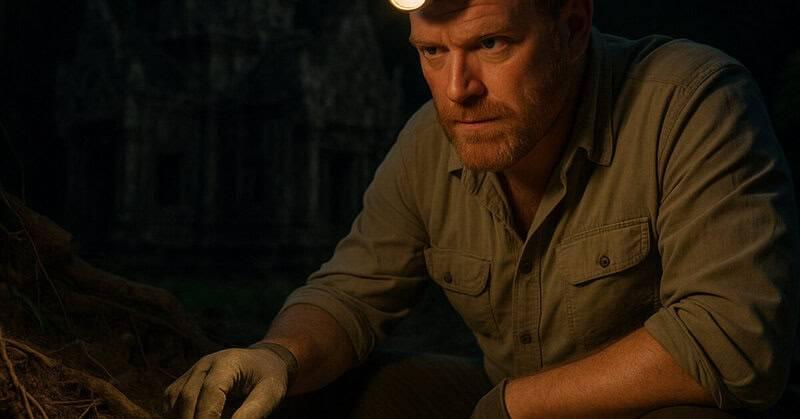
The headlamp catches it first — a curve of stone that doesn’t belong to the hillside, a geometry too deliberate for nature, half-swallowed by roots and centuries of silence. The man crouching over it exhales slowly, brushes dirt with a gloved hand, and the camera tightens on his face before it tightens on the object. In that suspended second, you are not watching television. You are watching the past refuse to stay buried.
Where Adventure Meets Genuine Archaeological Stakes

Expedition Unknown is the Discovery Channel series that has spent more than a decade placing a camera crew at the intersection of adventure journalism and real historical inquiry. Classified variously as documentary, reality, adventure, and travel programming, that hybrid identity is precisely what gives it staying power. Pure adventure shows thrill and fade. Pure documentaries inform and distance. Expedition Unknown, at its best, does something rarer: it makes the slow, uncertain, frequently humbling work of historical investigation feel as urgent as any thriller.
The news peg for revisiting all of this is concrete. Season 16 of Expedition Unknown premiered on November 5, 2025, alongside new episodes of Expedition Files, both debuting at 9PM ET/PT on Discovery Channel. That double premiere signals not just a scheduling decision but a cultural one — audience appetite for real expedition discoveries remains strong enough to anchor an entire programming night. An earlier 2025 season had already premiered on June 24 at 9PM on Discovery, suggesting a production cycle accelerating to match that appetite. As audiences settle in for a new run of investigations, the question worth asking is this: what is the real history underneath the drama?
Josh Gates: Field Credentials Behind the Familiar Face

It helps to understand who is holding that headlamp. Josh Gates arrived at television not from entertainment but from exploration. He studied archaeology and classical studies, worked in the field before cameras followed him there, and has logged expeditions across some of the world’s most demanding environments — the Himalayas, the Amazonian interior, sub-Saharan Africa, the Arctic. That background matters because it shapes the questions he asks on screen. Gates is not a host performing curiosity; he is someone who already understands how painstaking genuine fieldwork is and knows what a credible find looks like versus a compelling shot.
The show’s format across sixteen seasons has remained consistent in structure while ranging widely in subject. Each investigation anchors itself to an unsolved historical event, a lost city, a buried treasure, or a civilization whose story Western scholarship has inadequately told. Gates travels to the source — geographically, archivally, ethnographically — and embeds with credentialed local archaeologists, historians, and community knowledge-keepers. Those expert collaborators are not window dressing. Their interpretations, corrections, and cautions shape what viewers see and, crucially, what claims the show is willing to make.
That consistent use of expert voices separates Expedition Unknown from the looser category of treasure-hunting entertainment and places it, imperfectly but meaningfully, within the documentary tradition. Critics of televised archaeology are right that cameras demand drama that excavation rarely delivers on schedule. But the show’s track record of presenting verifiable finds, engaging institutional archaeologists, and following local legal protocols for artifact handling has earned it a degree of scholarly acknowledgment that most genre rivals never approach.
When Legends Turn Out to Be Maps

Among the most historically significant patterns across the show’s run is its repeated engagement with sites and stories that academic consensus had prematurely dismissed. The arc follows a recognizable shape: a settlement, a city, or a route survives for centuries in oral tradition, in local memory, in Indigenous place-names that encode geography more precisely than any colonial-era map. Western scholarship arrives, finds no immediate physical corroboration, and files the story under legend. Then someone digs.
This is not a small historiographical point. Decades of archaeology have repeatedly demonstrated that oral traditions preserve genuine historical information across timescales that earlier scholars found implausible. Communities living on or near significant sites often maintained accurate memory of those sites through story, ceremony, and landscape knowledge. When Expedition Unknown engages Indigenous or local experts as co-investigators rather than as colorful background, the results tend to be both more historically honest and more archaeologically productive.
What it means on the ground when a structure emerges from jungle or silt is not simply that something was found. It means a regional chronology must be redrawn. Settlement patterns shift. Trade routes appear where none were mapped. The presence of a building implies the presence of builders, of sustained communities, of agricultural surplus and organized labor. A single wall can move a civilization’s known boundary by hundreds of miles and hundreds of years. The best episodes of the series have circled exactly this kind of discovery — moments where a single physical fact collapses the distance between myth and history.
What the Show Gets Right About Real Archaeological Finds

Television archaeology faces a structural problem that honest viewers should understand. The medium requires a climactic moment of revelation — the object in the soil, the gasp, the close-up. Real excavation is iterative and slow, and typically concludes not with a dramatic find but with a careful, multi-year process of analysis, dating, and interpretation. What viewers see is often the most photogenic fraction of a much longer investigation.
Expedition Unknown’s production has generally handled this tension more responsibly than its critics allow. Artifacts discovered during filming are logged and reported to relevant authorities. Items of cultural or historical significance are typically transferred to local institutions or remain under the jurisdiction of host-country governments. The show does not operate as a treasure extraction enterprise; it operates as a documented investigation in which finds remain where law and ethics require them to remain.
This distinction matters for understanding the show’s history accurately. The most significant finds are rarely gold or jewels. They are ceramic sherds whose clay composition reveals trade networks. They are architectural alignments that demonstrate astronomical knowledge. They are documentary fragments, corroded coins, collapsed granaries — objects whose monetary value is negligible and whose historical value is immense. When Gates and his team crouch over something in the soil, the question they are actually asking is not “what is this worth?” but “what does this change?”
The Episodes That Moved the Historical Needle

Across the show’s extensive run, certain investigations stand apart not because they were the most dramatic but because they were the most consequential. The strongest episodes tend to pivot on a single unexpected detail that reframes everything around it — a misread map that turns out to be accurate, a wall whose construction technique places it two centuries earlier than surrounding structures, a ceramic style that connects a site to a civilization no one expected to find there.
What these moments share is not spectacle but productive surprise — evidence contradicting assumption. In several cases, investigations from the show have prompted follow-up work by academic institutions, with researchers returning to sites Gates’s team identified to conduct more extensive excavation under formal conditions. That kind of downstream scholarly engagement is the closest thing televised archaeology has to peer review, and it is a meaningful indicator of the show’s real contribution to the field.
When findings have cleared the bar of independent verification, they have occasionally entered broader circulation — referenced in heritage conservation debates and flagged as sites warranting further formal attention. That trajectory, from broadcast to citation, is rare in the reality genre and worth noting.
Season 16 and the Stakes of Exploration in 2025

The cultural context around exploration television has shifted considerably since Expedition Unknown’s early seasons. Audiences in 2025 bring sharper questions to the genre: Who owns what is found? Who benefits from the discovery? Whose history is being told, and by whom? The global conversation around heritage repatriation, the rights of descendant communities, and the ethics of outside researchers working in other nations’ territories has changed what responsible exploration television looks like — and what it is expected to acknowledge.
Season 16’s November 2025 premiere arrives in this more demanding environment. Based on the show’s established patterns — its recurring interest in civilizational crossroads, contested historical narratives, and geographies where Indigenous knowledge intersects with archival gaps — the new season is positioned to continue engaging with exactly the kinds of questions that sit at the edge of what historians currently know. The accelerated 2025 release schedule, with a season premiering in June and another in November, suggests a production that is both prolific and confident that its audience remains substantial and engaged.
What specific threads Season 16 pulls remains, at the time of writing, appropriately open. That uncertainty is itself the point. If the show’s history teaches anything, it is that the sites most worth investigating are precisely those where the existing record has gaps that physical evidence might close.
Why This Matters: Television as a Gateway to the Past
The larger argument for shows like Expedition Unknown is not that they replace scholarship. They don’t, and the best episodes don’t pretend to. The argument is that they perform a public service that scholarship, by its nature, cannot easily replicate: they make the tactile, uncertain, sometimes heartbreaking work of historical inquiry feel alive to audiences who will never read a peer-reviewed excavation report.
History taught as a sequence of settled facts is a history that forecloses curiosity. History experienced as an open investigation — with contested interpretations, surprising evidence, and the ever-present possibility that the next shovel-strike will change everything — is a history that invites participation. Expedition Unknown, across its sixteen seasons, has consistently argued for the second model.
The criticism that entertainment framing sensationalizes or oversimplifies is not without merit. Every episode contains compromises between what evidence supports and what the medium requires. But the show’s persistent inclusion of credentialed experts, its general fidelity to on-the-ground reality, and its track record of treating finds with institutional seriousness mitigate the worst distortions of the genre. It is imperfect public history — which is to say, the kind of public history that actually reaches people.
Return, then, to that hillside. The headlamp. The curve of stone in the dark. The held breath before the hand brushes the dirt away. You understand it differently now than you did at the top of this article — not as a television moment engineered for maximum suspense, but as a genuine epistemological threshold. On one side, what we thought we knew. On the other, what the ground is about to tell us. Season after season, that threshold is where Expedition Unknown lives, and it is why the questions the show asks keep mattering long after the credits roll.

 English
 Arabic
 French
 Spanish
 Portuguese
 Deutsch
 Turkish
 Dutch
Dutch
 Italiano
 Romaian
 Portuguese (Brazil)
 Greek
Greek