


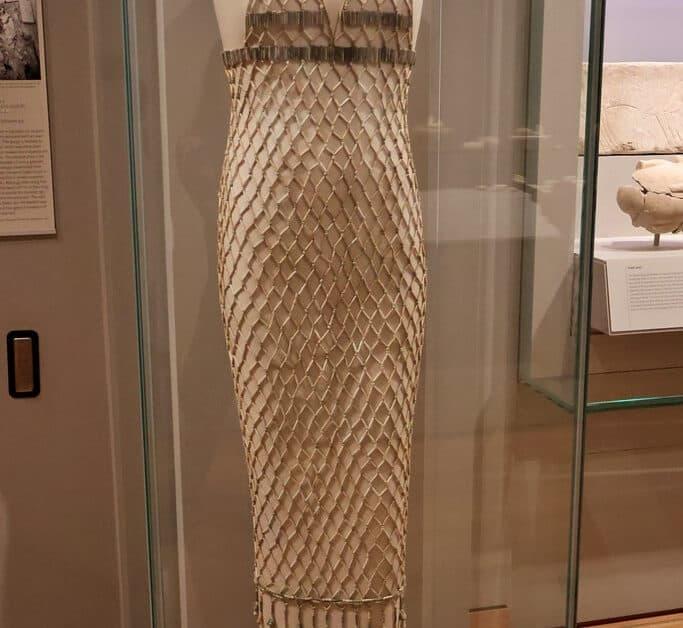
Somewhere near Cairo, around 3000 BCE, a group of mourners lowered a linen dress into a burial pit. They were not thinking about history. They were grieving, performing ritual, sending someone they loved into the afterlife with the things that mattered. They could not have known that the folded garment slipping beneath the earth would survive five thousand years — longer than the pyramids, longer than the pharaohs’ names — to become the oldest known piece of clothing on the planet.
The Oldest Dress in the World Still Has Fold Marks

The garment discovered at the Tarkhan cemetery site south of Cairo is known today as the Tarkhan Dress, and it is a quietly staggering object. Woven from linen, pleated at the shoulders and across the bodice, it was excavated in the early twentieth century and eventually identified — after years of reexamination — as the world’s oldest known woven garment. Radiocarbon dating placed its origins somewhere between 3482 and 3102 BCE, pushing it to the very edge of recorded Egyptian civilization.
What makes the Tarkhan Dress almost unbearably human is the forensic detail buried in its fabric: fold marks and wear patterns along the seams and armpits suggest it was not made for the tomb. Someone wore this dress. Someone washed it. Someone folded it, perhaps more than once, and at some point — at the death of its owner or as a gift for the dead — it was placed underground, where dry Egyptian sand did what desert does best and simply preserved it.
That single artifact is a doorway. Step through it and you enter a world of dress stretching back before 3100 BCE to the end of the Neolithic period — a civilization where garments, jewelry, footwear, and wigs formed a complete and deliberate visual language. Ancient Egyptian clothing was never merely vanity. It was identity, social rank, climate survival, and a message addressed simultaneously to one’s neighbors and to the gods.
Dressing for a Furnace: Why Less Was Always More

To understand ancient Egyptian fashion, you first have to feel the heat. Egypt is not warm — it is ferocious. The desert sun hammers down on exposed stone and skin with equal indifference. Sandy winds carry grit into every fold of cloth and every crease of an eye. Along the Nile’s narrow green corridor, humidity rises from the water and thickens the air. In this environment, the fundamental logic of dressing was ruthlessly simple: wear as little as possible. This was not a cultural quirk or an aesthetic statement. It was survival intelligence encoded over generations.
Children in ancient Egypt often went entirely unclothed until adolescence. Laborers worked in minimal wraps. Even among the wealthy, the ideal was not layers but refinement — the lightest, most exquisitely made version of the least amount of fabric. What emerged from this environmental pressure was one of the ancient world’s great textile traditions, built almost entirely on a single plant: flax.
Grown in abundance along the Nile’s fertile banks, flax was harvested, retted, combed, and spun into linen — a fabric so well suited to the climate that it dominated Egyptian dress for thousands of years with almost no competition. Linen breathes. It wicks moisture. It can be washed repeatedly without losing its structure. And when beaten and worked to its finest grade, it becomes nearly translucent, draping the body in folds of near-liquid white that the elite prized as a visible mark of refinement and wealth.
That class dimension was embedded in the fabric itself. A field laborer’s kilt was rough-spun, practical, and coarse to the touch. A nobleman’s pleated linen robe was the same raw material transformed by skilled hands into something closer to sculpture — luminous, precisely folded, and emphatically expensive. Same plant, same river. Worlds apart in what the garment communicated the moment its wearer stepped into public view.
The Schenti: A Kilt That Defined Male Dress for Three Thousand Years

If any single garment defines the visual grammar of ancient Egypt across three thousand years of recorded history, it is the schenti — the wrapped linen kilt worn by men across virtually every social rank, from farmers to pharaohs. Tomb paintings from the Old Kingdom, New Kingdom, and every era in between return to it persistently, as though Egyptian artists understood that this simple garment was the irreducible foundation of male identity in their world.
The schenti was worn by wrapping a length of linen around the hips and tucking or belting it at the waist. At its most basic, it fell to mid-thigh, was unadorned, and did its job without ceremony. But the schenti was also infinitely scalable in its eloquence. Lengthen it and the wearer projects gravity and status. Pleat it in careful horizontal folds starched to rigid precision and the cloth holds a geometric authority that reads clearly even from a distance. Add a decorated triangular apron panel at the front, stiffen it with starch so it projects outward from the body, and the schenti stops being a garment and becomes a proclamation.
Royal versions embodied exactly this transformation. Statuary of pharaohs from across the dynasties shows the kilt rendered in stone with its pleats and panels frozen in perfect, almost aggressive formality — a garment so charged with symbolic weight that sculptors treated its folds with the same care they gave to a god’s face. Yet the genius of the schenti was its democratic core. The same fundamental garment wrapped a laborer in the Nile fields and wrapped Ramesses II at Karnak. Egyptian dress, at its foundation, was one continuous spectrum, not a series of entirely separate worlds.
The Kalasiris: How Egyptian Women Wore Power

For women, the foundational garment was the kalasiris — a fitted linen dress that could run from below the breast to the ankle, sometimes supported by wide decorative shoulder straps, sometimes structured closer to the body in a sheath-like silhouette that has become one of the most recognizable images in all of ancient art. To look at wall paintings and dismiss the kalasiris as merely decorative, as passive feminine beauty on display, is to miss almost everything important about it.
The kalasiris was a vehicle for communication as precise as any court official’s robe of office. Its quality, its color, its embellishments — borders of woven pattern, beaded fringe, pleated panels added over a plain underlayer — told any observer exactly where its wearer stood in the social and religious hierarchy. High-ranking women, queens, and priestesses assembled their dress with the same deliberate authority that male officials used to signal rank, because Egyptian culture at its elite levels afforded women significant power and expected their clothing to reflect it.
Both men and women also wore linen cloaks layered over their primary garments — essential during cooler desert nights and during the formal rituals of temple ceremony, where warmth and grandeur were equally necessary. For elite women, a pleated linen cloak draped over the kalasiris added visual drama and ceremonial weight, transforming the wearer from a person in fine clothes into a figure of unmistakable significance. This layering effect appears again and again in tomb paintings, where the social hierarchy of a gathering is legible almost entirely through what each figure is wearing and how many layers they carry.
Jewelry, Wigs, and Kohl: Completing the Ancient Egyptian Outfit

To an ancient Egyptian, an outfit was never merely cloth. It was an assembled system — garment, wig, cosmetics, jewelry, and footwear working together to complete a single coherent statement about who a person was, what role they occupied, and which forces of the universe they wished to invoke in their favor.
Wigs were worn by both sexes, constructed from human hair or plant fiber and shaped into styles that varied by era and status. They served the intensely practical purpose of protecting closely cropped or shaved heads from direct sun — combining lice management and heat control in one elegant solution — while simultaneously projecting wealth and ceremonial intention. A heavy, elaborately braided wig signaled that its wearer had the resources and the occasion to carry it. In ritual contexts, specific wig styles were as codified as liturgical vestments.
Jewelry operated on a similar dual register of beauty and function. The broad beaded collar known as the wesekh — fanning out across the chest and shoulders in rows of faience, gold, and semiprecious stone — was not simply ornamental. Each bead, each amulet, each carefully chosen color carried protective or devotional meaning. Gold cuffs, earrings, and pectorals engraved with divine imagery were, in a very real sense, wearable prayers. To dress in ancient Egypt was to arm yourself spiritually as much as to present yourself socially. The full relationship between jewelry, adornment, and fabric traditions is traced in detail across resources covering ancient Egyptian clothing history.
Sandals — woven from papyrus, cut from leather, or for royalty fashioned from gold — completed the ensemble at ground level. Barefoot was the norm for much of the population and carried no stigma; sandals were worn when occasion demanded, then sometimes carried rather than worn to preserve them. And then there were the eyes. Kohl, ground from minerals including galena and malachite and applied in dramatic lines, was both cosmetic and medical technology. The dark pigment reduced sun glare the way an athlete today might smear black grease beneath their eyes. It also possessed genuine antibacterial properties, offering measurable protection against the eye infections that plagued a population living close to the Nile. That it looked extraordinary was, for the Egyptians, entirely the point: practical and beautiful were never opposites.
Pharaohs and Gods: When Dress Became Theology

At the apex of Egyptian society, clothing ceased to be fashion in any ordinary sense and became something closer to theater — or theology. The pharaoh’s dress was a sacred costume, a transformation technology that converted a human being into a living interface with divine power.
Consider what the pharaoh wore during major ceremonies: the double crown combining the white crown of Upper Egypt and the red crown of Lower Egypt, encoding the entire geography of the kingdom on a single head. The crook and flail held crossed at the chest, borrowed from the iconography of Osiris himself. A bull’s tail attached to the back of the royal kilt, evoking animal strength and primordial authority. A false beard, sometimes gilded and curled, worn even by ruling queens such as Hatshepsut to claim the full visual vocabulary of kingship. Every element was a word in a language spoken not just to human audiences but to the gods watching from their temples and stars.
The concept of ritual clothing — garments worn only during specific ceremonies, charged with sacred significance, never casually donned — was embedded in Egyptian religious practice across the dynasties. Priests wore white linen specifically because its purity signaled fitness to approach the divine. Temple rituals involved the dressing and undressing of divine statues with the same care and sequence applied to the pharaoh’s own body, because the line between human and divine was precisely the line that dress helped maintain and occasionally dissolve.
The richest surviving evidence for royal dress comes from Tutankhamun’s tomb, discovered in 1922, which yielded hundreds of garments: kilts, decorated robes, gloves, headdresses, and sandals, some clearly worn in life and others made specifically for eternity. The sheer volume of clothing preserved in a single royal burial speaks to how seriously ancient Egyptians treated dress as a permanent, not merely temporal, statement of identity. A pharaoh needed to be correctly dressed for the afterlife as much as for any ceremony on earth. The full spectrum of these royal and ceremonial traditions is documented in overviews of ancient Egyptian costume and fashion history.
How Egyptian Fashion Changed Across the Dynasties
It would be a mistake to treat ancient Egyptian dress as a single unchanging tradition. Across three thousand years, fashions shifted in ways that are clearly visible in the surviving record — in tomb paintings, statuary, and the garments themselves.
During the Old Kingdom, dress tended toward severe simplicity: short white kilts for men, close-fitting white sheaths for women, minimal adornment at all but the highest social levels. The Middle Kingdom introduced more elaborate pleating and greater use of layered garments, reflecting both an expanding economy and evolving aesthetic sensibilities. The New Kingdom — the era of Tutankhamun, Ramesses II, and Nefertiti — brought the most visually complex dress of any period: heavily pleated robes for both sexes, richly decorated collars, elaborately braided wigs, and an explosion of color achieved through imported dyes and painted linen. Contact with Nubia, the Levant, and eventually the wider Mediterranean introduced foreign fabrics, decorative motifs, and silhouettes that Egyptian tailors absorbed and transformed on their own terms.
By the Late Period and into the Ptolemaic era, Greek influence began to blend with indigenous Egyptian tradition, producing hybrid garments that reflected a civilization in cosmopolitan conversation with the wider ancient world. Even across this entire arc of change, however, white linen remained the prestige material, the schenti and kalasiris remained the foundational garments, and the principle of dress as simultaneous social signal and spiritual statement never wavered.
The Legacy Woven in Linen
The Tarkhan Dress sits today in a museum archive, its linen pleats still visible after five millennia, its fold marks still recording the shape of a body that wore it, washed it, and finally gave it to the earth. It is older than the Great Pyramid at Giza. It is older than most of what we call recorded history. And yet it is immediately recognizable as a garment — something a person wore because they cared about how they appeared in the world.
That recognition is the point. Egyptian fashion, in all its remarkable range from a laborer’s rough kilt to a pharaoh’s gilded ceremonial robe, reveals a civilization that understood clothing as a complete human system. Fabric was climate technology. Jewelry was spiritual armor. Wigs were social signal and sun protection simultaneously. The act of getting dressed each morning was entangled with identity, with religion, with the precise negotiation of one’s place in a fiercely hierarchical society. Practicality and symbolism were not in tension — they were inseparable, woven together as tightly as the linen fibers themselves.
The influence has never fully faded. Twentieth-century Art Deco designers drew heavily on Egyptian motifs after the 1922 opening of Tutankhamun’s tomb sent waves of aesthetic inspiration crashing through European fashion. Contemporary runways return periodically to pleated linen, to bold gold collars, to the clean geometric drama that Egyptian dress perfected thousands of years ago. The silhouette of the kalasiris, the structural elegance of a broad beaded necklace fanning across bare shoulders — these images are so deeply embedded in the human visual imagination that they feel less like historical influences than like inherited memories.
Ancient Egyptian dress is not a museum curiosity. It is not a footnote in a history textbook or a costume for a school play. It is a fully alive human story — proof that the desire to present ourselves to the world deliberately, meaningfully, and beautifully is not modern, not superficial, and not trivial. It is as old as civilization itself, and it began, perhaps, with a linen dress folded carefully into a burial pit somewhere near Cairo, five thousand years ago.

 English
 Arabic
 French
 Spanish
 Portuguese
 Deutsch
 Turkish
 Dutch
Dutch
 Italiano
 Romaian
 Portuguese (Brazil)
 Greek
Greek