


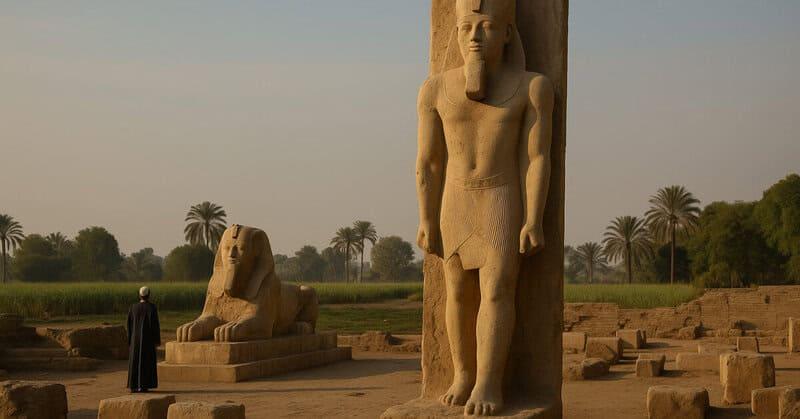
The traveler who makes the journey to Mit Rahina today, a low-lying stretch of floodplain southwest of Cairo, finds palm groves, waterlogged fields, and a colossal stone face staring up at the sky from a shallow pit — the fallen statue of Ramesses II, half-submerged in damp earth as though the ground itself is slowly swallowing the memory of what once stood here. This is all that visibly remains of Memphis, a city that ruled the ancient world for longer than Rome ruled its empire, and its near-total disappearance is one of history’s most haunting ironies.
How Memphis Was Founded — and Why the Mystery Matters

Every great city has a founding myth, but Memphis has something rarer — a founding mystery. Ancient sources credit the city’s creation to a pharaoh named Menes, described even by Egyptian tradition as a figure on the edge of legend, who around 3100 BCE achieved something that had never been done before: he united the kingdoms of Upper and Lower Egypt into a single state. Then, with the political instinct of a born strategist, he planted his capital at the precise geographic seam between them.
The location was an act of genius. Memphis sat at the junction of the Nile Delta and the river valley, a fulcrum point from which one city could command both halves of the country. The Egyptians understood this themselves — they called the city Ineb-Hedj, meaning “the White Walls,” and sometimes referred to it simply as “the Balance of the Two Lands.” Control Memphis and you controlled the conversation between north and south, desert and delta, trade route and river.
Scholars today handle the founding story carefully. Dates for the city’s founding range from roughly 3100 to approximately 2900 BCE depending on the source, and whether Menes was a single historical king or a composite of several early rulers remains genuinely debated. What is not in doubt is the scale of the achievement: whatever its precise birth date, Memphis was from its earliest days the administrative capital of arguably the first nation-state in human history — a political experiment so successful it would endure, in one form or another, for over three thousand years.
A Metropolis of White Walls and Crowded Docks

Picture Memphis at its height and resist the temptation to imagine ruins. The city that dominated the Early Dynastic Period and the Old Kingdom was alive with whitewashed mudbrick palaces, military arsenals, and granaries large enough to feed armies. Its docks were loud with commerce — cedar timber brought from Lebanon, gold carried up from Nubia, linen and grain shipped to every corner of the Egyptian world. Foreign merchants from Phoenicia and, later, from Greece and Persia kept their own quarters in the city, making Memphis ancient Egypt’s most cosmopolitan address by a considerable margin.
The city occupied the western floodplain of the Nile, a position that balanced agricultural fertility with strategic defensibility while keeping it connected to both desert caravan routes and the river’s arterial commerce. To the west, across a band of sand and rock, the royal necropolis rose against the sky — the stepped pyramid complex at Saqqara, and further north the three great pyramids of Giza. We tend to experience these monuments today as isolated wonders, but they were nothing of the sort. They were Memphis’s funerary skyline, the city of the dead gazing back across the desert at the city of the living, both halves of an integrated religious and urban landscape that made sense only together.
It is worth pausing on what the building material of Memphis tells us about its fate. While the pyramid complexes were built in stone — intended, as their builders hoped, for eternity — the city itself was built largely in mudbrick. Practical, cheap, and recyclable, mudbrick was the standard material of Egyptian domestic and even palatial architecture. Every annual Nile flood softened it a little more. Every generation of farmers who followed discovered that ancient brick, decomposed into a rich silty compost called sebakh, was extraordinarily good fertilizer. For centuries, the physical substance of Memphis was systematically dug up and spread across agricultural fields. The city did not simply crumble. It was eaten.
The Temple of Ptah: Heart of a God and a Kingdom

If Memphis had a spiritual center of gravity, it was the great Temple of Ptah. By the time of the New Kingdom, this complex was one of the largest and most sacred religious sites in Egypt — a theological counterweight to the temple precinct of Karnak at Thebes and the ancient solar sanctuary at Heliopolis. To stand in its shadow was to stand at the center of the Egyptian cosmos, or so its priests maintained, and in a culture where theology and statecraft were the same language, they were not entirely exaggerating.
Ptah was the creator-god of Memphis, and his theology was unusually abstract for an ancient religion. Where other gods shaped the world through physical labor — kneading it like clay, swimming through primordial waters — Ptah was said to have spoken creation into existence through thought and the power of language. He conceived of things in his heart and named them into being. Greek philosophers who encountered this tradition centuries later noted its resemblance to their own cosmological ideas, a convergence that speaks to how far Memphis’s intellectual reach extended.
The temple’s influence was not merely theological. Its priesthood controlled vast agricultural estates, royal workshops, and one of the most coveted administrative titles in the kingdom. The High Priest of Ptah was, in effect, a minister of state as much as a religious official. The institution generated wealth, shaped policy, and trained the scribal and artistic talent that the pharaoh’s court required. Memphis without the Temple of Ptah would have been a capital without a nervous system.
Almost none of it survives. The temple’s stones were quarried during the medieval period to help build the new Islamic city of Fustat and, later, Cairo itself. Visitors to the archaeological site at Mit Rahina find foundation traces, scattered architectural fragments, and a celebrated alabaster sphinx — and then, lying in a shallow protective shelter, the great fallen colossus of Ramesses II, which serves as a proxy witness for everything that is gone. He bears the weight of representing a vanished world he only partially inhabited.
Six Dynasties and the Long Arc of Power

Memphis held the seat of Egyptian political power through the entire Early Dynastic Period and the Old Kingdom — more than six consecutive dynasties during which the fundamental structures of Egyptian civilization were invented, refined, and transmitted across the known world. The hieroglyphic writing system matured here. The centralized bureaucratic state took its shape here. The theology of divine kingship, which would influence political thought from the Mediterranean to sub-Saharan Africa for millennia, was elaborated here.
The city reached a peak of prestige under the Sixth Dynasty. The royal court attracted administrative, artistic, and intellectual talent from across Egypt and beyond, and the artistic conventions refined during this era became the canonical grammar of Egyptian visual culture for centuries afterward. The pyramid complexes that still define the western horizon above the site are the most durable products of that energy — stone translations of a city’s ambition.
Even when political power shifted south to Thebes during later periods of fragmentation and reorganization, Memphis retained an authority that no purely political calculation could fully explain. It was the first capital, the city where Egypt had been made, and that symbolic weight never entirely drained away. Pharaohs who ruled from Thebes still sought coronation legitimacy in the north. The priests of Ptah still wielded influence that stretched far beyond the city’s boundaries. Memphis was, in this sense, something like what Rome remained for centuries after it ceased to be the effective capital of empire — a place whose authority was partly spiritual, partly historical, and entirely irreplaceable.
Conquest, Alexandria, and the Long Goodbye

The decline of Memphis came not as a sudden catastrophe but as a slow, undramatic eclipse unfolding across centuries. The Persian conquest of 525 BCE was a shock — the city became an administrative hub for a foreign empire — but Memphis survived and continued to function as a major center. When Alexander the Great arrived in 332 BCE and was crowned pharaoh on Egyptian soil, he chose Memphis for the ceremony, acknowledging the city’s irreplaceable symbolic authority even as he was already planning something that would ultimately undo it.
Alexandria, the coastal city Alexander founded on the Mediterranean shore, was purpose-built for a different world — a deep-water port designed for Greek and Roman commerce, Mediterranean diplomacy, and a globalized economy that the old Nile-facing city of Memphis was structurally unable to compete with. Over the following three centuries, Alexandria drained Memphis of population, commerce, and imperial attention with a relentlessness that no political intervention could reverse. The center of gravity of the ancient world had moved to the sea, and Memphis was an inland city.
The city lingered through the Roman period, its great temples slowly falling silent as Christianity spread across Egypt and the old gods retreated. By the seventh century CE, Memphis had been largely abandoned — its residents absorbed into the surrounding landscape, its institutions dissolved, its stones already being repurposed by those who had decided the future lay elsewhere. When the Arab conquest established Fustat just to the north, the quarrying of Memphis’s remaining monuments became systematic. The city did not merely die. It was dismantled, brick by brick and block by block, to build its successor civilization.
What the Sebakh Farmers Took and What the Stone Preserved

The mechanism of Memphis’s disappearance deserves more attention than it typically receives, because it illuminates something important about how ancient cities vanish. The sebakh diggers — farmers who excavated decomposed mudbrick for use as fertilizer — were not vandals. They were agricultural workers responding rationally to the exceptional richness of ancient organic material. The practice was widespread across Egypt and is attested from antiquity through the nineteenth century. At Memphis, where the city’s mudbrick core was extraordinarily dense, the effect was devastating to the archaeological record.
What the sebakh diggers could not touch was what had already been converted to stone. Statues, column bases, granite thresholds, and the alabaster sphinx survived precisely because they had no agricultural value and because stone resists decomposition in ways that mudbrick does not. This selective survival has profoundly distorted how we understand Memphis. What we see at the site today is a sample biased toward the monumental and the durable — the exceptional rather than the everyday. The warehouses, the scribal schools, the domestic quarters of merchants and craftsmen, the neighborhoods where Memphis actually lived — all of that is gone.
This is why ongoing excavation work at the site, including digital reconstruction efforts that draw on excavation data and remote sensing to visualize the lost city, matters so much. Every season recovers fragments that complicate the picture. Waterlogged deposits have occasionally preserved organic materials that dryer conditions would have destroyed, offering rare windows into the city’s non-monumental life. The work is, by its nature, always incomplete and always surprising.
Memphis Today: A UNESCO Site Hiding in Plain Sight
The open-air museum at Mit Rahina is, by the standards of major archaeological sites, a modest place. The recumbent Ramesses colossus lies under a protective shelter built to slow the damage that groundwater and humidity have already done. The alabaster sphinx stands in an open courtyard, serene and largely intact. Foundation outlines and scattered column fragments require imaginative effort to read as the bones of a great temple complex. The site forms part of the Memphis and its Necropolis UNESCO World Heritage designation, which encompasses the pyramid fields stretching from Giza to Dahshur — a listing that quietly acknowledges that the city itself has left so little behind that its funerary monuments must stand in for it.
And in a real sense, they do. The pyramids of Giza and Saqqara are the afterlife of Memphis — the physical residue of the city’s ambition, theology, and royal power that the annual flood could dissolve when poured in mudbrick but could not reach when poured into limestone. They are what Memphis built when it decided to build for eternity, and they are the primary reason the city’s name is still spoken at all.
For visitors, the gap between what Memphis was and what it now shows can feel disorienting. The Mit Rahina site rewards those who arrive with context, who can look at foundation traces and column drums and mentally reconstruct the scale of what stood here. Without that context, the site risks seeming anticlimactic — a few scattered stones and one famous colossus — when it is actually one of the most consequential addresses in human history.
Why Memphis Still Matters
Memphis’s disappearance carries a lesson that cuts against the comfortable assumption that great civilizations always leave great monuments. The city that made Egypt — that gave the ancient world its first recognizable nation-state, elaborated the theology of divine kingship, and served as the cultural crucible for one of history’s most durable civilizations — built its daily life in perishable materials. That daily life is now almost entirely gone.
What survives is the exceptional, the monumental, the deliberately eternal. What is lost is everything human: the markets and the schools, the workshops where scribes learned to write and craftsmen learned to carve, the streets where Memphis’s residents negotiated, quarreled, cooked, and prayed. Memphis is a reminder that the most powerful cities do not always leave the most legible traces, and that the ground beneath our feet holds far more history than the monuments above it will ever be able to tell us.
The fallen colossus in his damp pit at Mit Rahina looks up at a sky that once looked down on all of this. He does not explain it. He simply marks the spot.

 English
 Arabic
 French
 Spanish
 Portuguese
 Deutsch
 Turkish
 Dutch
Dutch
 Italiano
 Russian
 Romaian
 Portuguese (Brazil)