


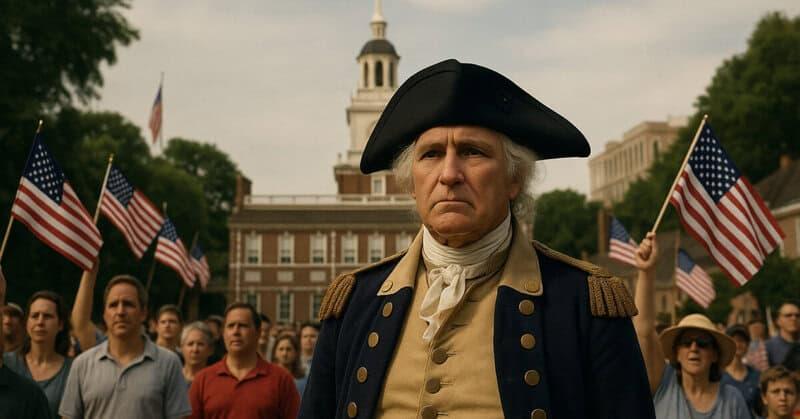
On a summer morning in Philadelphia, a single sheet of parchment changed the world — or at least announced that it intended to. Two hundred and fifty years later, on July 4, 2026, a nation of 340 million people will gather under fireworks and flags to celebrate that announcement, and to argue, as Americans always do, about whether they have kept the promise it made.
A Birthday Party With a Complicated Guest List

The Declaration of Independence began with a single sheet of parchment and 56 signatures. What followed was anything but simple. Every fifty years since, Americans have staged a jubilee — a formal, national attempt to look at those signatures and decide what they still mean. The pattern holds across the centuries: each celebration has doubled as a stress test, a moment when the country’s founding ideals collide with its present anxieties in public, under bunting, to music.
The machinery of the United States Semiquincentennial is already running. America250 events formally launched on July 3, 2025. The Army held its 250th Anniversary Parade on June 14, 2025. The White House has branded its vision “Freedom 250,” signaling executive-level investment in how the story gets told. The question that haunts all of it is the same one that haunted 1876, went unanswered in 1926, and was answered imperfectly but powerfully in 1976: what does it mean to throw the world’s biggest birthday party when the guest of honor is still arguing about its own identity?
1876: The Centennial’s Gilded Contradiction

Imagine standing in Machinery Hall on a sweltering Philadelphia afternoon in the summer of 1876. The Corliss steam engine — forty feet tall, the largest in the world — roared at the center of the building, driving hundreds of smaller machines through a web of belts and shafts. Ten million visitors came to the Philadelphia Centennial Exposition that year, making it the most attended event in American history to that point. Alexander Graham Bell demonstrated his telephone. George Washington’s artifacts drew reverent crowds. The Founding Fathers, rendered in marble and oil, gazed down from every wall like secular saints.
Eleven years earlier, the country had nearly destroyed itself. The Centennial was, among other things, a performance of recovery — proof that the republic had survived and was now, emphatically, an industrial power. But the shadow behind the spectacle was long and dark. Frederick Douglass, the most prominent Black American voice of the era, was pointedly excluded from the official program. Reconstruction was crumbling under the weight of white supremacist violence and federal indifference. The Supreme Court was already finding ways to hollow out the Fourteenth Amendment, the Civil War’s greatest constitutional legacy. The centennial celebrated freedom while that freedom was being dismantled in real time, in the same states, in the same summer.
What 1876 accomplished — and this is its lasting legacy — was to cast the Founding as a finished achievement rather than an ongoing project. The Declaration became a sacred text, Philadelphia became hallowed ground, and the Founders became something closer to gods than men. It was myth-making on a grand scale, and it worked precisely because the country needed the myth more than it needed the truth.
Pennsylvania’s America250 commemoration carries the slogan “Start Here, America Did” — a conscious echo of 1876’s Philadelphia-as-origin-story. It is a powerful claim, and an invitation to ask the same question Philadelphia’s centennial organizers never adequately answered: whose starting point? Which story of beginning gets placed at the center, and which gets moved to the margin?
1926: The Sesquicentennial Nobody Remembers

History has largely forgotten the 150th anniversary of American independence, and there is a reason for that. The 1926 Sesquicentennial Exposition, held again in Philadelphia, was by most accounts a failure. Attendance fell far short of projections. The centerpiece Liberty Bell Tower was widely mocked by critics and visitors alike. It rained heavily for much of the summer. President Calvin Coolidge, a man not given to theatrical enthusiasm, could not disguise his indifference at the opening ceremonies.
The Sesquicentennial misfired because the country could not find its footing. The Roaring Twenties were in full swing, but beneath the jazz and the prosperity ran a current of nativist anxiety. The Immigration Act of 1924 had just sharply restricted arrivals from Southern and Eastern Europe and barred most Asian immigrants entirely. Celebrating a “nation of immigrants” while those immigrants were being turned away at the border was an exercise in cognitive dissonance that the public seemed to sense, even if they could not name it precisely. When a country cannot reconcile its present behavior with its founding mythology, the party tends to fall flat.
There is a psychological lesson buried in 1926’s failure: jubilees need a narrative engine, and narrative engines require conflict or stakes. The 1876 centennial had the Civil War as its dark backdrop, which gave the celebration something to push against — a near-death experience that made survival worth marking. The 1926 sesquicentennial had no such animating drama, no obvious wound to dress in patriotic gauze. The result was a milestone that felt like a calendar obligation rather than a genuine national reckoning. Planners in 2026 would do well to study it carefully.
1976: Bicentennial Blues and the Party That Almost Wasn’t

By the early 1970s, the people tasked with planning the American Bicentennial were genuinely worried. The Vietnam War had divided the country in ways that felt irreparable. Watergate had done something perhaps worse — it had made cynicism feel like the only rational response to civic life. Early polling suggested that Americans were too demoralized, too angry, and too exhausted to celebrate anything at all.
And then July 4, 1976 arrived, and something unexpected happened. The Tall Ships sailed into New York Harbor in a flotilla that drew millions to the waterfront. Fireworks erupted over the National Mall. An estimated six million people gathered in Philadelphia. Grief and pride fused into something that television cameras struggled to contain — a catharsis that surprised even the people feeling it.
But the Bicentennial was never one thing. “Bicentennial Minutes” aired on CBS for four years, a nightly capsule of American history that reached into living rooms across the country. Meanwhile, protesters organized counter-events under the banner of a “Bicentennial Without Blacks,” demanding that the celebrations reckon with the ongoing realities of racial inequality. Native American activists declared July 4 a day of mourning, a tradition rooted in generations of dispossession and broken treaty obligations. The official celebration and its dissenting shadows existed simultaneously, in the same summer, on the same streets, neither canceling the other out.
This is the most important lesson 1976 offers: the most resonant jubilees are the ones that hold the contradiction rather than paper over it. A celebration that admits the distance between ideal and reality is not a failed celebration — it is a democratic one. The question for 2026 is whether its planners have the nerve to follow that example, or whether the pressure to project unity will smooth away the friction that gives a jubilee its meaning.
2026: The Semiquincentennial’s Impossible Assignment

The official architecture of the 250th anniversary is, by design, vast and deliberately decentralized. The America250 Foundation is coordinating events that span every state, tribe, and territory — an explicit acknowledgment that no single city, not even Philadelphia, can hold the whole story. Unlike the contained world’s-fair expositions of 1876 and 1926, the Semiquincentennial is meant to be everywhere at once: a national conversation conducted in town squares, school gymnasiums, and amphitheaters from Honolulu to Bangor.
Massachusetts250 has booked a July 4, 2026 celebration featuring Lainey Wilson and Chance the Rapper — a lineup that is itself a kind of cultural argument, two artists from radically different traditions sharing a stage to mark the same occasion. That pairing says something the planners may or may not have intended: that the country is big enough to contain both, if it chooses to be.
The central challenge is the same one that has faced every jubilee organizer since 1876. In a moment of acute polarization, a national celebration risks collapsing into one of two failures: a partisan rally that alienates half the country, or a beige, inoffensive blur that moves nobody. The 1976 bicentennial navigated something similar and only barely pulled it off, and it did so by leaving room for dissent — by not pretending the contradictions had been resolved before the fireworks were even lit.
The specific tensions of 2026 are familiar and pointed. Debates over whose history gets centered, whether to acknowledge failures alongside achievements, and how to include the roughly 45 million Americans whose ancestors arrived after the Declaration was signed — or who were already here when it was — are not peripheral questions to be managed by communications teams. They are the questions. They are what makes the anniversary worth having at all.
What Jubilees Actually Do

Historians who study commemorative culture make a useful distinction: major anniversaries do not simply look back at the past. They perform the present. They give a society a ritualized moment to rehearse who it claims to be — and, in the gap between the claim and the reality, to feel the weight of the distance it still has to travel.
The pattern across 1876, 1926, and 1976 is consistent. Each celebration amplified whichever national anxiety was loudest at the time, because the past is always a screen onto which the present projects itself. The unresolved wounds of Reconstruction haunted 1876. Nativist retrenchment haunted 1926. Post-Watergate disillusionment haunted 1976. The anxieties of 2026 — about democratic institutions, about national identity, about who the country is for and who it belongs to — are, by historical measure, as powerful as any of those predecessors, and arguably more openly contested.
Scholars sometimes call this dynamic “commemorative dissonance”: the gap between a nation’s stated ideals and its lived reality. The gap does not kill a jubilee. It fuels it, giving citizens something genuine to argue about — and argument, in a democracy, is not a sign of failure. It is the mechanism by which democracies recalibrate. The most dangerous jubilee is not the contentious one. It is the one where everyone agrees, because unanimous agreement at a national celebration usually means someone has been quietly removed from the room.
Writing the Next 50 Years in Real Time
That single sheet of parchment has survived 250 years not because it was a finished document but because it was a promissory note — a declaration of intent that each generation is obligated to redeem, or fail to redeem, in its own time. Every jubilee is an audition. The question is not whether America has fully kept the promise, but whether it still intends to, and who gets an equal say in the answer.
When the fireworks go up on July 4, 2026, from Philadelphia to Honolulu, they will light up a country that looks almost nothing like the one 56 men signed for — and almost everything like the one they claimed to be building. A country of immigrants and Indigenous peoples, of descendants of enslaved men and women, of first-generation citizens who arrived in this century and carry as much claim to the Declaration as anyone born on its soil. The official stages will be enormous. The speeches will be long. The music will be loud.
But the stories that will matter most will not come from any stage. They will come from the first-generation citizen watching the parade with her children, tears arriving before she expects them. From the historian arguing on a podcast that the celebration is getting something fundamentally wrong and being unable to let it go. From the teenager in a small town who builds a float for the local parade without fully knowing why it feels important — only knowing that it does.
Every fifty years, America looks in the mirror and argues about what it sees. The argument is loud. It is unresolved. It has been going on, in one form or another, for 250 years. And the argument — the stubborn, democratic, exhausting, necessary argument — is the point.

 English
 Arabic
 French
 Spanish
 Portuguese
 Turkish
 Dutch
Dutch
 Italiano
 Russian
 Romaian
 Portuguese (Brazil)
 Greek
Greek