


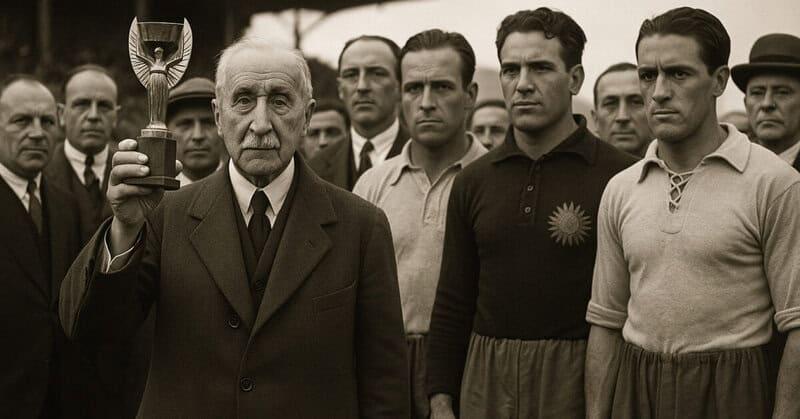
In the southern winter of July 1930, workers were still pouring concrete into the upper tiers of the Estadio Centenario when thirteen nations gathered in Montevideo, Uruguay, for the strangest, most improbable sporting experiment anyone had yet attempted — a global football tournament that nearly died in committee rooms, nearly drowned in the Atlantic, and nearly collapsed under the weight of European indifference before a single match was played.
The Visionary Who Wouldn’t Let It Die: Jules Rimet

To understand how the FIFA World Cup came to exist at all, you have to understand one man’s peculiar stubbornness. Jules Rimet, a French lawyer who became FIFA president in 1921, was not a pragmatist. He was a romantic — the kind of man who looked at a sport played in back streets and working-class stadiums across five continents and saw, instead of a game, a diplomatic instrument. Football, he believed, could bind nations together in ways that treaties and trade agreements never quite managed.
The structural problem, in the early 1920s, was real. Club football was thriving. The Olympic Games hosted international football, but under strictly amateur rules that excluded most of the world’s best players. There was no global stage for senior national teams — no competition that could ask, plainly and seriously, which country played football best. Rimet saw this gap as both a sporting failure and something close to a moral one.
He spent most of the decade lobbying FIFA members with the patient, grinding persistence of a man who had already decided how the story ended. Proposals were drafted, rejected, and redrafted. Continental federations were skeptical. The questions of who would host, who would pay, and who would actually bother to show up remained obstinately unanswered. Then, at the 1928 FIFA Congress in Amsterdam, the vote finally came — and a standalone World Cup tournament was approved. The idea had survived long enough to become real.
Rimet had also quietly commissioned a trophy: a gold-plated sculpture of Nike, the winged goddess of victory, mounted on a marble base, to be awarded to the first champions of the world. In time it would carry his name — the Jules Rimet Trophy — and become one of the most recognizable objects in sport.
Why Uruguay? The Politics of Picking a Host

The host selection for the first tournament was, in the language of modern sports politics, a knife-fight conducted in meeting rooms. Italy, Sweden, Hungary, Spain, and the Netherlands all raised their hands, each expecting the inaugural World Cup to settle sensibly and conveniently on European soil. They were wrong.
Uruguay made an argument that was difficult to counter. The Uruguayans had won the Olympic football tournament in 1924 in Paris and again in 1928 in Amsterdam — back-to-back gold medals that made them, by any reasonable measure, the best national team on earth. Beyond that, they made a financial commitment no European nation was prepared to match: Uruguay would cover all participating nations’ travel costs, construct a purpose-built stadium, and guarantee every squad’s expenses throughout the tournament. The host was, in effect, offering to fund the entire event.
There was also a layer of symbolism that mattered deeply to Uruguayan officials. The year 1930 marked a century of Uruguayan independence. Hosting the world’s first football championship was not merely a sporting ambition — it was woven into a national centenary celebration, a statement to the world that this small South American republic had arrived. The tournament was political theatre as much as sport, and Uruguay had written the most compelling script.
Europe had wanted the tournament. Then, almost unanimously, Europe refused to travel to it.
The European Boycott: Pride, Distance, and a Very Long Voyage

When FIFA sent out invitations in the months following the host announcement, the response from European football nations was, in the diplomatic phrasing of the era, deeply disappointing. In plainer terms: nearly everyone said no. England, Germany, Italy, Austria, and a string of other footballing powers all declined to make the three-week Atlantic crossing. The journey was expensive, the timing disrupted domestic league seasons, and — though few said it explicitly — there was an undercurrent of condescension about traveling to South America for a competition whose value remained unproven.
Rimet’s winter of 1929 into 1930 was consumed by frantic diplomacy. He wrote letters, made visits, called in favors accumulated over a decade of FIFA politics, and framed European absence not as a practical decision but as a historic disgrace — an act of abandonment toward the tournament he had spent years building. Slowly, reluctantly, four European nations relented.
France agreed to participate — Rimet was French, and French football owed him at least that much. Belgium followed. Yugoslavia sent a team. Romania came under circumstances that have passed into football folklore: King Carol II reportedly took a personal interest in the squad’s participation, selecting players himself and guaranteeing that those who traveled would not lose their jobs while they were away. It was royal patronage applied to football logistics, and it worked.
In late June 1930, all four squads boarded the SS Conte Verde at Villefranche-sur-Mer on the French Riviera, accompanied by Jules Rimet himself — and by the trophy, packed carefully for the voyage. The ship crossed the Atlantic carrying the entirety of Europe’s World Cup presence in a single floating embassy. It was, by any measure, a precarious beginning to what would become the most-watched recurring sporting event in human history.
Thirteen Teams, One Unfinished Stadium, and Instant Controversy

When the tournament finally began, its texture was rough in ways that modern audiences would find unrecognizable. Thirteen nations — from South America, North America, and Europe — were divided into four groups, with no seeding system to balance the draw. Scorelines reflected the chaos of mismatched opponents: the United States defeated Belgium 3-0 and Paraguay 3-0, while Argentina edged past France 1-0 in a match that ended in controversy when the referee, apparently losing track of time, blew his whistle to end the game with several minutes still remaining.
The Estadio Centenario — the showpiece venue built for the occasion with an intended capacity of around 93,000 — was not finished when the tournament opened. Opening matches were played at smaller club grounds across Montevideo while construction crews worked through the Uruguayan winter to complete the upper tiers. The stadium that was meant to announce Uruguay’s ambition to the world was, in its early days, a building site with football happening nearby.
Officiating added another layer of unpredictability. Referees from different nations brought conflicting interpretations of the laws of the game, and there was no systematic effort to ensure matches were governed impartially. Every game carried, at some level, the threat of diplomatic incident. Crowd dynamics only intensified this: Uruguayan and Argentine supporters packed the stands in enormous, passionate numbers, while European sides often played in front of thin, indifferent audiences. The geography of football passion was already clearly drawn, and it did not favor the visitors.
For broader context on how the early World Cup editions were organized — and what made them so structurally different from the competition we know today — the World Cup Ultimate Guide on Road Trips offers a useful comparative overview.
The Final: A Rivalry Ignites, a Legend Is Born

July 30, 1930. Uruguay versus Argentina. Two nations separated by the muddy brown expanse of the Río de la Plata, united only by their absolute refusal to lose to each other.
Argentine fans crossed the river by ferry in enormous numbers, a flotilla of supporters arriving in Montevideo with the particular intensity of people who believe they are watching history. They were right, though not in the way they hoped. Montevideo police reportedly confiscated revolvers at the stadium gates — passion brought to its most dangerous logical conclusion. Even the match ball became a flashpoint: the two sides could not agree on which to use, and the argument was resolved by a compromise that captured the spirit of the whole occasion — each team’s ball would be used for one half.
Argentina led 2-1 at halftime, and the supporters who had made the river crossing felt the quiet confidence of the nearly victorious. Then Uruguay came back. The second half dismantled Argentina’s lead with a force that felt less like tactics and more like national will. When the final whistle blew, Uruguay had won 4-2. The streets of Montevideo erupted. Across the water in Buenos Aires, the mood was the inverse: grief and fury that, according to contemporary reports, extended as far as the Argentine consulate in Montevideo, which was reportedly attacked by enraged fans in the aftermath.
Uruguay lifted the first FIFA World Cup trophy on home soil, and in doing so gave the tournament its founding mythology. The comeback. The neighbor-rivalry. The stadium packed with opposing passions and the police taking weapons from the crowd at the gates. Every future World Cup would try, in its own way, to match that template — a competition not just between teams but between national identities, histories, and desires.
The Immediate Legacy: From Experiment to Institution

Zoom out from Montevideo — from the half-finished stadium, the trophy crossing the Atlantic by ship, the king who personally selected his country’s squad — and what the first World Cup demonstrates is simpler than its complicated origin story might suggest. International football could command national emotion at a scale no other sport had yet matched. The experiment worked. The tournament that Jules Rimet spent a decade forcing into existence turned out to be something the world wanted, even if the world had not quite known it yet.
The immediate legacy was measurable. FIFA’s membership swelled with interest from nations newly aware of what they had missed. Italy — which had declined to make the Atlantic crossing — immediately bid for the right to host the 1934 tournament and won it, determined not to be absent from a competition that had so rapidly proved its significance. The four-year cycle was fixed as a permanent feature of global sport, a rhythm that has since organized the calendars of billions of people across nearly a century.
It is worth acknowledging plainly, though, what Montevideo in 1930 did not include. No African nations participated. No Asian powers. The women’s game was entirely unrecognized by football’s governing bodies. The organization that created the tournament was run by a small European elite whose vision of global sport had, by necessity and by habit, significant blind spots. The history of the FIFA World Cup is not only a story of what was built — it is also, honestly, a story of who was excluded and why, and of how slowly and unevenly those exclusions have been addressed in the decades since.
What Rimet’s Impractical Dream Became
Jules Rimet lived long enough to see the trophy he commissioned contested for decades — though Rimet himself died in 1956. Across those decades he watched a speculative idea become the defining recurring event in global sport. Today, according to widely reported FIFA estimates, more than five billion people watch a World Cup final — a figure so large it would have been incomprehensible to every skeptic who refused to board a ship in 1930, every official who judged the journey too long and the competition too uncertain to bother with.
The man with the gold-plated trophy and the impractical dream turned out to be right. The world did want this. It just needed someone stubborn enough — stubborn in precisely the right way — to build it before anyone had thought to ask.

 Arabic
 French
 Spanish
 Portuguese
 Deutsch
 Turkish
 Dutch
Dutch
 Italiano
 Russian
 Romaian
 Portuguese (Brazil)
 Greek
Greek