


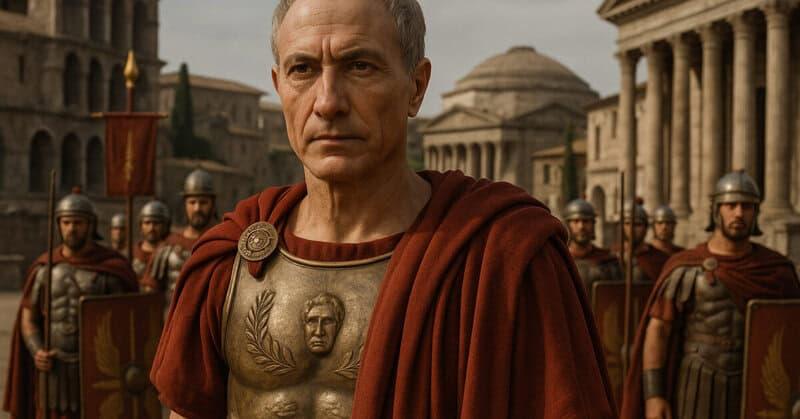
The marble floor of Pompey’s Theatre ran red on the morning of March 15, 44 BC, as twenty-three senators closed in on the most powerful man in the Roman world — daggers drawn, hands shaking, decades of resentment finally finding a blade’s edge. Gaius Julius Caesar, conqueror of Gaul, master of Rome, and dictator in perpetuity, fell to the floor having received, by ancient accounts, twenty-three wounds. The Republic’s last defenders had struck their blow. And in doing so, they guaranteed the very thing they most feared.
The Ides of March: A Knife in the Senate

There is a cruel irony stitched into the scene. The man who had outmaneuvered every rival across two decades of Roman politics, who had led armies through the forests of Gaul and the deserts of North Africa, who had crossed a boundary river in the predawn dark and dared the Republic itself to stop him — this man could not survive a single morning among colleagues in his own city. The conspirators called themselves liberators. They believed the death of one man would restore the breathing machinery of Roman self-governance. They were catastrophically wrong.
Caesar’s assassination is one of history’s great pivots — a moment that answers almost nothing and detonates everything. Was he a savior who had rescued Rome from a broken, oligarchic Republic? A destroyer who had strangled democratic tradition with his bare ambition? Or was he something more complicated: a man who simply read the room of history more clearly than anyone around him and acted on what he saw, consequences be damned? The answer shapes how we understand not just Rome, but every imperial system that followed. Because Caesar’s death did not stop Rome’s transformation. It accelerated it, making empire not merely possible but inevitable.
From Patrician Boy to Political Predator

Born around 100 BC into a family with distinguished bloodlines and perpetually strained finances, Gaius Julius Caesar learned young that noble birth without money was a kind of beautiful trap. The Roman Republic rewarded wealth as enthusiastically as it rewarded lineage, and Caesar had the latter without enough of the former. What he had instead was something rarer: an almost preternatural gift for reading people, a lawyer’s command of language, and an appetite for risk that his more cautious contemporaries found either thrilling or terrifying, depending on which side of it they stood.
He climbed the traditional Roman cursus honorum — the sequential ladder of public offices from quaestor through aedile, praetor, and eventually consul — as a lawyer and orator first, always calculating, always charming, and almost always in debt. He spent lavishly on public games and building projects, buying popularity with borrowed money the way a modern politician might buy advertising. The debts were enormous. The returns, measured in loyalty and reputation among Rome’s common citizens, were larger still. He served as governor of a small Roman territory in the south, learning the practical craft of administration and battlefield command at the edges of Roman power before setting his sights on something vastly more significant.
What makes Caesar uniquely legible across twenty centuries is that he wrote about himself with the same precision he applied to everything else. His accounts of his military campaigns — composed in clean, almost hypnotically clear Latin — were acts of political genius disguised as military history. He shaped how Rome saw him with a stylus as deftly as he ever did with a sword. Understanding who Caesar actually was requires reading both the man and the myth he so deliberately constructed around himself.
The First Triumvirate: Power Before the Wars

Before Caesar ever marched on Gaul, he understood that raw ambition required structured alliances to survive Rome’s political ecosystem. In 60 BC, he engineered an informal power-sharing arrangement with two of the most formidable men in the Roman world: Gnaeus Pompeius Magnus — Pompey the Great, celebrated conqueror of the East — and Marcus Licinius Crassus, the wealthiest man in Rome. The arrangement, which historians call the First Triumvirate, was never a formal office or a legal institution. It was a private compact, held together by mutual self-interest rather than affection.
The alliance gave Caesar what he needed most: the political backing and financial support to secure a consulship in 59 BC, and immediately afterward, a multi-year military command in Gaul. It gave Pompey ratification of his Eastern settlements, which a hostile Senate had blocked. It gave Crassus lucrative contracts for his business interests. Each man believed he was using the others. None of them was entirely wrong. The Triumvirate was, in essence, Caesar’s launching platform — the political mechanism that converted his reputation into real power and pointed him north toward the most transformative campaign of his life.
The Hunger for Gaul: Rome’s Greatest Gamble

When Caesar looked north from his provincial command toward the vast, unconquered territories of Gaul — roughly the geography of modern France, Belgium, and parts of Switzerland — he did not see wilderness. He saw destiny, and more practically, he saw money, military glory, and the kind of independent power base that Roman politics required if you wanted to survive at its highest levels without being destroyed by enemies the moment you returned to civilian life.
The Gallic Wars, which consumed eight brutal years from 58 to 50 BC, were among the most ferocious campaigns of the ancient world. Caesar’s own commentaries record millions of Gauls killed or enslaved — figures ancient historians and modern scholars alike treat with caution regarding their precision, but which point unmistakably toward destruction on a massive scale. Caesar fought hundreds of engagements across those years, commanding forces through terrain that ranged from riverine lowlands to dense forest highlands, against enemies who were neither primitive nor easily intimidated. He almost never lost.
The siege of Alesia in 52 BC remains a case study in audacious tactical thinking. Facing the Gallic chieftain Vercingetorix — who had united previously fractious Gallic tribes into a coordinated resistance — inside a fortified hill town, Caesar ordered the construction of a ring of circumvallation encircling the city entirely. When a massive Gallic relief army arrived, threatening to trap Caesar between two forces, he ordered a second ring of contravallation built facing outward. His army held both lines simultaneously — besieging the city from within while defending the outer perimeter against a relief force estimated in ancient sources at well over 200,000, figures modern scholars debate but which indicate a genuinely overwhelming threat. The double-ring strategy succeeded, Vercingetorix surrendered, and organized Gallic resistance effectively ended. Military historians still examine Caesar’s generalship at Alesia as one of antiquity’s most extraordinary feats of field engineering and tactical nerve.
Gaul transformed Caesar entirely. It made him fabulously wealthy from plunder and tribute. It gave him a battle-hardened army whose soldiers were loyal not to the Senate in Rome but to the general who had led them, fed them, and brought them through eight years of war alive. A clever politician had walked into Gaul. A legend walked back out.
Crossing the Rubicon: The Point of No Return

Roman law was unambiguous on one point: a general could not bring his army into Italy proper. The Rubicon River — a small stream in northeastern Italy — marked the legal boundary between Caesar’s province and the Roman homeland, and crossing it with troops under arms was not a legal gray area. It was an act of war against the Roman state itself. The Senate understood this when they ordered Caesar, in January of 49 BC, to disband his forces before entering Italy. His enemies had timed the demand carefully, calculating it would force him to choose between legal surrender and outright treason.
He chose neither in the way they expected. With a single legion, he crossed the Rubicon. Ancient sources, including Suetonius and Plutarch, record that he paused at the riverbank, seized by the weight of what the crossing meant — and then committed. The Greek phrase attributed to him, drawn from the playwright Menander and recorded by Plutarch, translates roughly as “the die is cast” — a gambler’s acknowledgment that the risk had been accepted, the outcome set in motion, and there was no retrieving the throw.
What followed looked like rebellion but functioned more like the final scene of a long institutional collapse. The Roman Republic’s governing structures had been hollowing out for a generation — civil wars, political murders, and the accumulation of personal military power by competing strongmen had all preceded Caesar. His crossing of the Rubicon was not the disease. It was the diagnosis made visible. Pompey, Caesar’s great rival and the Senate’s champion, fled Italy rather than fight, calculating he could regroup in Greece. Allies flooded to Caesar’s banner. Within months, he controlled Rome with almost no siege required. His speed and his reputation had done most of the fighting for him.
Dictator Perpetuo: The Man Who Rewrote the Rules

The office of dictator existed in Roman tradition as a constitutional pressure valve — a temporary grant of extraordinary power during genuine emergency, strictly limited to six months, after which the officeholder was expected to step aside and restore normal governance. Rome’s history included celebrated men, most famously Cincinnatus, who had held the dictatorship honorably and relinquished it voluntarily, which made what Caesar did next more shocking in its directness.
Caesar became the first to hold the title of dictator perpetuo — dictator in perpetuity — an appointment ratified by the Senate in early 44 BC that was less a legal office than a declaration of permanent personal supremacy. From 49 BC until his assassination in 44 BC, he held power almost continuously, and he used it with the focused energy of someone who understood he was remaking the world and had limited time in which to do it.
His reforms were genuinely sweeping and, in many cases, durable. He overhauled the Roman calendar, correcting the accumulated drift of the old lunar system by introducing a solar year of 365 days with a leap year every four years — the Julian calendar that emerged from this reform remained the dominant calendar of the Western world for roughly sixteen centuries, until the Gregorian revision of 1582. He undertook land redistribution to relieve poverty among Rome’s urban poor and military veterans. He extended Latin rights and eventually Roman citizenship to people in Roman-controlled territories beyond Italy, broadening the definition of who belonged to the Roman project. He expanded the Senate’s membership, rebuilt crumbling urban infrastructure, and reorganized provincial governance with an administrator’s eye for efficiency.
The paradox at the center of all this activity was dizzying. Caesar was using the institutions and language of the Republic — Senate decrees, legitimate offices, public benefactions — to systematically dismantle the Republic’s capacity to check concentrated power. He insisted, apparently with some genuine conviction, that he was healing Rome rather than ruling it as a monarch. Romans who had known him for decades could not quite agree on whether to call him reformer, king, god, or tyrant. Most settled for some uneasy mixture of all four, and it was precisely that unresolved tension that brought the daggers out on the Ides of March.
The General Who Remade the Map
Gaul was the centerpiece of Caesar’s military legacy, but it was never the whole picture. He led two expeditionary landings in Britain in 55 and 54 BC — penetrating the island, fighting its tribes, planting Rome’s standard at the edge of the known world, and sending dispatches home that electrified Roman public opinion, even though neither expedition resulted in permanent occupation. He fought at Pharsalus in Greece, where he decisively defeated Pompey in 48 BC, effectively ending the first phase of the civil war. He campaigned in Egypt, where his relationship with Cleopatra VII produced both a political alliance and, according to ancient sources, a son named Caesarion. He fought in Pontus on the Black Sea coast — the campaign that produced his famously terse dispatch to Rome: veni, vidi, vici, “I came, I saw, I conquered.” He subdued remaining Pompeian forces in North Africa and Spain before returning to Rome to consolidate power.
Caesar’s reputation as a commander rests on this combination of strategic vision across multiple theaters, tactical flexibility in the field, and the almost irrational loyalty he inspired in soldiers who had served under him for years. The wealth generated by those campaigns — particularly the Gallic gold and the plunder of successive wars — funded the physical and political infrastructure of Rome itself. Temples rose. Veterans were paid and retired with land grants. Every senator who stood in Pompey’s Theatre with a concealed dagger had, in some fashion, personally benefited from the territories and treasure that Caesar’s wars had delivered to Rome. The bitter irony is almost too neat: they murdered the architect of their prosperity while congratulating themselves on their republican virtue.
The Ghost That Built an Empire
The conspirators of the Ides of March believed they were saving Rome. What they actually produced was thirteen more years of catastrophic civil war — the conflicts that consumed the careers and lives of Mark Antony, Cleopatra, and ultimately Caesar’s own heir before the fighting was done. The assassination obliterated whatever remained of the Republic’s credibility as a self-governing system, because it demonstrated that political violence — not law, not tradition, not institutional process — was the ultimate arbiter of Roman power.
Into this chaos stepped Gaius Octavius, Caesar’s great-nephew and adopted heir, who would eventually receive the honorific title Augustus and become Rome’s first emperor. He wielded his adoptive father’s name as a political weapon of extraordinary potency, branding himself as the avenger of Caesar and the restorer of order, while building an imperial monarchy on the ruins of the Republic. Every emperor who followed him bore the name Caesar as a title of supreme authority. The word traveled outward through centuries and across continents: Kaiser in German, Czar and Tsar in the Slavic world — all of them linguistic descendants of one Roman’s family name, embedding his identity into the power structures of civilizations he never visited and cultures he could not have imagined.
Return, finally, to that marble floor in 44 BC. The senators who drove their daggers into Caesar believed they were killing a man. In a literal sense, they succeeded. But the idea of Caesar — the demonstrated possibility that one person could stand above the Republic’s machinery, could reorganize a civilization by force of will, military genius, and political mastery — that idea was already loose in the world and could not be recalled. What the conspirators actually killed, in the theatre named for his old rival Pompey, was the last functioning illusion that Rome could remain a republic. They struck twenty-three blows for the old order. With every one, they drove Rome deeper into the new.

 English
 Arabic
 French
 Spanish
 Portuguese
 Deutsch
 Dutch
Dutch
 Italiano
 Russian
 Romaian
 Portuguese (Brazil)
 Greek
Greek