


Why Did Japan Get Rid of The Samurai?

0
15

Why Did Japan Get Rid of The Samurai?

3. Abolition of the Samurai Privileges

Why Did Japan Get Rid of The Samurai?
Meiji reforms dismantled samurai privileges, marking the end of feudal hierarchy in Japan.

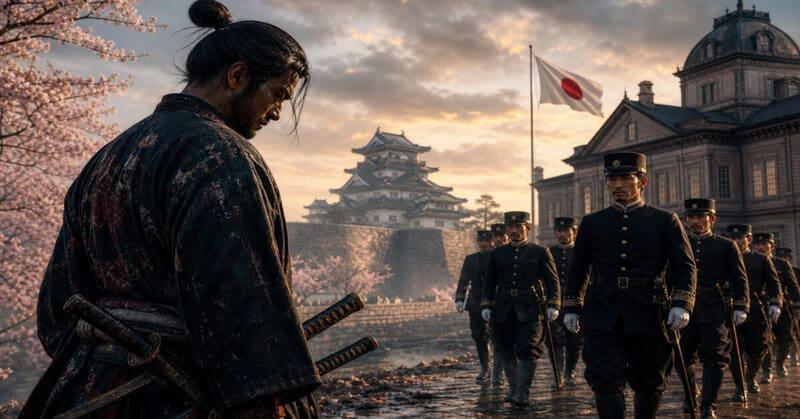
The Meiji government systematically dismantled the samurai’s unique social status and privileges. In 1871, the han system was abolished, replacing feudal domains with centralized prefectures, effectively ending the samurai’s hereditary stipends. The following year, the Haitōrei Edict prohibited the public from carrying swords, a right that had been emblematic of samurai authority. These reforms paralleled the global trend of dismantling feudal classes, leading to resistance from samurai who found their traditional roles and status undermined. (britannica.com)

4. Creation of a Conscription Army

Why Did Japan Get Rid of The Samurai?
Japan’s 1873 conscription system transformed military service, diminishing the samurai’s exclusive status.

In 1873, Japan introduced a national conscription system, replacing the samurai warrior class with a modern, Western-inspired military. This system mandated that all men serve in the military, drawing from all social classes, thereby diminishing the samurai’s exclusive role as warriors. The conscription model was influenced by European systems, notably those of France and Prussia, which emphasized universal military service and modernized training methods. This shift marked a significant departure from Japan’s feudal military traditions, aligning with global trends toward centralized, conscripted armies. (oup.com)

5. Economic Pressures and Financial Reform

Why Did Japan Get Rid of The Samurai?
The Meiji reforms transitioned samurai stipends into government bonds, easing Japan’s financial strain.

The hereditary stipends paid to the samurai class consumed nearly 30% of Japan’s national budget, placing a significant strain on the nation’s finances. To alleviate this burden, the Meiji government implemented financial reforms that phased out samurai support. In 1873, samurai were offered the option to convert their stipends into government bonds, valued at five to fourteen times the annual stipend, with interest rates of 5-7%. By 1876, this conversion became mandatory, leading to a substantial reduction in samurai incomes. This approach mirrored similar reforms in other modernizing nations, where dismantling hereditary privileges was essential for economic modernization. (japanesewiki.com)

6. Social Transformation and Public Order

Why Did Japan Get Rid of The Samurai?
Saigō Takamori leads the Satsuma Rebellion, challenging the Meiji government’s reforms and samurai status.

The Meiji government’s reforms aimed to establish a new social order based on equality before the law, moving away from the hereditary class system. This shift threatened the samurai’s traditional status and privileges, leading to significant resistance. The most notable manifestation of this opposition was the Satsuma Rebellion of 1877, led by Saigō Takamori, a former samurai and hero of the Meiji Restoration. The rebellion was ultimately suppressed, marking the definitive end of the samurai era and the consolidation of the new social order. (history.com)

7. Industrialization and Urbanization

Why Did Japan Get Rid of The Samurai?
The Meiji Restoration transformed Japan, reshaping roles from samurai to skilled labor in industry.

The Meiji Restoration’s rapid industrialization and urbanization created a demand for new professions, diminishing the relevance of traditional samurai roles. As factories and infrastructure expanded, the need for skilled labor and administrative expertise grew, leading many former samurai to transition into these emerging sectors. This shift mirrors the industrial changes in Victorian Britain, where traditional roles evolved to meet new economic demands. (britannica.com)

8. Education Reform and Social Mobility

Why Did Japan Get Rid of The Samurai?
Compulsory education reforms of the Meiji Restoration transformed social mobility through merit-based learning.

The Meiji Restoration’s education reforms, notably the Education Code of 1872, mandated compulsory education for all children, emphasizing practical knowledge and skills. This initiative fostered social mobility by enabling individuals from various backgrounds to pursue education and attain status based on merit rather than birth. The establishment of a national education system provided new pathways for success, diminishing the hereditary class distinctions that had previously constrained social advancement. (meijieducation.weebly.com)

9. The Legacy of the Samurai

Why Did Japan Get Rid of The Samurai?
Modern Japan embodies the samurai’s legacy of honor, discipline, and loyalty across society.

The samurai’s enduring legacy is evident in modern Japanese culture, where principles such as honor, discipline, and loyalty continue to influence various aspects of society. These values are deeply embedded in martial arts, corporate ethics, and social norms, reflecting the samurai’s lasting impact. This phenomenon parallels other cultures that have integrated martial traditions into their national identities, such as the chivalric codes in medieval Europe, which also emphasized honor and duty. (yoursecretjapan.com)

Conclusion

Why Did Japan Get Rid of The Samurai?
The samurai’s decline reflects Japan’s modernization, yet their values persist in today’s culture.

The decline of the samurai was driven by a confluence of social, economic, and political transformations during Japan’s modernization. The Meiji Restoration’s reforms, including the abolition of feudal privileges and the establishment of a conscripted army, rendered the samurai’s traditional roles obsolete. Despite this, the core values of the samurai—such as loyalty, honor, and discipline—remain deeply embedded in modern Japanese culture, influencing contemporary business practices, martial arts, and societal norms. (samurai-experience.com)

البحث
الأقسام
إقرأ المزيد
Food
The Method Behind Texas Roadhouse's Fall-Off-The-Bone Ribs
The Method Behind Texas Roadhouse's Fall-Off-The-Bone Ribs...
بواسطة Test Blogger1 2026-02-02 18:00:13 0 2كيلو بايت
أخرى
TNBC Treatment Market to Reach USD 1.2B by 2032 at 6% CAGR; Roche, AstraZeneca Lead
Fact.MR today unveiled its latest report on the Triple Negative Breast Cancer Treatment Market,...
بواسطة Prashil Sawale 2026-04-23 21:09:51 0 993
الألعاب
Blox Monsters codes (June 2026)
Blox Monsters codes (June 2026) With its inspirations clear to see, it's no surprise that a new...
بواسطة Test Blogger6 2026-06-12 13:00:08 0 8
Food
The Trader Joe's Frozen Good I Buy Every Trip
The Trader Joe's Frozen Good I Buy Every Trip...
بواسطة Test Blogger1 2026-02-23 05:00:08 0 2كيلو بايت
Food
Monomethylsilanetriol Market Gains from Personal Care Demand; Dow, Evonik Lead
The global monomethylsilanetriol market is witnessing strong growth as consumers increasingly...
بواسطة Prashil Sawale 2026-05-14 14:21:43 0 557