


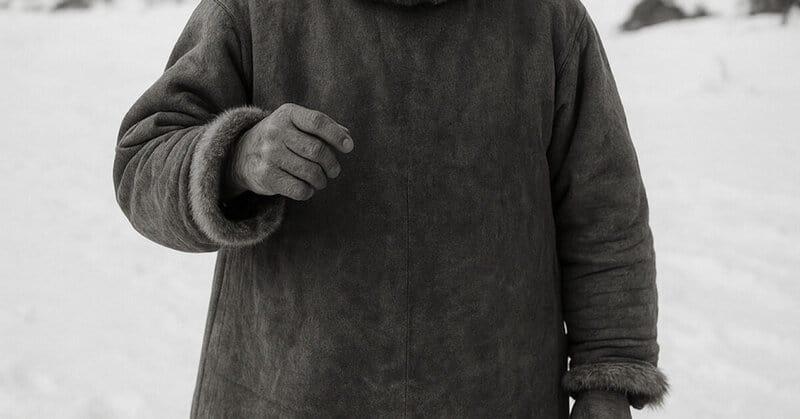
Somewhere in the long Arctic night, an Inuit elder once described the people who came before — enormous, gentle strangers called the Tuniit, so strong they could drag a walrus across the ice where ordinary men could not lift one, yet so easily startled that when the ancestors arrived, the Tuniit simply fled into the frozen distance and never came back. That story, passed down across generations of campfire tellings, may be the closest thing to a farewell that one of history’s most remarkable civilizations ever received.
The People Who Vanished Without a Trace

The Dorset people mastered the Arctic for roughly two thousand years — from around 500 BCE until somewhere between 1000 and 1500 CE — and then they were gone. Not conquered in any battle that left bones in a ditch. Not swallowed by a flood or buried under volcanic ash. They disappeared the way a breath disappears in cold air: visibly present one moment, and then simply not. What remains are harpoon heads of extraordinary craftsmanship, soapstone lamps no bigger than a human palm, and small ivory carvings of bears and human faces worn smooth by hands that have been dust for centuries. The archaeological record does not offer a final settlement layer, no mass grave, no scorched horizon. There is only an absence where a civilization once stood.
The driving question that haunts researchers is deceptively simple: what happened? Were the Dorset killed outright by more aggressive neighbors? Outcompeted into slow starvation? Ravaged by diseases their isolated immune systems had never encountered? Or were they undone by a warming climate that melted away the very ecological world they had spent two millennia learning to inhabit? As Polarpedia acknowledges, the Dorset were extinct by 1500 CE “for not fully explained reasons” — a phrase that captures science’s genuine uncertainty while signaling that no single cause is likely sufficient. The most compelling answer is that several pressures arrived at once, and a people already quietly diminished had no margin left to absorb them.
A Civilization Hiding in Plain Sight

For centuries, the Dorset’s artifacts were misread, misattributed, or lumped together with those of other Arctic peoples. It was not until 1925 that the Dorset were formally recognized as a distinct culture — a remarkably recent awakening to the presence of a people who had shaped the Arctic landscape for two millennia. The delay is partly understandable. The Arctic is vast, its archaeology brutally difficult to conduct, and the Dorset left behind no monuments, no written language, nothing that announces itself the way a pyramid or a stone temple does. What they left was more intimate: small things, carefully made.
The archaeological signature of the Dorset is precise and, once recognized, unmistakable. Their soapstone lamps — crucial for heat and light through months of polar darkness — were finely shaped and thermally efficient. Their carvings of polar bears, seals, and half-human transformation figures were rendered with a sensitivity that suggests not just skilled hands but a rich spiritual world, one centered on the porous boundary between human and animal. Then there are the notable absences, which tell their own story: no evidence of dog sleds, no bows and arrows. These were people who traveled on foot or by small watercraft, moving through their world at a human pace, building intimate knowledge of specific territories rather than ranging widely across the tundra.
Their geographic reach, however, was anything but small. The Dorset occupied a world stretching across Arctic Canada and Greenland — frozen coastlines, sea-ice hunting grounds, and semi-subterranean winter houses dug into the permafrost for insulation. For those two thousand years, they were effectively the Arctic’s only human inhabitants, and they were extraordinarily accomplished at it. Understanding how the Dorset lived — and how they differed from the Thule people who followed — makes their disappearance all the more striking.
Life on the Ice: Mastery Without Dogs or Bows

To survive in the Arctic without dogs, without bows, without the mobility those technologies provide, the Dorset developed other forms of mastery. Their toggling harpoons — designed so that the head would pivot sideways inside a seal’s body once struck, making escape nearly impossible — were engineering solutions arrived at through generations of refinement. Snow goggles cut from bone or ivory protected their eyes from the blinding glare of sunlight on ice fields. Their soapstone lamps burned seal oil with a low, steady flame capable of warming a snow shelter through a night when the temperature outside dropped to levels that freeze exposed flesh within minutes.
These were not primitive improvisations. They were the product of accumulated knowledge, passed through generations in communities small enough that every individual carried an irreplaceable share of the group’s collective expertise. Shamanic carvings — small ivory figurines depicting humans mid-transformation into animals — suggest a spiritual framework built around the idea that the boundary between the human and animal worlds was navigable by those with the right knowledge and relationship. This worldview was not incidental to Dorset survival. It was probably central to how communities understood their obligations to the seals, bears, and walruses on whom their lives depended.
Yet the same intimacy that made the Dorset so finely adapted to their environment also made them structurally fragile. Small, semi-nomadic bands — resilient in the face of ordinary hardship — would have been acutely vulnerable to any large-scale disruption: a new competitor entering their territory, a sudden shift in the availability of prey, or the silent pressure of a new pathogen moving faster than any human runner.
The Rivals Arrive: The Thule Migration

Around 1000 CE, the world the Dorset had inhabited alone began to change. A new people were moving eastward out of Alaska — the Thule culture, direct ancestors of every modern Inuit group — and they traveled with an entirely different technological repertoire. Dog sleds gave them speed and range across the ice that the Dorset, traveling on foot, could not match. Large open skin boats called umiaks allowed them to hunt bowhead whales in open water, bringing in quantities of food and oil that dwarfed anything a seal hunt at a breathing hole could produce. And they carried bows — weapons that extended a hunter’s reach and altered the calculus of any encounter, whether with prey or with strangers.
What happened when these two peoples shared the same coastlines is suggestive without being conclusive. The massacre hypothesis — that the more mobile and better-armed Thule actively exterminated Dorset populations — is the most dramatic explanation, and it cannot be entirely dismissed. Some researchers argue that Thule technological superiority made violent displacement not just possible but likely in at least some regions. Physical evidence of systematic violence, however, is scarce and contested across the archaeological record.
A quieter but perhaps equally lethal alternative is competitive displacement — not war but economics. Thule hunters pursuing bowhead whales could harvest resources on a scale the Dorset’s seal-hunting strategy never approached. If both peoples were drawing from the same shared pool of caribou, fish, and marine mammals, the Thule’s superior logistical efficiency may simply have left Dorset communities with diminishing returns season after season, year after year, until populations fell below the threshold of viability and collapsed without dramatic incident. No violence required — just hunger, repeated often enough, across enough winters.
A Warming World That Targeted Their Strengths

Climate change added another dimension to an already precarious situation. The Medieval Warm Period — roughly 900 to 1300 CE — brought rising temperatures to the Arctic that reduced and destabilized the sea ice the Dorset depended upon. Their signature hunting technique, waiting patiently at a seal’s breathing hole in stable, predictable ice, required exactly that: stable, predictable ice. When the ice became less reliable and more seasonal, the Dorset’s most refined skill became less effective. The environment was not simply changing in general ways; it was transforming in ways that specifically targeted the adaptations the Dorset had spent two thousand years perfecting.
The cruel irony is that the same warming conditions that undermined Dorset hunting opened new possibilities for the Thule. Longer stretches of open water suited their large boats and whale-hunting methods perfectly. The Medieval Warm Period, in a very real sense, shifted the competitive advantage decisively toward the newcomers. Researchers have argued that the Dorset were too deeply committed to a cold-climate strategy — too specialized — to pivot when the cold that had been their ally began to retreat. Unlike the Thule, who carried a broader technological toolkit capable of adapting to shifting ecological conditions, the Dorset may have had nowhere to go when their environmental niche shrank around them.
Smaller bands already under food stress would have faced cascading vulnerabilities: reduced fertility, greater susceptibility to illness, and less resilience when any single bad hunting season struck. A people in ecological distress would have been far less capable of absorbing the simultaneous shock of a larger, faster, and better-armed culture pressing into their territories from the west.
Written in the Blood: What Ancient DNA Reveals

The Dorset’s own biology offers one of the most sobering pieces of evidence in this story. Analysis of ancient mitochondrial DNA extracted from Dorset remains has revealed striking genetic uniformity across populations separated by vast geographic distances — a pattern pointing to a people who had been small in number and reproductively isolated for a very long time. Low genetic diversity is not merely an abstract statistic. It signals reduced immune resilience across a population. A pathogen new to the Dorset — even one that Thule communities had developed partial resistance to through prior exposure in Alaska — could have moved through Dorset bands with catastrophic speed, killing individuals who carried no inherited defenses.
The DNA evidence reframes the entire timeline in an important way. The Dorset were not a robust, flourishing civilization suddenly struck down at the moment of Thule contact. They may have been a people already in slow demographic decline long before the Thule arrived — too few, too genetically similar, too isolated to weather shocks that a larger and more diverse population might have survived. The arrival of the Thule, the destabilization of the Medieval Warm Period, and the possibility of novel disease exposure may not have been the causes of extinction so much as the final convergence of pressures on a civilization that was already quietly running out of room to survive.
Remembered as Giants: The Dorset in Inuit Oral Tradition
And yet, they are remembered. The Inuit oral tradition preserved the Dorset as the Tuniit — beings of extraordinary physical strength, capable of feats ordinary humans could not match, who could drag walruses across ice where others could not even lift them. In these stories the Tuniit are described as giants, but not cast as villains or enemies. They are also described as shy, gentle, easily startled, and quick to abandon their homes when confronted — a portrait that some scholars read as a folk memory of a people broken by repeated displacement, dwindling in number, losing the collective confidence that comes from a community intact and secure in its world.
That the Inuit remembered the Dorset at all, and remembered them with something closer to awe than contempt, suggests that the encounter between these two cultures was not simply a story of conquest. Something more complex passed between them — an awareness of the other’s strangeness and capability, a recognition across the distance of generations that the giants who vanished had once been masters of the same ice in ways that still commanded respect.
What the Carved Faces Leave Behind
The Dorset spent two thousand years learning one of Earth’s most hostile environments with a thoroughness that bordered on the extraordinary. They built a complete civilization — spiritual, technological, artistic — without the tools we typically associate with resilience and expansion. And then, somewhere in the centuries between 1000 and 1500 CE, they were gone: absorbed by no one, leaving no descendants in the genetic record of any surviving population, remembered only in the oral traditions of the people who inherited their coastlines and in the artifacts that frozen ground continues to surrender one excavation at a time.
Those artifacts — the carved ivory faces that still watch from museum cases with expressions of unsettling calm, the delicate soapstone lamps, the precisely engineered harpoon heads — are not relics of failure. They are evidence of a people who were, for two millennia, exactly right for the world they occupied. It was the world that changed around them faster than any civilization, however skilled, could adapt. The mystery of what finally extinguished the Dorset remains, like the Arctic itself, not fully yielded — a convergence of pressures that archaeology can describe but cannot yet fully explain, pressing down on a people who had already given everything they had just to survive.

 English
 Arabic
 Spanish
 Portuguese
 Deutsch
 Turkish
 Dutch
Dutch
 Italiano
 Russian
 Romaian
 Portuguese (Brazil)
 Greek
Greek