


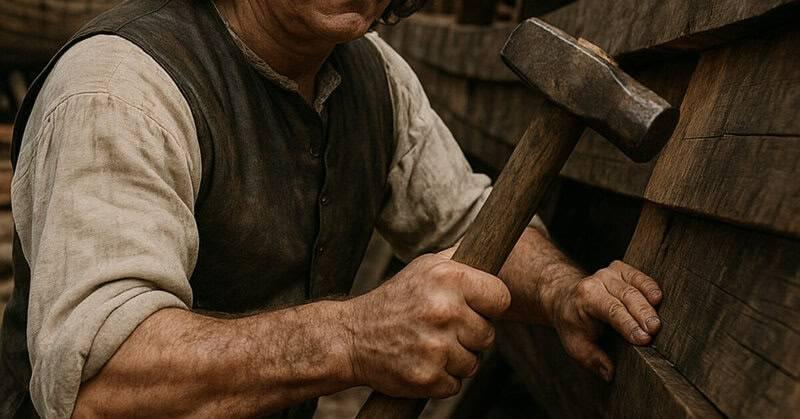
In the autumn of 1697, a giant of a man — six feet seven inches tall, with restless dark eyes and hands already thickening with calluses — bent over a half-finished ship’s hull in a Dutch yard at Zaandam and swung a hammer like any other apprentice carpenter. His name, as far as his coworkers knew, was Peter Mikhailov. He had sawdust in his hair, splinters in his palms, and the absolute sovereignty of one-sixth of the earth’s landmass tucked quietly behind his assumed identity. No European monarch had ever done anything remotely like it. That strange, almost violent humility — the world’s most powerful autocrat insisting on learning how to shape timber with his own hands — tells you everything you need to know about what Peter I of Russia was about to do to his country.
Early Life and the Trauma That Shaped a Tsar

Peter was born on June 9, 1672, in Moscow, the fourteenth child of Tsar Alexis by his second wife, Natalya Naryshkina. His early childhood offered little suggestion of the upheaval to come. What came instead, in the spring of 1682, was something closer to a nightmare. Peter was nine years old when the Streltsy — the semi-professional musketeers who formed the backbone of Russia’s old military — rose in revolt. The boy stood on the Kremlin’s Red Staircase and watched soldiers drag his relatives into the mob below, where they were murdered. It was a lesson written in blood: the old Russia, with its unreformed military and its poisonous court intrigues, was a machine that could turn on anyone at any moment.
Following the Streltsy revolt, Peter was crowned co-tsar alongside his ailing half-brother Ivan V, but the crown meant almost nothing. Real power belonged to his half-sister Sophia, who governed as regent. Peter was kept at arm’s length from the machinery of state and spent those years at the village of Preobrazhenskoye, outside Moscow, doing something that looked like play but was actually a long, obsessive experiment. He recruited neighborhood boys and servants into mock regiments — his so-called “toy soldiers” — drilled them, equipped them, and gradually turned them into something genuinely formidable. By the time Ivan V died in 1696 and Peter finally stood alone as Tsar, those boyhood war games had produced the disciplined Preobrazhensky and Semyonovsky Guards regiments, the nucleus of the military revolution he intended to impose on Russia. The trauma of 1682 had not broken him. It had given him a blueprint.
The Grand Embassy: A Tsar Goes Undercover in Europe

Peter ruled alone for barely a year before he did something that astonished Europe and scandalized the Russian court. In 1697, he organized the Grand Embassy — a diplomatic mission of roughly 250 men — and embedded himself in it under the alias Peter Mikhailov, travelling incognito through Brandenburg-Prussia, the Dutch Republic, England, and the Holy Roman Empire. The official purpose was to build alliances against the Ottoman Empire. The real purpose was Peter’s personal education in everything Russia lacked.
He spent several months in Zaandam and Amsterdam, rising before dawn to work in the shipyards, staying late to interrogate master craftsmen about rigging, hull design, and naval gunnery. He attended anatomy lectures in Leiden and visited the Royal Observatory at Greenwich. European hosts were simultaneously charmed and unsettled by this enormous, fidgeting, intensely alive man who could sit quietly for hours watching a craftsman at work, missing nothing, and then pepper the craftsman with questions no dignitary was supposed to ask.
What Peter brought back to Russia was more than impressions. He returned with hundreds of European engineers, doctors, naval officers, and craftsmen he had recruited personally — human capital he intended to transplant directly into Russian soil. The Grand Embassy was less a diplomatic tour than a talent raid on Western civilization, conducted by a man who understood that ideas travel fastest inside the heads of the people who hold them.
The Reforms That Shocked a Nation

Peter was barely back in Moscow in 1698 before the transformation began, and it started with something so personal it bordered on theatre. At a reception for his nobles, he produced a pair of shears and cut off their beards himself — grabbing the long, lustrous symbols of Orthodox Russian manhood and shearing them on the spot. It was humiliating by design. He then formalized the gesture into law: shave or pay a tax. Keep your beard if you must, but carry a copper token proving you had paid for the privilege of looking like the past.
The beard tax was a small symbol of a vast program. Over the following decades, Peter imposed sweeping reforms that touched almost every institution in Russian life. He replaced the old system of hereditary court privilege with the Table of Ranks, a civil service and military ladder on which advancement depended on merit and service to the state rather than the accident of birth. He reformed the calendar and mandated Arabic numerals in official documents, replacing the Slavonic counting system that had hampered Russian record-keeping. He established schools teaching mathematics, navigation, and engineering, including the School of Mathematical and Navigational Sciences founded in Moscow in 1701. He required Western dress at court. Most consequentially for the long term, he subordinated the Orthodox Church to state authority by abolishing the Patriarchate after the death of Patriarch Adrian and replacing it with a Holy Synod governed by a lay official, the Chief Procurator, who answered directly to the crown.
None of this was gentle. Reforms were enforced through punishment, exile, and execution. Peter drew no sentimental line even at family. His own son Alexei, who openly opposed Westernization and represented a rallying point for conservative opposition, fled Russia, was lured back under promises of pardon, was tried for treason, and died in the Peter and Paul Fortress in 1718 after being tortured — almost certainly with his father’s knowledge and approval. The modernization of Russia was not offered as a choice.
This is the paradox historians have never quite resolved: Peter replaced medieval institutions with modern ones, but he did so using tools of coercion that were medieval in their absolute ruthlessness. He dragged Russia into the early modern era with one hand and signed death warrants with the other. The new apparatus of state was more rational and more efficient than what it replaced, but its efficiency served an autocracy as absolute as anything old Muscovy had produced.
War as the Engine of Change: The Great Northern War

Peter understood something about geopolitics that his predecessors had either missed or ignored: a Russia cut off from the Baltic, boxed in by Sweden’s empire to the north and west, would remain poor, isolated, and strategically irrelevant. Access to the sea was not a luxury — it was an existential requirement for the trading connections and diplomatic relationships that made states powerful. That logic made confrontation with Sweden not a choice but an inevitability.
The Great Northern War began in 1700 and opened with catastrophe. At the Battle of Narva in November of that year, a Swedish army of roughly 8,000 men under the twenty-year-old King Charles XII routed a Russian force of perhaps 40,000 in a matter of hours, capturing most of Peter’s artillery and killing or scattering his officer corps. Almost any other ruler might have sued for peace. Peter went home and treated the defeat as a design brief. He famously ordered church bells melted down to cast new artillery. He rebuilt his officer corps around trained professionals. He drove the expansion of Russian iron foundries — the Ural metallurgical works that expanded dramatically in this period — to feed the insatiable appetite of a modernizing army. The pressure of war became the pressure of reform; every military requirement forced a corresponding transformation somewhere in the Russian economy or administration.
The reckoning came at Poltava on June 27, 1709. Peter’s rebuilt army met Charles XII’s forces — weakened by a catastrophic winter campaign and a Ukrainian Cossack revolt that had not delivered the support Charles expected — and destroyed them on a summer battlefield in what is now central Ukraine. Charles XII escaped into Ottoman territory; his army ceased to exist as a fighting force. It was one of the most decisive engagements of the eighteenth century, not just a military victory but a geopolitical announcement that Russia had arrived as a European power of the first rank.
The Great Northern War ground on until 1721, ending with the Treaty of Nystad, by which Sweden ceded Livonia, Estonia, Ingria, and part of Karelia to Russia. Peter now held the Baltic coastline he had always needed. His Baltic Fleet — built from nothing in barely two decades — was a regional force no rival could dismiss. At the conclusion of peace, the Russian Senate proclaimed him Emperor, and the title “Peter the Great” entered official use.
A City Built on Bones: The Creation of St. Petersburg

Even by the standards of Peter’s reign, the founding of St. Petersburg was an act of almost irrational willpower. In 1703, in the middle of an active war, he began building a European-style capital city on a Baltic marsh — flood-prone, bitterly cold in winter, and reachable by sea by any enemy fleet that cared to try. The practical objections were overwhelming. Peter ignored them all.
Tens of thousands of conscripted laborers and serfs died during construction, felled by cold, disease, flooding, and the sheer brutality of building on waterlogged ground with inadequate tools and insufficient provisions. Workers were not volunteers. They came because the Tsar commanded it, and they died because the conditions were lethal, and the city kept rising anyway.
But the city that emerged was a declaration in stone and water. Straight boulevards cut through what had been swampland. Baroque palaces and government buildings lined the Neva. Canals modeled on those of Amsterdam reflected the northern sky. The Peter and Paul Fortress rose on Hare Island as both a military installation and a symbolic anchor for everything that followed. Every design choice announced the same message: Russia now faced West. The country that European courts had long condescended to as a semi-Asian backwater had built itself a European capital in less than a decade and moved its government there in 1712, before the city was even finished.
Peter died in St. Petersburg on January 28, 1725, in the city he had conjured from marshland. Russia would be governed from there until 1918 — a span of nearly two centuries — making the founding of St. Petersburg one of the most consequential acts of deliberate city-building in modern history.
What Peter Actually Built: Reforms in Summary

It is easy, given the drama of the wars and the founding of the city, to lose track of the institutional changes that proved most durable. A brief accounting is useful:
- Military: Peter replaced the Streltsy (disbanded after their 1698 revolt) with a standing army organized on Western European lines, introduced a formal navy from nothing, and established officer training schools.
- Administration: He replaced the old Muscovite chancellery system with colleges modeled on Swedish practice, introduced guberniyas (provinces) as the basic unit of regional administration, and created a Senate to manage government in his absence.
- Economy: He promoted manufacturing through state-sponsored factories, expanded the Ural metallurgical industry, built canals linking river systems, and actively encouraged foreign trade through the new Baltic ports.
- Education and culture: He founded the first Russian newspaper (Vedomosti, 1702), established the Academy of Sciences (chartered in 1724, opened after his death), introduced a simplified civil typeface to replace Church Slavonic script in secular publications, and sent hundreds of young Russians abroad for technical education.
- Church: By abolishing the Patriarchate and subordinating the Church to the Holy Synod, Peter made organized religion an arm of the state — a structural change with consequences that lasted until 1917.
What he did not change is equally important. Serfdom — the mass legal bondage of the Russian peasantry — remained entirely intact and in some respects was reinforced, as serfs were tied more firmly to their obligations to fund the wars and construction projects his ambitions demanded. The modernization of Russia’s surface rested on a foundation of human unfreedom Peter never thought to question.
Legacy: The Giant Who Left a Giant Shadow
The debate that began in Peter’s own lifetime has never ended. On one side: he built a navy from scratch, secured Russia’s window on the West, replaced a medieval court structure with something recognizably modern in its bureaucratic bones, and made Russia impossible for European powers to ignore. The transformation was genuine, deep, and in important respects permanent. On the other: his methods were those of a military autocrat who treated human beings — particularly peasants and conscripts — as raw material to be expended in the service of his vision. The new institutions were more efficient than the old ones, but their efficiency served an autocracy that remained as absolute as anything medieval Russia had produced.
His ghost has haunted every subsequent Russian ruler who needed a justification for forcing change from above. Catherine the Great consciously modeled herself on his legacy, adopting the imperial title he had established and continuing his policy of selective Westernization. Stalin invoked Peter explicitly to justify forced industrialization — the argument that Russia must modernize brutally or be destroyed had a long genealogy that ran directly through the reign of Peter I. More recently, Vladimir Putin has cited Peter’s territorial ambitions as a model for Russian great-power policy, evidence that Peter’s legacy remains not a settled historical question but a living political instrument.
Which brings us back to the Dutch shipyard, and the enormous man with sawdust in his hair, learning to shape timber because he had decided that shaping timber was something a Russian Tsar needed to understand. The image is historically authentic, and it genuinely captures something essential about Peter: his conviction that you could not change a country from a distance, that transformation required getting your hands on the material. He got his hands on Russia. He bent it, broke it in places, and rebuilt it into something new.
Whether that act of shaping was, in the end, more liberation than subjugation — whether the city built on bones was worth the bones — is a question Russia has been arguing about for three hundred years. It has not finished arguing yet.

 English
 Arabic
 French
 Spanish
 Deutsch
 Turkish
 Dutch
Dutch
 Italiano
 Russian
 Romaian
 Portuguese (Brazil)
 Greek
Greek