


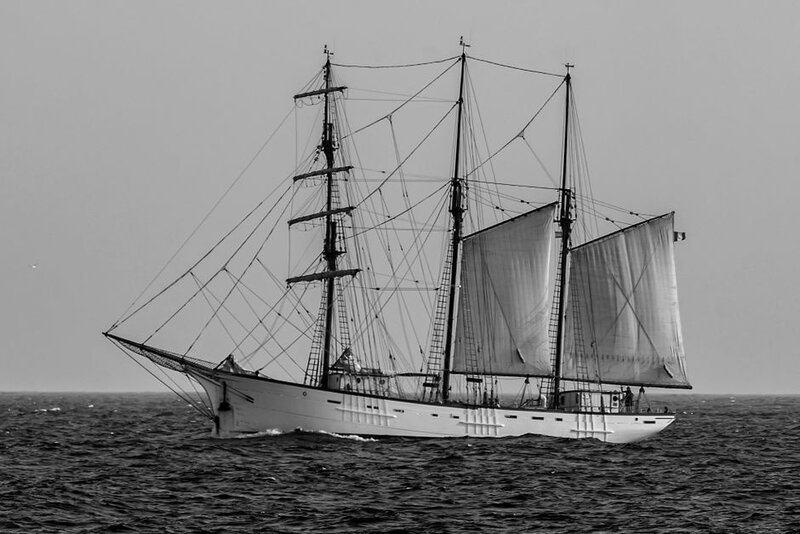
On the morning of May 21, 1891, a three-masted schooner named the Thomas Hume slipped out of Chicago harbor, turned her bow north across the gray chop of southern Lake Michigan, and sailed off the edge of the known world. No distress signal. No wreckage. No bodies. She simply ceased to exist, taking with her somewhere between six and seven men and leaving behind nothing but silence and an absence so complete it would haunt the Great Lakes for more than a century.
The Ship That the Lake Swallowed Whole

What made the Thomas Hume‘s disappearance so unsettling — even by the brutal standards of Great Lakes maritime history — was not the sinking itself but the totality of it. Ships went down on Lake Michigan with grim regularity in the late nineteenth century. They almost always left something behind: a shattered spar, a hatch cover spinning in the swells, a body eventually washed ashore. The Thomas Hume left nothing. It was as if 132 feet of working schooner and every soul aboard her had been erased rather than sunk.
She was, by the measures of her era, an ordinary vessel doing ordinary work. Built for cargo rather than comfort, the Thomas Hume was a three-masted lake schooner owned by the Hackley & Hume lumber company — one of the dominant forces in the Muskegon, Michigan, timber trade. She hauled lumber south to Chicago and returned north empty, running the same route again and again in service of an industry that was consuming the forests of the Great Lakes region at a ferocious pace. Her crew knew her rhythms. They had made this crossing dozens of times. And then, on a spring morning in 1891, they made it for the last time.
Lumber, Lakes, and the Ruthless Economy of 1891

To understand why the Thomas Hume was out there at all — riding high on an empty hull in the unpredictable waters of southern Lake Michigan — you have to understand the world she sailed in. The late nineteenth century was the apex of the Great Lakes lumber trade, a roaring industrial system that linked the pine forests of Michigan and Wisconsin to the insatiable appetite of Chicago, then one of the fastest-growing cities on earth. Muskegon alone was sometimes called the “Lumber Queen of the World,” its mills screaming day and night, its harbor perpetually choked with schooners loading and unloading timber.
The Chicago-to-Muskegon run was the workhorse route of this economy, but workaday never meant safe. The southern basin of Lake Michigan is particularly treacherous — shallow enough that storms build short, steep, violent waves with alarming speed, waves that hit a vessel like a series of hammer blows rather than the long rolling swells of open ocean. Sailors respected the crossing. They also had no choice but to make it, season after season, because the economy demanded it and because that was the job.
The Thomas Hume, on that final voyage, was sailing northbound and empty after unloading her lumber cargo in Chicago. An unladen schooner rides high in the water, her hull exposed to the wind, her stability reduced. She is more vulnerable, not less, than a loaded ship — and May on Lake Michigan is among the most treacherous months, a time when winter’s cold still grips the deep water while warm spring air rolls in from the south, spawning fast and unpredictable storms with very little warning.
Exactly how many men were aboard when she left Chicago remains, maddeningly, unresolved. Some records place the crew at six; at least one source states seven hands were lost. The discrepancy is small in number but large in implication — it quietly underscores just how completely the ship and her people were swallowed, leaving even the basic accounting of lives unfinished. The mysterious circumstances of her disappearance meant that even the most fundamental facts slipped through history’s fingers.
One historical note deserves clarification: at least one account incorrectly places the Thomas Hume‘s disappearance in September 1891. The weight of evidence — and the more reliable sources — firmly establishes the date as May 21, 1891. The error has circulated long enough to muddy the record, and it should not be repeated.
When Silence Becomes Every Story at Once

In the weeks and months after the Thomas Hume failed to arrive in Muskegon, the absence of facts created a vacuum that rumors rushed to fill. When a ship vanishes without a trace, the human mind — unwilling to accept the plain violence of nature — reaches for narratives it can understand and assign blame within. There was talk of mutiny. There were whispers about insurance fraud, the suggestion that the ship had been scuttled deliberately for the payout, her crew scattered to new lives under new names.
The southern Lake Michigan region has long attracted such stories, a stretch of water where the absence of answers has historically invited the supernatural to step in. The Thomas Hume was not the first ship to vanish there and inspire dark theorizing, and she would not be the last. It is worth being plain about the Lake Michigan Triangle, however: it is a piece of folklore, not a recognized navigational phenomenon. Ships vanish on Lake Michigan for the same reasons ships vanish anywhere — weather, mechanical failure, human error — and the Thomas Hume is not evidence of anything stranger than that.
But for the Hackley & Hume company and for the families of the crew, the mystery was not a matter of folklore — it was a wound that never closed. Losing a ship was a financial blow, the kind that could be absorbed by a large lumber operation. Losing men with names and families was something else. And the not-knowing was its own particular cruelty, a grief without the finality that even the worst news can provide. For the wives and children left behind in Muskegon, there was no grave to visit, no definitive moment to mourn from. There was only the lake, vast and indifferent, keeping its secret.
Without physical evidence, the Thomas Hume entered a strange liminal space — neither fully a disaster nor fully a mystery, talked about in maritime circles, logged in the loss registers of the insurance underwriters, and then gradually receding from living memory into the long list of ships the Great Lakes had taken and refused to explain.
Found: 150 Feet Down, Largely Intact

More than a hundred years after she vanished, the Thomas Hume was found.
She was lying on the floor of southern Lake Michigan in approximately 150 feet of water — and she was largely intact. Not a broken ruin scattered across the lakebed. Not a field of splintered timber slowly dissolving into sediment. A schooner, recognizable and upright, the bones of her hull and her three masts still telling the shape of the ship she had been on the morning she left Chicago for the last time.
The discovery was credited to the Michigan Shipwreck Research Association, which located the wreck using side-scan sonar during a systematic survey of the southern lake bottom. Researchers and divers encountered what looked less like a wreck and more like a ship that had simply been set down on the bottom and left there, suspended in a world where time moves differently than it does on the surface. The subsequent archaeological investigation is documented in a detailed report produced through Grand Valley State University, which provides the most thorough published account of the wreck’s condition and the evidence it yielded.
The reason for her remarkable preservation lies in the nature of the lake itself. Lake Michigan’s depths are cold — near freezing at 150 feet — dark, low in oxygen, and entirely free of the saltwater that destroys wooden hulls in ocean environments. The same conditions that make deep Lake Michigan so lethal for those who fall into it also make it an extraordinary time capsule. The wreck sits in a world where the forces of decay operate at a fraction of their normal speed, preserving the ship in a state of suspended twilight that no surface environment could replicate.
What the Evidence Finally Said: Storm, Not Scandal

The condition of the wreck, paradoxically, was itself a form of testimony. Investigators concluded that the Thomas Hume had succumbed to a storm. The reasoning was forensic and straightforward: the hull was too intact, too structurally undamaged, to be the victim of a collision with another vessel — one of the theories that had circulated in the years after her disappearance. A ship struck hard enough by another vessel to be sent to the bottom would bear the marks of that impact. The Thomas Hume showed no such damage.
What the evidence suggested instead was a vessel overwhelmed by wind and water, driven under before she could be rescued or before her crew could mount an effective response. An empty schooner, riding high, caught by a spring storm on the southern lake, could go down fast — fast enough that the ship settled relatively cleanly, sparing her hull the catastrophic damage of a vessel that broke apart on the surface before sinking. The physical evidence, as the wreck site tells it, points consistently to a sudden, storm-driven foundering rather than anything more complicated.
For the families who waited in 1891, for the port of Muskegon that wondered and theorized and grieved, the answer that finally came is simultaneously the most ordinary and the most devastating one possible: a storm took her. No mutiny, no fraud, no supernatural intervention. Just the old lethal arithmetic of wind and water and a spring afternoon that turned murderous faster than anyone could survive it. Somehow that makes it more heartbreaking, not less.
What the wreck cannot tell us is everything else: the exact moment the storm overwhelmed her, the precise sequence of what went wrong, the last actions of the men on deck as the lake rose around them. Some silences the lake keeps even after it gives up its dead. The schooner’s hull is there. The men are not. And no amount of careful archaeology can recover what happened in those final minutes on the surface of a lake that had already decided it was done with the Thomas Hume and all who sailed her.
A Wreck as Memorial, a Lake as Mirror

The Thomas Hume is one of hundreds of ships lost on the Great Lakes — the inland seas that most of the world forgets are oceans in all but name. But her near-perfect preservation and her century-long disappearance make her an unusually powerful window into the industrialized, dangerous world of late nineteenth-century lake commerce: a world of timber barons and working sailors, of schooners driven by economics as surely as by wind, of families in lakeside towns who understood that the men they loved might not come home from a routine crossing.
Underwater wrecks are not only archaeological sites. They are memorials. The Thomas Hume is still, in the most literal sense, the last resting place of the men who crewed her, and that fact shapes how researchers, divers, and preservationists approach her. She is evidence, yes — but she is also a grave, and the distinction matters. Those who dive the site today do so under that understanding: careful observation is welcome; disturbance is not.
Lake Michigan continues to yield its secrets slowly and on its own terms. Each discovery reframes our understanding of how industrialization, labor, and nature collided on these extraordinary bodies of water. Each wreck recovered from the cold dark returns a human story that the lake had nearly claimed permanently.
Somewhere in 150 feet of cold water, the Thomas Hume sits as she settled more than 130 years ago. Sails long gone. Crew long gone. But the ship herself still there, still holding the shape of a vessel that left Chicago on a May morning in 1891 and sailed, without drama or farewell, into the longest and most private silence Lake Michigan ever kept.

 English
 Arabic
 French
 Spanish
 Portuguese
 Deutsch
 Turkish
 Italiano
 Russian
 Romaian
 Portuguese (Brazil)
 Greek
Greek