


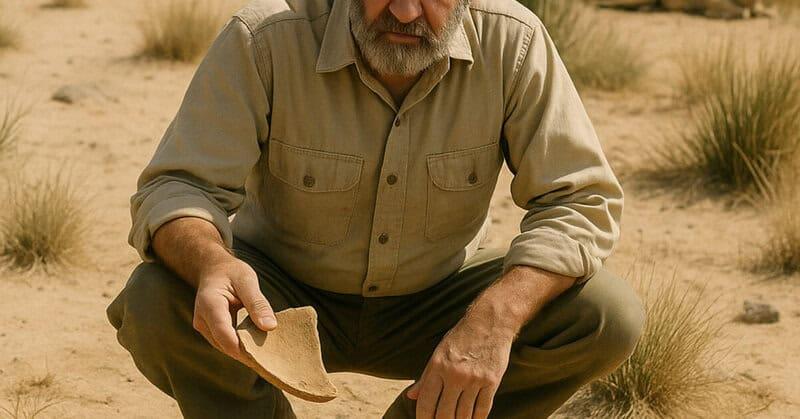
In the spring of 1978, an Egyptian military helicopter set down near Jebel Musa — the granite peak tradition identifies as the biblical Mount Sinai — and the soldiers who stepped out onto the wind-scoured plateau stumbled across a scatter of potsherds and bones. Archaeologists summoned to the scene felt the familiar electric charge of possibility before the dating verdict arrived: Byzantine, not Bronze Age, roughly a thousand years too late. The desert had teased them again.
The Silence of the Sand

That near-miss captures something essential about Exodus archaeology — the maddening gap between what the story promises and what the ground delivers. The biblical narrative describes an event of staggering scale: hundreds of thousands of people trudging through one of the world’s harshest landscapes for forty years, with the text enumerating 600,000 fighting men alone. By any reasonable calculation, that migration should have left an enormous archaeological footprint — tent rings, hearth ash, middens, burials, broken pots, lost tools. After more than a century of systematic excavation across Egypt and the Sinai Peninsula, that footprint is essentially invisible.
The silence is not merely academic. For hundreds of millions of Jews, Christians, and Muslims, the Exodus is not a footnote in ancient Near Eastern history but the founding act of monotheism — the moment when a God intervened in human affairs, shattered the power of the greatest empire on earth, and forged a covenant with a liberated people. When archaeologists report that they cannot find it, the news lands differently than a report about a missing Hittite settlement. Which is exactly why the debate has burned so fiercely for so long, drawing in scholars of genuine brilliance who reach opposite conclusions from the same evidence.
This is not an attempt to debunk the Exodus or to vindicate it. It is a walk through what excavators have actually found, what they have not, and why the argument remains so stubbornly alive.
What the Bible Claims — and What That Would Require

The story moves with the momentum of myth and the texture of memory. Israelites, descendants of the patriarch Jacob, settle in Egypt during a famine. Generations pass, a pharaoh rises who did not know Joseph, and the settlers become slaves. After ten devastating plagues, a leader named Moses guides them out through a miraculously parted sea, receives divine law at a desert mountain, and leads the community — imperfectly, stumblingly — across forty years of wilderness wandering toward a land promised to their ancestors. It is a narrative that has structured Western moral imagination ever since.
Translated into archaeological expectations, such a migration should have produced abundant evidence. Forty years of campsites across a peninsula roughly the size of Switzerland would mean countless fire pits, food waste, broken ceramics, and human burials. Egyptian administrative records, meanwhile, are famously thorough — surviving papyri track grain rations, labor rosters, and border crossings with bureaucratic precision. If hundreds of thousands of people departed Egypt in a single dramatic episode, some trace of that departure, or of their prolonged sojourn as slaves, ought to appear somewhere in the documentary record.
Complicating every investigation is a dating problem that has never been fully resolved. Scholarly estimates for when the Exodus might have occurred range across several centuries. Some place it during or just after the Hyksos expulsion around 1550 BC, when a Semitic population was driven out of Egypt’s northeastern delta. Others favor the reign of Ramesses II, who ruled from approximately 1279 to 1213 BC and built on a scale that fits the biblical description of Israelite labor at the store cities of Pithom and Ramesses. Without consensus on the date, archaeologists are not entirely sure which layer of soil they are looking for, or which pharaoh’s archive might contain the relevant records.
As for Egyptian documentation, the silence is total. No surviving inscription, papyrus, or administrative record mentions an Israelite population in Egypt, a series of plagues, or a mass departure of slaves. Scholars who find this silence damning note that Egyptian scribes recorded even minor border incidents. Scholars on the other side counter that Egyptian texts were also famous for omitting humiliating defeats — the Battle of Kadesh was spun as a triumph despite being a costly draw — and that the absence of a record is not the same as a record of absence.
A Stele Speaks: The Merneptah Inscription

Against that silence, one artifact stands apart. In 1896, the British Egyptologist Flinders Petrie was excavating at Thebes when his team uncovered a slab of black granite nearly ten feet tall, covered in hieroglyphic text celebrating the military campaigns of the pharaoh Merneptah, who ruled Egypt from approximately 1213 to 1203 BC. Near the end of the inscription, among a list of defeated peoples and cities, appeared a name that stopped scholars cold: Israel.
“Israel is laid waste, its seed is no more.” The boast was conventional Egyptian hyperbole, almost certainly exaggerated. But the name was real, and its implications were immediate. The Merneptah Stele is widely regarded as the most famous and arguably most important archaeological discovery related to Moses and the Exodus — because it constitutes the earliest known extrabiblical reference to Israel as a distinct people. Whatever else one believes about the Exodus, by roughly 1208 BC a group identifiable as Israel existed in or near Canaan. Any Exodus, if it occurred, must have concluded before that date, which tightens the chronological window considerably.
The hieroglyphic determinative — a scribal symbol appended to a word to indicate its category — is particularly revealing. Merneptah’s scribes attached to “Israel” a sign indicating a people or ethnic group rather than the determinative used for a settled city-state or a territorial land. Many scholars read this as evidence that Israel in 1208 BC was not yet an established political entity with fixed borders, consistent with a population that had only recently arrived in the region or was still semi-nomadic — and therefore consistent with a group that had recently emerged from a desert journey.
What the stele does not prove is equally important to state clearly. It says nothing about Egypt, slavery, Moses, desert wandering, or divine intervention. Maximalist scholars embrace it as a crucial chronological anchor. Minimalists note, correctly, that it merely confirms a people named Israel existed near Canaan around 1208 BC — a fact compatible with many historical scenarios, not only the one described in the book of Exodus.
Decades in the Field: What Excavations Have — and Haven’t — Found

The search has been serious and sustained. Flinders Petrie, who found the stele, also conducted pioneering digs at Tell el-Hesi in the 1890s, helping establish the principle of ceramic stratigraphy that would become a cornerstone of Near Eastern archaeology. Decades later, Israeli archaeologist Eliezer Oren led a systematic survey of the northern Sinai’s ancient military road during the 1970s and 1980s, uncovering a chain of Egyptian forts that guarded the route between Egypt and Canaan. His team found evidence of Egyptian administrative presence, trade goods, and military activity — but nothing that could be identified as an Israelite camp or a Semitic refugee settlement from the Bronze Age.
The most tantalizing delta site is Tell el-Dab’a, ancient Avaris, where the Austrian archaeologist Manfred Bietak spent decades uncovering a large Semitic settlement in the Nile Delta dating to roughly 1700-1550 BC. The population here spoke a Semitic language, practiced Semitic burial customs, and lived in a region that corresponds geographically to the biblical land of Goshen. For maximalist scholars, Avaris is electrifying — a real Semitic community in the right place at a plausible time. The complication is primarily chronological: the settlement predates the most favored Exodus candidates by a century or more, and the community appears to have been absorbed into or expelled from Egypt during the Hyksos period rather than during the reign of Ramesses II.
Ongoing scholarship continues to reassess how archaeological evidence from key sites might align with the biblical timeline, and the conversation is far from closed. Critics of the “no evidence” conclusion point to a genuine methodological problem: the Sinai Peninsula is vast, wind erosion over three millennia is severe, and Bronze Age nomadic camps — people living in tents, cooking over wood fires, carrying ceramic vessels that could shatter and be buried under drifting sand — leave almost nothing behind even under ideal preservation conditions. Absence of evidence, they argue, is not evidence of absence, particularly for a tent-dwelling migrant population traversing a geologically aggressive landscape that has never been fully and systematically surveyed.
The scientific tools applied to this question have grown more sophisticated over time. A peer-reviewed reassessment published in the ISCAST journal applied radiocarbon dating constraints at key archaeological sites to test whether the archaeological timeline could be reconciled with Exodus and Conquest narratives. The study illustrates that the debate is not simply a clash between faith and skepticism but an ongoing, methodologically rigorous scientific conversation in which new data can and does shift positions.
Two Camps of Scholars: Minimalists vs. Maximalists

Biblical archaeology has long been divided into two broad schools of thought, though the line between them is blurrier than popular accounts suggest. Minimalists tend to treat the Hebrew Bible as a relatively late theological document, largely composed or substantially elaborated during the seventh century BC, with limited reliable historical memory of Bronze Age events. Maximalists approach the text as a source that, read carefully and cross-referenced with Near Eastern parallels, preserves genuine historical kernels buried beneath layers of literary elaboration.
The minimalist case, associated with scholars including Israel Finkelstein and Neil Asher Silberman, rests heavily on the archaeological silence. Their argument is that the Exodus story served a nation-building purpose for the emerging Israelite monarchy, providing a unifying origin narrative that did not need to be a precise historical record to be culturally powerful. The story, in this reading, is theology expressed as history — profound, influential, and largely constructed as a coherent narrative during a specific political moment.
The maximalist counter, represented by scholars such as James Hoffmeier and Kenneth Kitchen, argues that the details embedded in the Exodus text are too culturally specific to be late invention. Egyptian place names, administrative titles, and court customs described in the narrative reflect genuine knowledge of New Kingdom Egypt — knowledge that a seventh-century BC author would have had difficulty fabricating convincingly. Semitic slaves are well-attested in New Kingdom Egyptian records. Border papyri describe small groups of Asiatic laborers crossing into and out of Egypt. The cultural texture, maximalists argue, is authentically Egyptian in ways that demand explanation beyond dismissal as literary fiction.
Notably, this debate does not map neatly onto religious versus secular assumptions. Some deeply religious archaeologists align with minimalist interpretations, finding that the theological meaning of the Exodus survives intact even if the historical details are largely symbolic. Some secular historians find the maximalist arguments about textual authenticity surprisingly compelling on purely literary and comparative grounds. This is a genuine scholarly contest, driven by evidence and interpretation rather than by simple cultural allegiance.
The Smaller Exodus Hypothesis: A Third Way

Increasingly, a third position is gaining traction among scholars who find both extremes unsatisfying. It begins with the biblical numbers. Ancient Near Eastern texts routinely used large numbers symbolically — to convey grandeur, divine favor, or the magnitude of an event — rather than as precise headcounts. The Hebrew word eleph, conventionally translated as “thousand,” can also denote a military unit or clan group of indeterminate size. If the Exodus narrative’s figures are symbolic or conventionalized rather than literal, the actual event may have involved a much smaller group: perhaps several thousand people, or fewer.
Some scholars argue that if the Exodus involved a smaller group rather than a mass departure, both archaeological and textual evidence that could support the event’s historicity comes into sharper focus — including Egyptian records of small groups of Asiatic slaves and refugees crossing the border, which do exist and are well-documented. A caravan of several thousand people crossing the Sinai over a period of decades genuinely might not leave recoverable archaeological traces, given erosion rates, the incompleteness of survey coverage, and the near-impossibility of identifying a small nomadic group’s campsites after three millennia.
This reframing is intellectually attractive but theologically inconvenient on multiple fronts. It preserves historical plausibility while challenging literalist readings of the text. It satisfies neither committed minimalists, who regard it as special pleading to rescue an essentially mythological narrative, nor committed maximalists, who resist any scaling-back of the biblical account. Yet it is increasingly where the evidentiary center of gravity appears to be settling — a historically rooted kernel, dramatically amplified by centuries of retelling, theological reflection, and the sheer narrative power of a story too important to remain small.
What the Desert Still Might Yield — and Why It Matters
The search is not finished. Renewed excavations at sites along the northeastern delta, continued LiDAR surveys capable of detecting buried landscape features invisible to the naked eye, and fresh analysis of Egyptian papyri in museum collections that have never been fully studied could still produce the kind of game-changing discovery that the Merneptah Stele once delivered to a startled Victorian world. Every dig season brings that possibility. The desert has surprised scholars before and will again.
The deeper lesson the Exodus debate offers is about how archaeology actually works. It is not a simple fact-retrieval machine that produces clean verdicts. It is an interpretive discipline in which the same sherd, the same stele, the same layer of ash can mean radically different things depending on the questions, assumptions, and frameworks an excavator brings to the site. The silence of the Sinai sand is real data — but data that does not interpret itself.
And then there is the question that no trowel can answer. Whatever its precise historical kernel, the Exodus narrative has structured the moral imagination of billions of people across thirty centuries. It gave language to the American abolitionist movement, to liberation theologians in Latin America, to civil rights marchers crossing a bridge in Selma, Alabama, and to communities throughout the world who reached for this story when they needed a vocabulary for freedom, resistance, and the belief that suffering is not the final word. That is a kind of historical reality — a force that has shaped events, toppled regimes, and sustained communities under oppression — that archaeology can illuminate but never fully excavate.
The desert is almost certainly holding more than it has given up. The next dig season, the next CT scan of an unwrapped papyrus, the next recalibrated radiocarbon date could shift the entire conversation in ways that would have astonished Flinders Petrie, standing over that granite stele in 1896 with the dust of Thebes still on his hands. The argument is not settled. In a story this old and this important, that may be precisely the point.

 English
 Arabic
 Spanish
 Portuguese
 Deutsch
 Turkish
 Dutch
Dutch
 Italiano
 Russian
 Romaian
 Portuguese (Brazil)
 Greek
Greek