


On a warm June evening in 1926, an elderly man in a threadbare coat lay bleeding on the cobblestones of Barcelona’s Gran Via de les Corts Catalanes, struck down by a tram, while the city’s residents stepped around him — certain, from the look of his cracked shoes and worn clothes, that he was simply another vagrant who had stumbled into the road.
A Stranger in the Street

The bitter irony of that moment would take hours to fully land on Barcelona. The old man in the dust was Antoni Gaudí i Cornet — the most celebrated architect in Spain, the visionary whose half-built cathedral already clawed at the city’s skyline like a stone forest reaching for heaven. Several taxi drivers refused to carry him. His appearance offered no reason to hurry. Only when a policeman finally intervened was Gaudí brought to the Hospital de la Santa Creu, the city’s medieval charity hospital — the place where paupers went to die. He had no money in his pockets, no identification on him. He arrived as a nobody, and for a few terrible hours, that is what he remained.
Three days later, on June 10, 1926, Antoni Gaudí died in that same hospital ward. The funeral procession that followed would stretch for miles through the very streets that had failed to recognize him. The story of those three days — the accident, the anonymity, the vigil, the grief — is one of the most haunting parables in the history of art: a city that could not see its own genius until it was too late to save him.
The Evening Walk He Always Took

To understand how Gaudí ended up bleeding and unrecognized on a Barcelona street, you have to understand the man he had become in his final years. At 73 — his 74th birthday was only fifteen days away — he had shed nearly every comfort that his fame might have afforded him. He had given away his wealth. He slept in the workshop at the Sagrada Família construction site, surrounded by plaster models and architectural drawings. He ate so little that friends and colleagues grew openly worried. His daily routine had contracted to the essentials: prayer, work, and the walk between the two.
Every evening, Gaudí made the same journey — from the church of Sant Felip Neri, where he prayed, toward the Sagrada Família. It was less a commute than a pilgrimage, repeated with the quiet discipline of a monk who had organized his entire life around a single, consuming act of devotion. The route was familiar to the point of invisibility. He knew every stone of it. On the evening of June 7, 1926, he set out as he always did, and a tram came as it had never come before.
His appearance — the worn coat, the rough hands, the unshorn beard — was not poverty by accident. It was poverty by conviction. Gaudí had looked at the cathedral he was building, at its soaring ambition and its decades-long demand on every human resource he possessed, and had decided that nothing should compete with it. Not comfort, not vanity, not even the social legibility that might have told a taxi driver, at a glance, that this man was worth stopping for. That decision, made in faith, would cost him the minutes that might have saved his life.
Three Days Between the Accident and History

The Hospital de la Santa Creu was an institution built for those with nowhere else to go. Its Gothic cloisters had sheltered Barcelona’s sick and destitute for centuries. When Gaudí was carried through its doors on the evening of June 7, unidentified and unconscious, he was simply one more broken body in a place that received many. It was only later — accounts differ on exactly how long it took — that someone recognized the gaunt face beneath the matted hair, and the word began to move through the city.
Once his identity was known, Barcelona’s wealthier circles stirred. Offers came to transfer him to a private clinic, to give him the care that his stature surely deserved. Gaudí, it is said, refused. He had arrived among the poor, and among the poor he would stay. Whether this was a final act of principled humility or simply the decision of a man too gravely injured to be safely moved, it sealed something about the story — a last, wordless statement about how he had chosen to live.
For three days, the city held its breath. His collaborators came. Clergy came. Admirers who had followed his work for decades filed through the ward and stood at the bedside of a man who had remade what architecture could be, now fading in a charity hospital because strangers had mistaken him for someone who did not matter. At 5 PM on June 10, 1926, fifteen days before what would have been his 74th birthday, Antoni Gaudí i Cornet died.
The Cathedral He Left Behind

In 1926, the Sagrada Família was less a building than a promise written in stone. The crypt was complete. The towers of the Nativity façade rose dramatically enough to anchor the Barcelona skyline and draw visitors from across Europe. But the vast central nave, the Glory façade, and the great central tower of Jesus Christ that Gaudí intended to be the tallest element of the entire structure — all of it existed only in drawings, correspondence, and the elaborate plaster models that his workshop had been refining for years.
Gaudí had worked on the Sagrada Família for more than forty years, and he had understood for most of that time that he would never see it finished. He designed it anyway — at a scale and with a complexity that would outlast several human lifetimes. This was not hubris. It was, in his view, the correct response to building something for God rather than for a client with a deadline. The cathedral’s timeline was geological. His role was simply to begin it correctly and trust that others would carry it forward.
That trust was tested almost immediately. In 1936, during the Spanish Civil War, anarchists burned Gaudí’s workshop in the crypt. The plaster models — the primary record of his intentions for the unbuilt portions of the cathedral — were smashed and scattered across the floor. Decades of patient reconstruction followed, piecing together thousands of fragments like a three-dimensional jigsaw puzzle, trying to reverse-engineer a dead man’s vision from its shattered remains. The work of interpreting and continuing Gaudí’s design has never fully stopped, and arguments about how faithfully any continuation can honor the original remain alive to this day.
The Sagrada Família is now the most visited construction site in the world. Millions of people pass through it each year, moving between towers that Gaudí completed in his mind and towers that are still rising from the ground. The basilica launched its centenary commemoration program in October 2025, with a calendar of events building toward June 10, 2026 — one hundred years to the day since Gaudí died in that charity hospital ward.
Why Barcelona Wept — and Why It Had Failed Him

The funeral was immense. Tens of thousands of people lined the streets as Gaudí’s coffin was carried from the Hospital de la Santa Creu to the crypt of the Sagrada Família, where he had asked to be buried. It was one of the largest public mournings in the city’s modern history — a spontaneous outpouring that filled the streets and spilled from the pavements into the road. Barcelona had recognized its loss.
But recognition, arriving three days late, carries a particular weight. This was a city that had watched its greatest living architect lie in the gutter while people walked past. That had sent taxi after taxi away from a dying man because his coat was too old. The grief in those funeral crowds was genuine, but it was threaded through with something harder to name — a collective guilt that a city absorbed and has never entirely metabolized.
Gaudí’s deliberate self-erasure was, in the deepest sense, an act of faith. He had made himself anonymous so that the cathedral could be everything. But anonymity, in a city full of strangers, is indistinguishable from insignificance. The poverty he chose as a spiritual practice became, in the moments after the tram struck him, a social verdict. The city read his clothes and moved on. There is something in that failure that extends far beyond Gaudí, beyond Barcelona, beyond 1926 — a parable about how societies assign value, and how easily they overlook the people who have given the most to them.
The Buildings That Redefined a City

The Sagrada Família is only the most visible of the things Gaudí left behind. Casa Batlló, Park Güell, and Casa Milà — structures that bent the grammar of architecture toward the organic, replacing straight lines with the curves of bones and shells and breaking waves — were already reshaping how the world thought about what buildings could be. His influence spread beyond Catalonia: the sinuous ironwork, the mosaic surfaces, the parabolic arches he developed through careful study of natural load-bearing forms anticipated structural ideas that engineers would not formalize for decades.
His death froze that evolution mid-sentence. There is no knowing what he might have designed in the years that followed, what further experiments in natural form and structural ingenuity he might have pursued. What remained instead was a body of completed work extraordinary enough to define an entire city’s identity, and an unfinished cathedral that became, paradoxically, the most enduring monument to the idea that some things matter too much to be hurried.
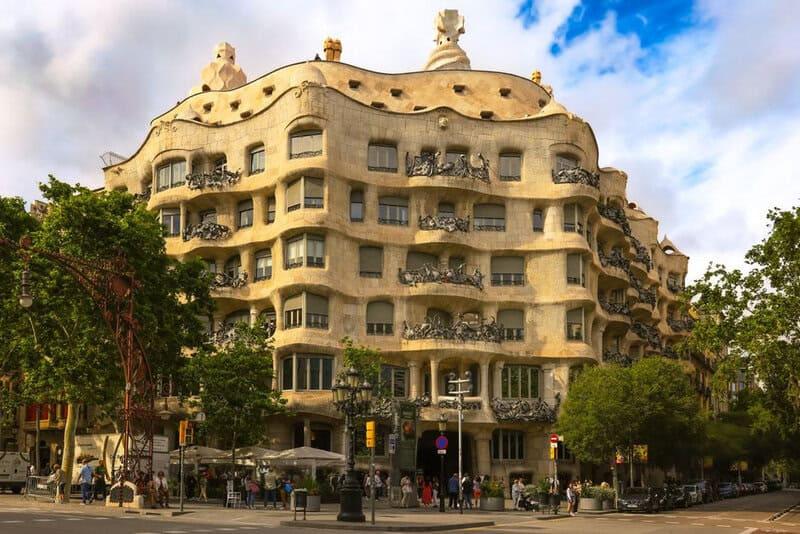
Casa Milà — La Pedrera — is among the institutions marking 2026 as a Gaudí Year, with a full calendar of events recognizing the centenary across the buildings he left standing in Barcelona. The anniversary is being observed not merely as a local commemoration but as an international cultural moment, reflecting how completely Gaudí’s work has passed into the shared inheritance of world architecture.
Beatification and the Question of Sainthood
In 2000, the Catholic Church opened a cause for Gaudí’s beatification — the formal process that could lead, eventually, to sainthood. The man his contemporaries called “God’s architect” may yet be recognized by the institution he served so absolutely. It is a process that moves slowly, as his cathedral did, measured in decades rather than years.
The Pope is expected to mark the centenary of Gaudí’s death in 2026 — a recognition that the architect’s legacy has grown large enough to belong not just to Barcelona, or to Spain, but to the wider history of human devotion expressed in built form. For those who have followed the beatification cause, that papal acknowledgment carries weight beyond the ceremonial: it signals that the institutional Church continues to take seriously the possibility that the man who gave his life — and ultimately his life itself — to building a cathedral may one day be formally declared a saint.
One Hundred Years On
June 10, 2026 will mark a century since Gaudí died. The Sagrada Família will not be finished by then — the full realization of his vision remains some years beyond that milestone — but its most iconic elements are expected to reach a significant new stage of completion, timed deliberately to honor the centenary. There is something deeply Gaudían about that: a deadline set within a century-long project, organized around an absence rather than a presence.
What the anniversary asks, more than any celebration can answer, is how we sit with the unfinished. Gaudí spent his life in deliberate relationship with incompletion — not as a failure of ambition, but as the honest condition of any work that reaches toward something genuinely beyond the reach of one human life. The cathedral was always going to outlast him. He built it to. The question the centenary raises is whether we have learned anything, in a hundred years, about how to see the people among us who are doing the hardest and most important things — before it takes a funeral to make them visible.
On a Barcelona street in June 1926, an old man in a threadbare coat lay in the dust while the city moved around him. In the workshop he had just left were the plans for one of the greatest buildings the world has ever seen. The tram that struck him did not stop the work. It only removed his hands from it. A hundred years of other hands have continued in his place, and the cathedral he imagined is still, slowly, becoming what he knew it could be.

 Arabic
 French
 Spanish
 Portuguese
 Deutsch
 Turkish
 Dutch
Dutch
 Italiano
 Russian
 Romaian
 Portuguese (Brazil)
 Greek
Greek