


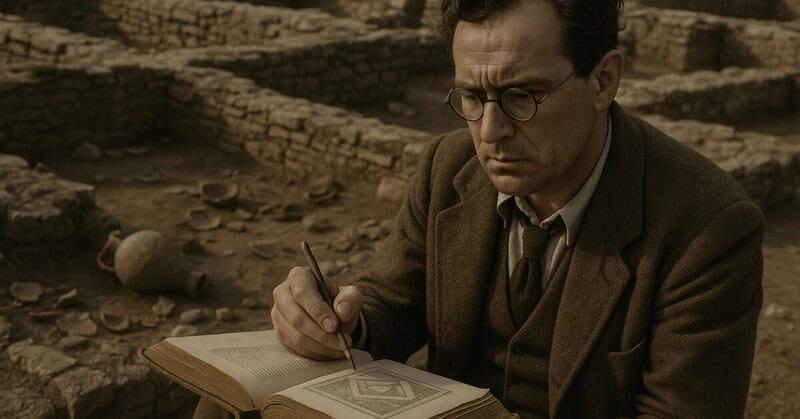
In 348 BC, Philip II of Macedon destroyed Olynthus so completely that the city simply ceased to exist. No conqueror rebuilt it, no new population moved in to disturb the layers — it was sealed under Greek soil like a letter never opened, its streets and painted floors and broken pots waiting undisturbed for more than two thousand years.
The City Philip Burned — and the Dig That Lit Another Fire

When archaeologists describe a “perfect” site, they mean something close to what Olynthus offered: a single destruction event, a clean stratigraphic horizon, no later occupation to scramble the evidence. Philip’s thoroughness was, from one angle, a gift to posterity. Every mosaic floor left behind, every storage jar cracked in the heat, every loom weight dropped in a panicked household belonged unmistakably to a single moment in classical Greek life. The site promised to answer questions that grander, more continuously occupied cities — Athens, Corinth, Sparta — could never cleanly resolve: How did ordinary Greeks actually live? What did their houses look like from the inside? What did they eat, store, worship, and discard?
That promise drew David Moore Robinson to northern Greece in 1928. A classicist at Johns Hopkins University, Robinson arrived with institutional backing, considerable ambition, and the authority of a man accustomed to directing large enterprises. What followed, over ten seasons running through 1938, was an excavation that generated fourteen published volumes and genuine archaeological discoveries of lasting importance — and a controversy sharp enough that a contemporary observer described it as a scandal being aired in Athens. The city Philip destroyed in a single season proved far more durable than the excavation’s reputation.
Robinson’s Empire: Power, Prestige, and the Johns Hopkins Machine

To understand what went wrong at Olynthus, it helps to understand what Robinson was building. He was not merely excavating a site; he was constructing a legacy. The excavation operated as a personal fiefdom, with Robinson controlling the fieldwork, the interpretation, and above all the publications that would determine how Olynthus was remembered by the scholarly world. Those publications — the Excavations at Olynthus series — appeared from Johns Hopkins Press between 1929 and 1952, a monumental run of volumes issued under the institutional authority of Johns Hopkins University. The branding was deliberate: it gave the project the imprimatur that Robinson’s directorial role alone might not have sustained indefinitely.
Inside that imposing edifice of scholarship, the actual labor was distributed very differently from the way credit would eventually be assigned. Graduate students — many of them women — performed painstaking documentation in the field and rigorous analysis afterward, feeding Robinson’s publication machine with their intellectual work. This was not unusual for the era. Academia in the 1920s and 1930s operated under hierarchies of gender and professional rank that made the exploitation of junior scholars structurally expected rather than exceptional. Women could do the work. They could not, in practice, claim it.
The 1931 Season: Where the Worst of It Happened

The 1931 excavation season has since been identified as the nexus of one of the most egregious cases of academic misconduct connected to the site. That summer, among the students working under Robinson’s direction, was Mary Ross Ellingson. She was not a peripheral figure doing peripheral work. Ellingson performed detailed on-site documentation, developed interpretive frameworks for understanding the domestic architecture she was uncovering, and produced written analysis demonstrating exactly the kind of close, sustained engagement with the material that a site like Olynthus demanded.
Her work became her master’s thesis. Then it became her doctoral thesis. Both represented genuine scholarly contributions — the kind of sustained intellectual labor that, under any fair accounting, would have established her as a significant voice in the study of classical domestic architecture and material culture. Instead, they became raw material for someone else’s byline.
Robinson incorporated Ellingson’s master’s thesis and her doctoral thesis into two of his Olynthus volumes without attribution. Her words, her analysis, her interpretive framework — absorbed into the prestige of a Johns Hopkins publication series and published under his name. The plagiarism was hiding in plain sight, embedded inside one of the most formally credentialed archaeological publication series in American classical studies.
Plagiarism in Plain Sight: How Robinson Took Her Words

What made the theft so easy to sustain was not its cleverness but its context. Robinson’s name was synonymous with Olynthus. The volumes carried the weight of a respected university press. The sheer scale of publication — fourteen books across more than two decades — projected an authority that made critical reassessment feel almost impertinent. And Ellingson herself was a woman scholar in a mid-century academic world that offered women limited institutional power and even more limited recourse when wronged by senior men. To contest Robinson would have meant staking a junior career against a powerful director’s reputation, in an era when such contests had predictable outcomes.
The full shape of what happened to Ellingson remained peripheral to the canonical story of Olynthus for decades. It took Alan Kaiser’s book Archaeology, Sexism, and Scandal: The Long-Suppressed Story of One Woman’s Discoveries and the Man Who Stole Credit for Them — and the wider attention it received — to bring the history into sustained scholarly focus and name it plainly. Kaiser reconstructed the paper trail, identified the specific volumes implicated, and made the case for what Ellingson had actually contributed versus what she had been credited with — which was nothing. The cruel irony was structural: the very publication series designed to enshrine Olynthus’s discoveries for posterity had become the instrument of one scholar’s erasure from that record.
‘A Scandal Aired in Athens’: The Wider Problem with How Olynthus Was Dug

The plagiarism was not the only charge. Contemporary observers also criticized the excavation methods themselves, describing the dig as having been conducted in an unscientific manner — a damning verdict in a field actively trying to professionalize and distinguish itself from the treasure-hunting traditions of an earlier century. The criticism was apparently specific enough, and credible enough, to be discussed critically in Athens among Greek scholars and official observers who had a direct stake in how foreign excavators treated Greek heritage.
What did “unscientific” mean in practice during this period? It meant inadequate stratigraphic recording — the failure to document precisely where objects were found in relation to the soil layers that encode the passage of time. It meant finds removed without sufficient contextual notation. It meant the pace of digging taking priority over the rigor of recording. At a site as uniquely pristine as Olynthus, where the entire value lay in context — in the relationship between objects and the rooms they had occupied for two millennia — this was a particularly costly failure. Evidence irretrievably lost is not merely an academic problem; it is a permanent subtraction from the human record.
The phrase “scandal aired in Athens” also opens a window into how the Greek scholarly community experienced foreign excavations in this period — not always as gifts of knowledge freely shared, but sometimes as extractions conducted on Western institutions’ own terms, within a framework that granted foreign excavators enormous authority over Greek heritage while leaving Greek authorities with limited recourse when standards slipped. The archaeologists came, dug, published, and departed. The controversy, when it came, had to surface where the work was done.
The Long Silence: Why It Took Decades for the Truth to Surface

That the criticism existed at the time — apparently not entirely secret among informed observers — makes the subsequent silence more striking rather than less. Portions of the controversy were known, whispered about in certain circles, and yet the canonical narrative of Olynthus as a landmark American archaeological achievement largely held. Robinson’s prolific output was itself part of the mechanism of suppression: fourteen volumes projected mass and authority, and each new publication reinforced the framework he had built, making the whole edifice harder to challenge from outside. Institutions protect their investments, and Johns Hopkins had invested heavily in Olynthus.
The structural silencing of women in mid-century academia did the rest of the work on Ellingson’s story. She belonged to a generation of women scholars who performed essential intellectual labor and then watched it disappear into someone else’s bibliography. The professional risk of accusing a powerful director — of making the accusation stick, of being believed, of surviving the professional consequences — was simply too high. The archive preserved Robinson’s name. It did not preserve hers, at least not in the way it should have.
Scholarly examination of the Olynthus controversy represents a relatively recent reckoning — which is itself instructive. It demonstrates how long academic self-protection can defer accountability, and how much depends on individual researchers being willing to do the uncomfortable work of returning to the archive and asking whose labor, exactly, is encoded in these pages.
What the Evidence Actually Shows: Separating the Record from the Reputation
It is worth pausing to distinguish between what is well documented and what remains harder to pin down precisely. Kaiser’s scholarship establishes the plagiarism case against Robinson on firm textual grounds: the parallel passages between Ellingson’s theses and Robinson’s published volumes are a matter of documented record, not allegation. The methodological criticisms of the dig are attested in contemporary accounts and archival sources, though the full extent of what was lost through inadequate recording is, by definition, difficult to measure — losses of context leave no clean inventory of what they took. Readers approaching the primary sources will find the plagiarism case the more precisely documented of the two charges, while the methodological critique, though credible and corroborated, depends partly on inferences from what the published volumes do and do not record.
This distinction matters because the Olynthus case is sometimes invoked broadly as a cautionary tale, and caution is warranted in both directions: against whitewashing a genuine scandal, and against allowing the scandal to obscure the real archaeological value the site produced. Both things are true simultaneously, and the tension between them is part of what makes Olynthus such a revealing case study.
Olynthus Today: What the Scandal Teaches Us About Who Gets to Own the Past
Olynthus still matters. Its mosaic floors remain among the finest evidence available for classical Greek domestic decoration. Its house plans have shaped how scholars model the Greek urban household. The objects recovered from its rooms — mundane, broken, ordinary — still speak to questions about how people actually lived in the ancient world, questions that grander, more continuously occupied sites cannot answer as cleanly. The archaeological record from Olynthus is real and valuable, even as it is permanently entangled with questions about how it was produced and who was erased in producing it.
That entanglement is the point. The Olynthus case is not an outlier or an aberration; it is a prism. Held up to the light, it refracts issues that run through the history of archaeology globally and are still being actively reckoned with: excavation frameworks that treated other people’s heritage as Western scholarship’s raw material; the systematic appropriation of women’s intellectual labor by men with institutional power; the complicity of prestigious presses and universities in laundering that appropriation through the authority of publication. These are not questions archaeology has fully answered, even now.
The broader lesson for anyone reading history — professional or curious — is this: the authority of published scholarship, especially scholarship bearing the name of a great institution, is not the same thing as its integrity. The archive always contains the politics of the people who made it. Prestige can be a shield. Publication can be an erasure.
Philip II destroyed Olynthus so completely that it never rose again, its secrets preserved beneath the northern Greek soil for more than two millennia. The scandal of its excavation proved harder to freeze into the record — contested, suppressed, whispered about, and deferred for decades. But it is there now, named and documented, examined in peer-reviewed scholarship and open archival sources alike, as durable as any mosaic floor. Some things, it turns out, cannot be buried twice.

 English
 Arabic
 French
 Spanish
 Portuguese
 Deutsch
 Turkish
 Dutch
Dutch
 Italiano
 Russian
 Romaian
 Portuguese (Brazil)