


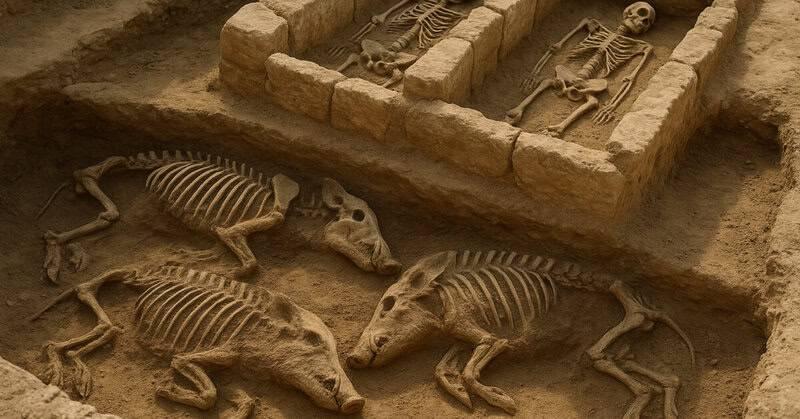
The trowel stopped. Beneath the dry sediment of Tell Kom Aziza, in Egypt’s western Nile Delta, what archaeologists expected to find was another human burial — one more fragment of the Greco-Roman necropolis they had been patiently mapping for weeks. What they found instead was a skull lined with tusks: the unmistakable face of a wild boar, whole and intact, lowered deliberately into the ancient earth as if someone had once decided this animal deserved a grave.
Not a Midden — a Burial

It was not a midden. Not the scattered remnants of a feast, nor the gnawed leavings of a predator. The boar was complete — Sus scrofa, the Eurasian wild boar, a muscular, bristled creature of forest and marsh — and it had been placed in the ground with apparent care. In archaeology, the difference between discarded and buried is everything. Discarded bones end up in fragments, out of order, mixed with ash and food waste. Buried bodies arrive whole, oriented, deliberate. These boars were buried.
Then the diggers found another. And another. A pattern emerged from the sediment, one that ruled out coincidence entirely and insisted, with the quiet logic of accumulated evidence, on repeated ritual — on a cultural practice performed more than once by people who believed they had good reasons for what they were doing. The discovery at Tell Kom Aziza now presents researchers with one of the more beguiling puzzles of recent Egyptian archaeology: why, on this particular patch of Nile Delta earth, did someone bury wild boars whole — and do so repeatedly?
To approach that question honestly, you have to understand two distinct worlds layered one atop the other at this site: a Greco-Roman city of the dead built over something older and stranger still.
A Delta Town With Deep Roots

Tell Kom Aziza sits in Egypt’s western Nile Delta, a region that has functioned as a cultural crossroads for longer than most civilizations have existed. The word tell — from the Arabic — describes something specific and important: an archaeological mound formed by centuries of continuous human habitation, each generation building on the ruins of the last, compressing layer upon occupation layer into a hill that rises almost imperceptibly above the surrounding plain. Walk across a tell and you are walking across time. Dig into one and you are reading backward through it, chapter by chapter.
The Nile Delta itself was never a quiet backwater. By the time Alexander the Great swept into Egypt in 332 BCE and ended Persian rule, the Delta had already absorbed waves of Libyan, Assyrian, and Persian influence. After Alexander came the Ptolemies — a Greek dynasty that ruled Egypt for nearly three centuries, blending Hellenic culture with ancient Egyptian tradition in ways that were sometimes deliberate political theater and sometimes genuine synthesis. After the Ptolemies came Rome, which absorbed Egypt in 30 BCE and administered it for centuries more. Throughout all of this, the Delta towns were where cultures collided: Egyptian priests, Greek merchants, Roman administrators, and communities whose identities braided together all these threads at once.
In such a world, what a society did with its dead was among the most revealing choices it made. Burial practice is theology made physical. It encodes beliefs about the soul, the afterlife, the relationship between the living and the dead, the power of gods and the vulnerability of human bodies. A necropolis — a city of the dead — is, in this sense, a kind of archive.
The Necropolis: A City Built for the Dead

The Greco-Roman cemetery uncovered at Tell Kom Aziza is precisely such an archive, and what archaeologists have found there reflects the complicated, layered identities of the people buried within it. The human burials date to the Greco-Roman period — roughly the last three centuries BCE through the early centuries of the Common Era — and they do not tell a single, uniform story. They tell many stories at once.
In Greco-Roman Egypt, burial was never simply one tradition or another. It was negotiation. Egyptian mummification persisted even as Greek-style interment became fashionable among certain communities. Roman funerary goods appeared in tombs alongside hieroglyphic amulets. The dead were wrapped in linen, adorned with cartonnage masks painted in the naturalistic portrait style popular under Roman influence, and accompanied by objects that spoke simultaneously to Egyptian, Greek, and Roman conceptions of the afterlife. A single burial could contain multitudes. The diversity of practices found at Kom Aziza embodies this hybridity — a population of mourners who drew on whichever traditions felt most appropriate, most powerful, or most true.
It is a rich document of ancient life. But to reach the deepest mystery of Tell Kom Aziza, you have to go further down.
The Boars Beneath the Bones

Stratigraphically — meaning in terms of the physical layers of soil and history — the wild boar burials sit beneath the Greco-Roman cemetery. They predate the human necropolis. Before this ground became a formal burial place for people, before the first Ptolemaic-era mourner lowered a wrapped body into this soil, someone had already been coming here and burying wild boars in it.
The significance of that sequence is hard to overstate. It means the boar burials are not a footnote to the human cemetery. They are, in a sense, its foundation — chronologically prior, occupying the earth before the necropolis existed. Reporting on the Tell Kom Aziza excavation confirms that the animals were found intact, whole-bodied, and deliberately interred. This is not the profile of butchery waste or casual disposal. It is the profile of ritual.
Consider the strangeness of it. Someone — we do not know precisely who, or in exactly which era preceding the Greco-Roman occupation — decided that this ground was the right place to bury a wild boar, whole. Then they, or others who shared their belief, came back and did it again. The multiple burials transform a single unusual event into a pattern, and patterns in archaeology speak of cultural meaning. People do not repeat meaningless acts in sacred-seeming ways. They repeat acts that carry weight — religious weight, apotropaic weight, the weight of tradition and obligation.
Wild boars do not bury themselves. Somebody buried these. The question is why.
Seth’s Animal: What the Boar Meant in Ancient Egypt

To approach an answer, you have to meet Seth. He is one of the oldest and most complicated figures in the Egyptian pantheon — a god of chaos, storms, the desert, and the untamed natural world. He is not simply a villain, though later mythology would cast him in that role, particularly in the conflict with Osiris and Horus. He is something older and stranger: the divine embodiment of forces that exist outside human order, forces that cannot be domesticated or controlled, that are necessary and terrifying in equal measure. Seth’s power was real power, and for much of Egyptian history he was revered as much as he was feared.
Seth had a strong association with pigs. In ancient Egyptian religious thought, pigs — including the wild boar — were linked symbolically to Seth, the god of chaos and the untamed natural world, connected to the wild, liminal, and dangerous forces this god represented. The pig stood at the edge of order, associated with chaos and the untamed. In some ritual contexts, that symbolic charge made pigs powerful — powerful enough, perhaps, to be buried in the earth as part of a religious act whose precise mechanics we cannot yet recover.
The interpretive possibility that follows is tantalizing, though researchers are careful to flag it as possibility rather than certainty: the wild boar burials at Kom Aziza may reflect a ritual relationship with Sethian symbolism. Burying whole animals associated with the god of chaos — deliberately, repeatedly, in the same ground — could represent an act of appeasement, of containment, or of honoring a dangerous divine force by returning one of its emblematic creatures to the earth. It could reflect a practice of which we have no written record, performed by people who left their intentions encoded only in bones.
Researchers are puzzled, not certain. The stratigraphic position of the boars complicates the picture further: the burials predate the Greco-Roman period, meaning they likely originate in an earlier phase of Egyptian cultural life, though the precise dating and cultural context are still being worked out. Multiple explanations remain on the table, and the excavation is actively producing new evidence.
Why This Discovery Matters Beyond the Headlines

Egypt was extraordinary even by the standards of the ancient world in its relationship with animals. The civilization that mummified cats, ibises, crocodiles, and baboons — sometimes by the millions, in the case of the sacred ibis — clearly understood animals as participants in religious life, not merely as food or labor. Animal burials in Egypt can represent cult offerings, votive deposits, sacred animals interred with honor, or ritual acts whose meaning we are still working to decode.
The Kom Aziza boar burials fit into this broader tradition, but with a specific twist that raises important methodological questions. When animal burials predate the human cemetery built above them, they suggest something significant about the ground itself: that this location was already considered meaningful — sacred, charged, or ritually appropriate — before the necropolis arrived. The people who established the Greco-Roman cemetery may have been drawn to ground that was already considered special, whether or not they knew exactly what lay beneath their feet.
This possibility reframes the entire site. The Greco-Roman necropolis may not have been placed here simply for practical reasons of geography or proximity to a settlement. It may have been built here because this ground already had a reputation — a memory, however dim, of being a place where important things had been lowered into the earth. Ancient communities frequently built sacred spaces atop older sacred spaces, sometimes knowingly, sometimes following an intuition whose origins they had forgotten. The boars beneath the bones at Kom Aziza may represent exactly this kind of layered sanctity: one people’s ritual ground becoming, across generations, another people’s city of the dead.
The discovery also serves as a useful reminder of how much ancient religious life remains invisible to us. Most of what people believed, feared, and practiced in the ancient world was never written down. It was enacted — in gesture, in sacrifice, in the deliberate act of lowering an animal into prepared earth — and what survives is only the physical trace. Bones. Pits. The shape of an absence in the soil where something whole once rested.
An Active Excavation, an Open Question
Tell Kom Aziza is not a finished story. It is an active excavation, and active excavations have a way of overturning their own working interpretations with each new season of work. A single unexpected find — a new stratigraphic layer, a deposit of objects, an inscription — can reorder everything that seemed settled. The researchers working this site know this well. The excavation continues, and with it the careful, slow work of reading a mound that has been accumulating human meaning for millennia.
What the site already represents, even in its current partially-excavated state, is something philosophically striking: a Greco-Roman city of the dead, itself a layered record of cultural blending and human grief, built over a still-older ritual landscape whose full meaning we cannot yet read. Generation upon generation of people made meaning out of the same patch of Nile Delta earth. Each generation inherited a ground already charged with the acts of those who came before.
And then there are the boars themselves — whole, silent, lowered into prepared earth by hands that left no written record of their intentions. They waited in the dark beneath the Delta for two thousand years or more, beneath human graves, beneath the accumulated strata of Ptolemaic and Roman occupation, beneath centuries of prayer and ceremony and grief, until a trowel found them again. They are still waiting, in a sense, for us to understand what they mean: what it signified to bury a wild animal here, in this ground, before any human necropolis existed above it, and whether the full answer is something the earth will ever give up entirely.

 English
 Arabic
 French
 Spanish
 Portuguese
 Deutsch
 Turkish
 Dutch
Dutch
 Russian
 Romaian
 Portuguese (Brazil)
 Greek
Greek