


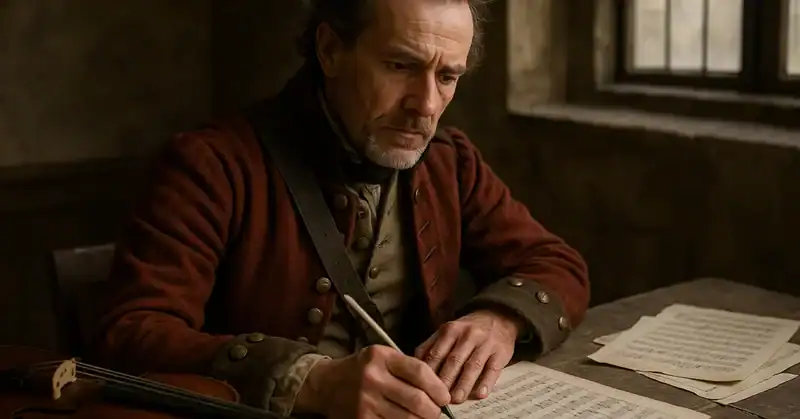
Some of history’s most inventive musicians never received the recognition they deserved during their lifetimes — and Captain Thomas Hume, a Jacobean soldier-composer who pioneered techniques that would not become standard for another century, is a striking example of how brilliance can slip through the cracks of history.
London, sometime around 1605: a broad-shouldered man with the weathered hands of a soldier settles a small, flat-backed instrument onto his knee in a smoky room and draws a bow across its strings in a way nobody in the city has quite tried before — striking the wood of the bow against the gut rather than laying the horsehair flat, producing a percussive crack that sounds less like music and more like a snare drum conjured from thin air. That man was Captain Thomas Hume: mercenary, veteran of northern European campaigns, and one of the most overlooked musical pioneers of the Jacobean age.
A Soldier Who Walked Into Music History Uninvited

The central strangeness of Thomas Hume’s story is this: he was not a court musician, not a chapel organist, not a lutenist in silk attending some nobleman’s dinner. He was a professional soldier who had endured the mud and privation of actual campaigns — likely in Sweden and possibly Poland — before returning to England and walking straight into London’s flourishing music culture as though he belonged there. In his own reckoning, he did.
He produced two printed collections of instrumental music, in 1605 and 1607, containing techniques so adventurous they would not become standard orchestral vocabulary for another century or more. Then, professionally speaking, he fell almost entirely silent. His music sat in a handful of library copies for roughly three hundred years, gathering the particular kind of dust that settles on things the world has forgotten it owns.
The question that makes Hume’s story compelling is not merely biographical. It is structural: how does a soldier-composer invent techniques ahead of his time, argue publicly and defiantly for his instrument’s supremacy, publish his work in print — and then vanish so completely that musicians have to rediscover him centuries later, as though finding a wreck on a lakebed that everyone had stopped believing was there?
The Instrument at the Heart of It: What Is a Lyra Viol?

To understand what Hume was doing, you need to understand the instrument he chose, because the lyra viol is not something most people have ever seen, let alone heard. Smaller than a cello but richer in resonance than a violin, it belongs to the viol family — fretted along its neck like a lute, held between the legs rather than tucked under the chin, and played with an underhand bow grip that gives the player an almost conversational intimacy with the strings. Its tone in the right hands is somewhere between a lute and a harp: luminous, slightly nasal in the upper registers, and capable of sustaining long, shimmering chords that hang in a room the way candlelight does.
What made the lyra viol genuinely peculiar, even among early modern instruments, was the practice known as playing “lyra-way.” Instead of reading standard musical notation, the performer worked from tablature — a system that shows finger positions rather than pitches — and, crucially, retuned the strings constantly depending on the piece. This scordatura, as it is technically called, meant that each composition existed in its own sonic world, the open strings ringing out particular intervals chosen specifically to color that piece’s mood. A performer moving from one Hume piece to the next might retune three or four strings between them. It was demanding, idiosyncratic, and it produced a flexibility of harmonic texture that standard tuning simply could not provide.
The lyra viol flourished in England between roughly 1600 and 1680 and barely crossed the Channel — a hyper-local phenomenon, deeply rooted in a specific cultural moment, which partly explains why it evaporated from musical history so completely when that moment passed. But within its brief flowering, Hume pushed it further than anyone else. He called for col legno — tapping or striking the strings with the wooden back of the bow rather than the hair — explicitly notated in his printed scores, making him one of the earliest documented composers to require a technique that would later become a staple of orchestral writing. He built in double-stopping drones, percussive rhythmic effects, and passages where the instrument imitates trumpets, drums, lutes, and even the human voice, turning a single chamber instrument into a one-man theatrical machine.
Captain Hume: Soldier First, Musician Always

His biography is full of honest gaps. His birth date is unknown; he was likely Scottish, judging from certain dedications and cultural references in his published work; he served as a mercenary in northern Europe before England claimed most of his adult life. What is clear is that the soldier identity was not a colorful footnote to his musical career — it was the other half of a single, defiant self-presentation.
When he published Musicall Humors in 1605, he titled pieces with names like “The Souldiers Song” and “Captaine Humes Poëticall Musicke,” making no attempt to soften or hide the martial character running through both his life and his art. The swagger was intentional. So was the lyrical delicacy that appeared in the same collection, sitting alongside ferociously energetic dances and programmatic battle scenes as if Hume were daring the listener to decide which was the real man.
He was also a controversialist in print. In the introductory material to his collections, he argued explicitly that the viol was a superior instrument to the lute — a genuinely provocative claim in an era when the lute was the prestige instrument of the educated classes and its players enjoyed powerful patronage. Hume made enemies. He made his position clear anyway. It was the behavior of a man who had faced worse consequences than a bad review.
A second collection appeared in 1607, and then the professional silence descended. His later years were marked by poverty and repeated, apparently unsuccessful petitions to the Crown for a pension or preferment — a soldier-artist who had served, composed, and published, now reduced to asking the establishment he had always somewhat disdained to notice that he existed. He died in poverty at Charterhouse, the London institution that provided shelter to impoverished gentlemen, leaving no estate to preserve his papers and no pupils to carry forward his methods.
How the Music Disappeared — and Why

The disappearance of Hume’s music follows a logic that is, once you see it, almost inevitable. The lyra viol went extinct as a living performance tradition by the late seventeenth century. Without players, the repertoire had no audience; without an audience, there was no incentive to teach the scordatura tunings, copy the tablature, or explain to anyone how to decode what was on the page. Hume’s two printed books survived — printing was precisely what gave them their three-century half-life — but they were curiosities in libraries rather than scores anyone was actually using.
The broader sweep of musical history had no lane for him. The shift toward violin-dominated ensemble music, then the long pipeline of Baroque style into Classical symphony, bypassed the English solo viol tradition entirely. The techniques Hume had used traveled onward in other vessels: col legno appeared in later orchestral writing attributed to other inventors; scordatura became a recognised device in violin repertoire; programmatic solo writing found its champions elsewhere. Hume received no credit because nobody was reading him.
His outsider status compounded the problem. No wealthy patron had championed his legacy during his lifetime; no institutional memory preserved his name after his death. He had been too proud, too strange, too stubbornly both things at once — soldier and composer, Scotsman and Londoner, popular entertainer and musical polemicist — to fit cleanly into any category that posterity found worth preserving. Musicologists of the eighteenth and nineteenth centuries catalogued him as a footnote rather than as a figure whose output warranted serious revival.
The Long Rediscovery: Scholars, Gambists, and a Quiet Revolution

The early music revival of the twentieth century changed everything, gradually and then all at once. Figures like Arnold Dolmetsch, who in the late nineteenth and early twentieth centuries began building and playing historical instruments from surviving examples and written descriptions, helped restore the viol family to living use. By the mid-twentieth century, a generation of historically informed performers was treating early music not as museum material but as a living repertoire that deserved to be heard on the instruments for which it was written, played according to the practices its composers had specified.
For Hume, this meant that specialist viol players and musicologists began the slow, meticulous work of transcribing his tablature, experimenting with the scordatura tunings he had notated, and working out what the col legno effects actually sounded like when produced on a period instrument by someone using the bow grip he would have known. The results, when recordings began to appear, were striking. Hume’s music does not sound antique when performed correctly. It sounds strange, in the best possible way — percussive where you expect it to be smooth, tender where you expect martial stiffness, formally adventurous in ways that feel genuinely surprising rather than academically reconstructed.
The rediscovery is still uneven and ongoing. Hume remains far less famous than his near-contemporary John Dowland, whose melancholy lute songs have found a substantial modern audience. Among viol enthusiasts and early music scholars, however, he is increasingly treated as a genuine pioneer — someone whose place in the history of musical technique needs to be understood and acknowledged, not merely noted and set aside.
Three Things That Make Hume’s Case Unique

It is worth being precise about what sets Hume apart from the broader category of neglected early composers, because not every forgotten figure deserves the same claim on our attention.
He documented his innovations in print. Unlike many performers of his era whose techniques are reconstructed from second-hand accounts or surviving instruments alone, Hume notated what he was doing. The col legno markings in Musicall Humors are explicit. The scordatura tunings are specified. The programmatic titles and performance directions are there in the original printed editions. This means the rediscovery is not a matter of educated guesswork — it is a matter of reading what he actually wrote and then doing it.
His techniques demonstrably preceded their later, better-known appearances elsewhere. Col legno as an orchestral effect is most familiar to modern listeners from much later repertoire — but Hume’s printed specification of it predates the examples usually cited. Whether later composers arrived at the technique independently or through some indirect chain of influence is a matter for ongoing musicological debate, but the chronological priority is not seriously disputed.
His music rewards performance in ways that cannot be appreciated from the page alone. This sounds obvious, but it matters. Some historically significant music is significant primarily as a document rather than as a listening experience. Hume’s pieces, when played correctly on the appropriate instrument with the correct scordatura, are genuinely arresting. They hold attention. They do things that feel fresh. That quality of aliveness is part of why the rediscovery has momentum — performers who encounter the scores and work through them tend to become advocates.
Why Hume Matters Now
His story functions as a corrective to a comfortable myth: that musical innovation flows neatly through established institutions, court appointments, and the patronage of the powerful. Sometimes it arrives through a mercenary captain with a viol and nothing left to lose, writing music in a form nobody else was pushing as far, for an audience that may have been smaller than he deserved.
He also stands as a case study in the fragility of musical legacy. Printing saved his scores from total oblivion, but printing alone was not enough to keep the music alive in any practical sense. It took an unbroken performing tradition, patrons willing to champion a name, and pupils trained to carry the methods forward — none of which Hume had. Without all of those things working together, even genuinely original work can simply stop existing in any meaningful way for centuries, reduced to a bibliographic entry in a catalogue of curiosities.
The most resonant thing about Thomas Hume’s rediscovery may be how straightforward it ultimately was. The music was always there, pressed into those few surviving printed books in libraries that never threw them away. It was waiting for someone willing to pick up the bow, sit with the tablature, retune the strings to the intervals a soldier had specified four hundred years earlier, and simply listen to what he heard.
In an era when algorithms surface the famous and bury the merely significant, Hume’s story is also a reminder that historical obscurity is not the same thing as historical unimportance. Sometimes the most interesting figure in a room is the one standing slightly outside the circle of light, waiting to be asked what he knows.

 English
 Arabic
 French
 Spanish
 Deutsch
 Turkish
 Dutch
Dutch
 Italiano
 Russian
 Romaian
 Portuguese (Brazil)
 Greek
Greek