


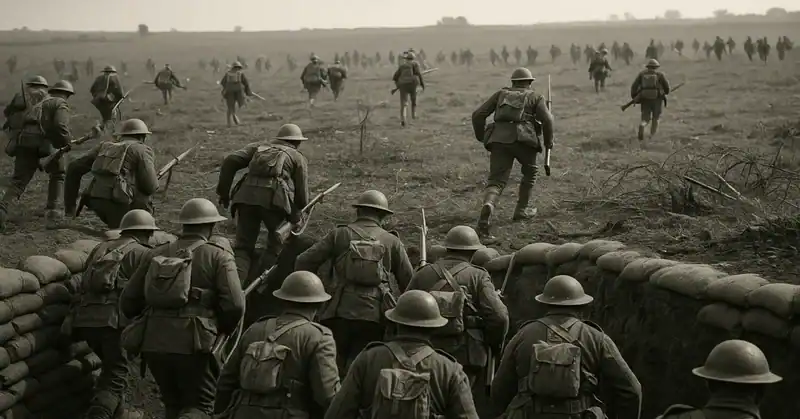
At 7:28 a.m. on 1 July 1916, a whistle shrieked along the British line and thousands of men climbed wooden ladders out of the earth and into the summer morning. Within seconds, the German machine guns that a week-long bombardment had utterly failed to silence opened up across the chalk downland of Picardy, and the bloodiest day in the history of the British Army had begun.
The Morning Everything Changed

The sun was already warm. That detail surfaces again and again in the letters and diaries that survived the day — the incongruous brightness of it, the way the light lay golden across the long grass of no man’s land before the smoke and the noise consumed everything. Soldiers who had crouched for days in the wet dark of forward trenches emerged blinking into what should have been an ordinary July morning. It was not.
By midnight, the British Army had recorded nearly 57,000 casualties — killed, wounded, missing — in fewer than eighteen hours. To hold that number still for a moment: 57,000 is roughly the population of a mid-sized British market town. Approximately 19,240 of those men were dead. The rest were wounded, missing, or so shattered by shell-shock that the word “casualty” itself had to stretch to contain them. No single day in British military history, before or since, has produced anything close to that arithmetic of ruin.
What turned a military catastrophe into something that would scar the British imagination for generations was the nature of the men who went over the top. These were the Pals battalions: volunteer units built, at Lord Kitchener’s suggestion, from men who already knew each other — men from the same street, the same factory floor, the same Saturday football terrace. The Accrington Pals. The Bradford Pals. The Sheffield City Battalion. They had enlisted together in the patriotic fever of 1914, trained together for nearly two years, and on 1 July 1916 they walked into no man’s land together — and in many cases died together, within minutes. When the telegrams began arriving in northern mill towns and mining villages, entire streets received them on the same morning. Whole communities lost a generation between breakfast and lunch.
The World That Made the Somme

To understand 1 July 1916, you have to understand the pressure that produced it. Since February 1916, the French Army had been fighting and dying at Verdun in numbers that threatened to break France entirely. General Sir Douglas Haig, commanding the British Expeditionary Force, launched the Somme offensive partly because his French allies were desperate for relief. The battle was as much a product of alliance politics as of military calculation: Britain was being asked to bleed so that France might survive to bleed another day.
The landscape chosen for this sacrifice looked, on a summer morning, almost gentle. The rolling chalk downland of Picardy — farms, hedgerows, the occasional village — gave little outward sign of what lay beneath. What lay beneath was the problem. The Germans had held this ground since 1914 and had used the time well. Their dugouts descended thirty feet or more into the chalk, deep enough to shelter men and machine guns through even the most sustained bombardment. The British plan rested on the assumption that seven days and approximately 1.5 million shells would destroy those positions — that the infantry would advance not into a battle but into a mopping-up operation, walking upright across ground already pacified by artillery.
That assumption was not simply the product of stupidity, though it has often been portrayed as such. It reflected the genuine limits of 1916 battlefield communication. Once men went over the top, commanders had almost no real-time information about what was happening at the front. Runners were killed. Field telephones failed. The fog of war was literal as well as metaphorical, and decisions were made on the basis of hope and yesterday’s intelligence. What Haig and his staff did not know — could not know, given the technology available — was that the German dugouts had largely survived, that the wire in front of the German positions had not been cut, and that men were dying in their thousands before the first hour was out.
Kitchener’s New Army — the volunteers of 1914, trained for nearly two years, now stepping into their first major engagement — were brave, disciplined, and almost entirely unprepared for what industrial war actually looked like. Nothing in their training had resembled this. Nothing could have.
A Patchwork of Tragedy and Fleeting Triumph

The front stretched for eighteen miles, and the experience of 1 July varied along it in ways that history sometimes flattens into a single catastrophe. On the southern flank, near Mametz and Montauban, British and French units achieved their objectives with something approaching the planned success. The ground there was slightly different, the artillery more concentrated, the German positions marginally less impregnable. Men took their objectives and held them.
On the northern and central portions of the line, however, the day became something else entirely. The 36th (Ulster) Division attacked the Schwaben Redoubt near Thiepval with extraordinary courage — some accounts describe men reaching the German second line — but were cut down in such numbers, and so quickly, that initial gains could not be held or reinforced. Elsewhere, whole battalions were destroyed within yards of their own trenches. The wire that the bombardment was supposed to have cut was found intact, channelling men into narrow gaps where machine guns had been pre-aimed and were waiting.
The sensory reality of the day is almost impossible to reconstruct from this distance, but soldiers’ letters and memoirs reach toward it: ground churned into something that was neither solid nor liquid; the smell of cordite and something worse; the wounded lying in no man’s land through the long summer afternoon, unable to be reached, calling out in ways that the men in the trenches could hear but not answer without exposing themselves to the same fire. The stretcher-bearers worked until they dropped. In some sectors, a silence eventually fell when there was simply no one left to make noise.
And the battle did not stop. Haig continued the offensive until 18 November 1916 — four and a half months, the chalk of Picardy turning to mud as autumn came, tanks appearing in battle for the first time in September, tiny territorial gains measured in hundreds of yards. At its deepest penetration, the British line had advanced roughly seven miles. Total British casualties for the entire campaign exceeded 400,000. The debate about whether that cost was necessary, or justified, or simply the grim arithmetic of coalition warfare in the industrial age, has not been settled in the century since and will not be settled here. What is settled is the scale.
The Cultural Wound That Never Fully Healed

The Somme did something to Britain that no amount of subsequent victory could undo. It entered the national imagination not as a triumph — even as part of a war that was ultimately won — but as a byword for futility and sacrifice squandered. Wilfred Owen’s searing condemnation of the old lie that it is sweet and fitting to die for one’s country drew directly from the reality the Somme represented. Siegfried Sassoon, who fought on the Somme, threw his Military Cross into the Mersey and published a formal declaration against the war. Decades later, the BBC sitcom Blackadder Goes Forth — set in the trenches, ending with its characters going over the top into silence and slow-motion poppies — became one of the most emotionally devastating half-hours in British television history precisely because every viewer understood the Somme reference without being told.
The Pals battalion legacy was particularly acute in its geography. Accrington lost so heavily on 1 July that the town was visibly diminished. Bradford, Sheffield, Barnsley — concentrated grief reshaped communities in ways that showed up in pub conversation, church attendance, and the simple fact of who wasn’t there at the factory on Monday morning. The gaps in a generation were not statistical abstractions; they were the empty chairs at specific kitchen tables.
From this grief came the “Lions led by Donkeys” critique of British generalship — the idea that brave ordinary soldiers were sacrificed by incompetent or indifferent commanders. It is a simplification, and historians have spent decades complicating it, pointing to the genuine learning curve the British Army did eventually climb, the real constraints of technology and coalition politics, and the counter-factual horrors of a German victory. But the critique endures not because it is precisely accurate but because it gives shape to loss that would otherwise be shapeless. When incomprehensible numbers of people die, we need a story. The Somme gave Britain a story about itself that it has never entirely put down.
What the country that emerged from the Somme carried forward was a fundamentally altered relationship with the ideas of sacrifice, authority, and war itself. The deference that had sent men up those ladders without serious public question was never entirely restored. The seeds of a more sceptical, more democratically demanding British public were watered, horribly, in the chalk of Picardy.
The Graves, the Gardeners, and the Unfinished Work of Remembrance

Walk the Somme battlefield today and the dead are everywhere. More than 150 Commonwealth War Graves Commission cemeteries dot the landscape — white headstones in precise rows, tended year-round by CWGC gardeners who treat the work as something closer to a vocation than a job. The grass is always cut. The flowers are always fresh. Each headstone carries a name, a regiment, a date, and often a line chosen by a family that received a telegram a century ago.
The founding principle of the CWGC was itself a quiet revolution: every soldier, regardless of rank or wealth, would receive an equal, named marker. Generals and privates lie under identical headstones. The democratic statement embedded in that decision — that the life of a Durham miner’s son was worth the same commemoration as a field marshal’s — was not obviously guaranteed in the Britain of 1917. It has since become so fundamental to how we think about war remembrance that we have largely forgotten it was ever a choice.
For those who have no known grave — those whose bodies were never recovered, or could not be identified — the Thiepval Memorial stands on a ridge above the Ancre valley. It is the largest British war memorial in the world: a massive brick and stone arch visible for miles across the rolling farmland. On its panels are carved 72,195 names of men of the British and South African forces who died on the Somme between July 1915 and February 1918 and have no known grave. Stand in front of it in the late afternoon and read names for as long as you can bear, and you will not reach the end. The names run out of light before they run out of names.
The work of accounting for the Somme’s dead is not finished even in the most literal sense. Archaeological excavations continue to recover remains from the battlefield, and advances in DNA identification mean that soldiers missing for more than a century are periodically identified and given named graves. The Somme is still, quietly and persistently, giving up its dead.
Why 110 Years Still Matters

The 110th anniversary of the Battle of the Somme on 1 July 2026 will be marked with a Royal British Legion commemorative ceremony held alongside the Commonwealth War Graves Commission, sustaining a thread of public remembrance that now stretches across more than a century. It is not a round number. A centenary commands itself; a 110th anniversary is a choice, and choices are more revealing than obligations.
The UK Parliament has tabled an Early Day Motion commemorating the 110th anniversary — a formal gesture that signals something important: the Somme remains a matter of national conscience rather than merely historical record. Parliaments do not table motions about battles that have receded into footnotes.
BBC One and BBC iPlayer will broadcast What Happened At The Somme, a special BBC World Service documentary to mark the anniversary. Its significance is easy to understate. Most people who watch it will never visit Picardy. They will never stand at Thiepval and try to read all 72,195 names. The documentary reaches them in living rooms and on phones, translating archive and testimony into something that can still move a person who has no family connection to the battle, no geographical proximity to the cemeteries, no memory of knowing someone who remembered. That translation — from history into felt experience — is what keeps remembrance alive rather than merely observed.
For younger generations, the Somme is as temporally remote as Waterloo. Encountering 1 July 1916 for the first time, they bring none of the inherited grief that shaped how their great-grandparents understood the day. What they may bring instead is a different kind of fluency: one sharpened by a media environment saturated with mass casualty events, where the compression of individual lives into catastrophic numbers is a familiar and urgent problem. The Somme posed that problem first, and most severely. Commemorative battlefield tours to the Somme for the 110th anniversary are already drawing interest from people of all ages who want to do something more than read — who want to stand in the place and feel the weight of it.
What We Still Owe the Man on the Ladder
Return, for a moment, to 7:28 a.m. Among the hundreds of thousands who went over the top on 1 July 1916 were men whose names are now carved at Thiepval — men who left behind letters describing the landscape, the waiting, the comrades they hoped would come through it with them. Private soldiers who had answered a call in 1914 because their country asked, because their friends were going, because it seemed the right and necessary thing. They climbed the ladder with what courage they had, which was considerable, into a morning that had no use for courage of that particular kind.
The question the Somme refuses to release is not whether it was worth it — that framing trivialises grief into a ledger. The question is what it means that a democracy could ask this of its people: could send volunteer citizens, men who had chosen to serve, into conditions so catastrophically misjudged that nearly 57,000 of them became casualties before the day ended. And what obligation that places on the democracy that asked.
The answer, if there is one, lies in the act of remembrance itself — not the ceremony alone, though ceremony matters, but the insistence, repeated at 110 years as it was at 100 and as it will be at 120, that the individuals swallowed by industrial war are not statistics. They are stories. They are the man who noticed the sun was warm as he climbed the ladder. They are the letters home that arrived after the telegram. They are the names on the stone that the gardener has just cleaned, in the late afternoon, before closing the gate — the light falling across 72,195 names on the ridge above the Ancre, quiet and enormous and unresolved, as it has been for 110 years.

 English
 Arabic
 French
 Spanish
 Portuguese
 Turkish
 Dutch
Dutch
 Italiano
 Russian
 Romaian
 Portuguese (Brazil)
 Greek
Greek