


In the summer of 1462, Sultan Mehmed II — the man who had shattered Constantinople nine
years earlier — rode toward the Wallachian capital of Târgoviște with an army of roughly
90,000 men. He had crushed the Byzantine Empire. He would not be stopped by one renegade
Christian prince. Then he saw the forest.
Stretching nearly two miles outside the city walls stood approximately 20,000 impaled
bodies — Ottoman prisoners and Bulgarian Muslims, arranged in deliberate rows by height and
rank. Mehmed II, a man who had watched cities burn without flinching, reportedly turned his
army around. The prince responsible had already retreated north. His name was Vlad III.
History would add the epithet: Impaler.
A Prince Born Into Chains, Raised in a Foreign Court
Vlad III was born around 1428 in Sighișoara, in the Transylvanian region his father ruled
as a vassal prince. His father, Vlad II, bore the name Dracul — dragon — as a member of the
Order of the Dragon, a chivalric order sworn to defend Christendom against Ottoman expansion.
The son would inherit the name Dracula: son of the dragon. He would also inherit an
impossible political situation.
In 1442, when Vlad was approximately fourteen, his father made a calculated diplomatic
sacrifice. To secure peace with Sultan Murad II, he handed over two of his sons as political
hostages. Vlad and his younger brother Radu spent years inside the Ottoman court at Edirne,
learning Turkish, studying Islamic theology, riding and fighting in the Ottoman style. Radu
converted, befriended the Sultan’s son, and thrived. Vlad did not. He watched, and he
remembered, and when news reached him in 1447 that his father and older brother had been
assassinated by Wallachian boyars with Transylvanian backing, something in him calcified
into permanent severity.
The Throne He Had to Seize Three Separate Times
Vlad’s reign over Wallachia was not a single, continuous rule — it was three brutal
attempts to hold a principality that powerful neighbors treated as a chess piece. His first
reign in 1448 lasted two months before he was driven out by a rival backed by Hungary. His
second reign, beginning in 1456, would be the one history remembers. He killed his way back
to power, impaled the boyars who had murdered his family, and immediately began transforming
Wallachia’s political culture through systematic, highly visible violence.
The impalement was not random sadism. Vlad used it with bureaucratic precision, calibrating
the height of the stake to reflect the victim’s social rank — a grim protocol that made his
punishments read as official sentences rather than outbursts of madness. Merchants who cheated
customers, corrupt officials, nobles who plotted against the throne — all faced the same fate,
displayed publicly to eliminate any ambiguity about consequences. Within months, Wallachia’s
crime rate collapsed. Contemporary Saxon merchants from Transylvania, who would later circulate
pamphlets portraying Vlad as a monster, initially wrote home praising the safety of Wallachian
roads.
Why the Ottomans Never Forgot What They Saw Outside Târgoviște
When Mehmed II moved against Wallachia in 1462, Vlad could not fight him in open battle —
no Wallachian prince could match Ottoman numbers in a conventional engagement. What Vlad
understood was psychological terrain. He poisoned wells. He sent men infected with plague and
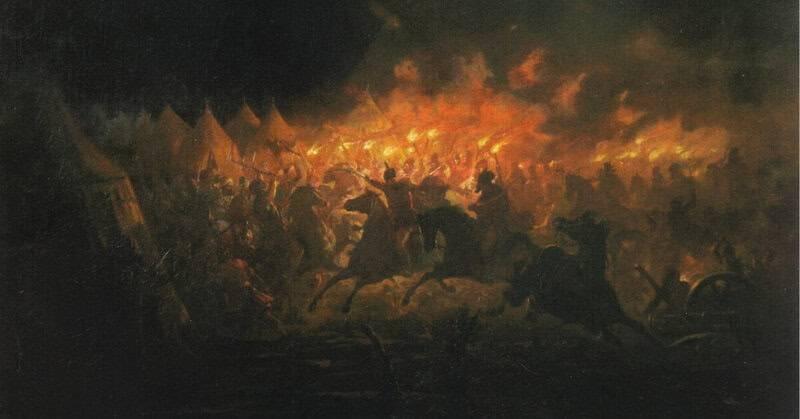
leprosy into Ottoman camps. He led a night raid directly at Mehmed’s tent on June 17, 1462,
missing the Sultan by a matter of meters and killing thousands of soldiers in the darkness.
He was not defending a country in the traditional sense; he was making the cost of invasion
feel infinite and inescapable.
The forest of stakes outside Târgoviște was the culmination of that strategy. Byzantine
historian Laonikos Chalkokondyles recorded Mehmed’s reaction as genuine distress — not at
the violence itself, but at the magnitude of will it represented. A ruler willing to do this,
Mehmed reportedly told his commanders, was a ruler who could not be governed by ordinary fear.
He left Wallachia to his ally — and Vlad’s traitorous brother — Radu. Vlad fled north, where
he was imprisoned by his supposed ally, the Hungarian king Matthias Corvinus, for more than
a decade.
The Detail That Bram Stoker Never Used
Stoker drew heavily on a 1820 account by William Wilkinson that mentioned the name
“Dracula” in connection with Wallachia. He borrowed the geography of Transylvania and the
aura of aristocratic menace. But the detail he never reached — and perhaps the most revealing
of all — is that Vlad’s own people eventually canonized him. The Romanian Orthodox Church
added Vlad III to its list of saints in 2023, a decision that ignited fierce historical debate.
To many Romanians, he had always been a defender: a prince who held the line against Ottoman
conquest when Western Europe offered prayers but no armies.
The Monster Who Became a Mirror
Five and a half centuries after his death in battle in December 1476, Vlad III refuses
simple judgment. His violence was real, documented, and staggering in scale — German pamphlets
from the 1480s claimed he had killed between 40,000 and 100,000 people, numbers almost
certainly exaggerated by political enemies but rooted in genuine atrocity. Yet the same man
held a small Christian principality against the most powerful empire in the world for years
with almost no external support, using the only weapons he believed he had.
What Vlad understood — and what makes him still uncomfortable to contemplate — is that
terror has a logic. Not a moral logic, but a strategic one. Every ruler who has ever
rationalized extreme violence in the name of survival has walked some version of the same
road he walked through those dark Wallachian forests in 1462. The vampire was easier to
invent. The prince was harder to forget.
The stakes outside Târgoviște have long since rotted into the earth, but the question
they posed — how much horror can one act of desperation justify — has never fully
decomposed.

 English
 Arabic
 French
 Spanish
 Portuguese
 Deutsch
 Dutch
Dutch
 Italiano
 Russian
 Romaian
 Portuguese (Brazil)
 Greek
Greek