


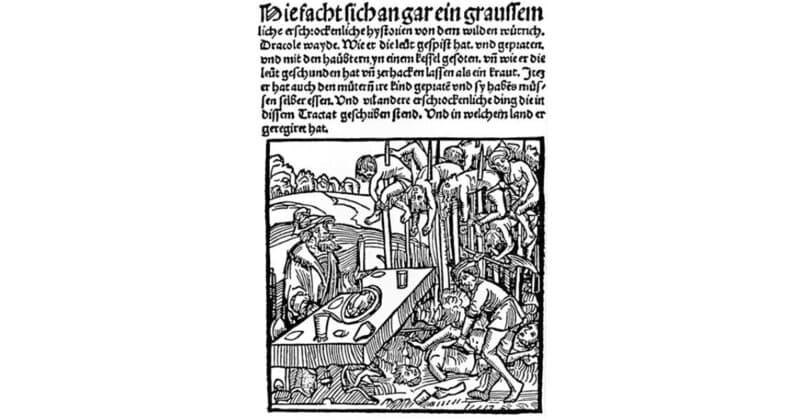
In 1463, a printing press in Nuremberg produced a pamphlet with a woodcut illustration
on the cover: a man dining calmly at a table surrounded by impaled corpses. The text inside
detailed his crimes in language designed to horrify a Christian audience — a ruler who drank
blood at meals, who roasted children and fed them to their mothers, who impaled priests on
Sundays for sport. The pamphlet sold widely. It was almost entirely fabricated. And it was
the first chapter in one of history’s most accidental mythologies.
The man in the woodcut was Vlad III of Wallachia. The pamphlet had been commissioned,
historians now believe, largely at the direction of his political enemies — Saxon merchants
from Transylvania whose trade privileges he had stripped, and possibly the Hungarian court
that briefly imprisoned him. They had no way of knowing they were not just destroying a
reputation. They were building a legend.
Before Stoker, There Was Four Centuries of Sediment
Bram Stoker did not invent Dracula from nothing. He pulled from a thick vein of Eastern
European vampire lore that had been accumulating for centuries, and within that tradition,
stories connected to Vlad’s name had a specific, persistent shape: a ruler who would not
stay dead, who returned from defeat to reclaim his throne, who seemed to feed on the
suffering of others. This was not coincidental. Vlad’s biography almost demanded supernatural
interpretation from medieval eyes.
He died — or appeared to die — at least once before his verified death in December 1476.
His first reign ended in sudden flight; he vanished from history for years, then reappeared
on the throne as if resurrected. His third reign began in 1476 after twelve years of
captivity, when he seized Wallachia yet again at roughly age forty-five. For a medieval
population accustomed to reading providence into political events, a ruler who kept coming
back — who seemed unkillable — carried an unsettling charge. The word strigoi, the Romanian
undead, was applied to him in oral traditions that long predate Stoker’s 1897 novel.
The Ottoman Propaganda Machine That Ran in Parallel
While German printers were manufacturing one kind of monster, Ottoman court historians were
manufacturing another. Tursun Beg, who accompanied Mehmed II’s 1462 campaign and wrote its
official history, described Vlad not as a brave enemy but as something deranged and
inhuman — a ruler so far outside civilized conduct that he barely registered as a political
actor. This framing served Mehmed’s reputation: you did not retreat from a military genius,
you withdrew from a madman whose battlefield was beyond rational strategy.
The two propaganda streams — German and Ottoman — agreed on almost nothing about Vlad
except his fundamental monstrousness, and that agreement, repeated across languages and
borders, gave the image a credibility it would never have achieved from a single source.
By the early 16th century, Vlad III existed in European collective memory as something
adjacent to human: a ruler who occupied the space where political power bleeds into
supernatural horror.
The One Detail Stoker Got Completely Wrong
Stoker set his Count Dracula in Transylvania — the region of the Carpathian mountains
associated with dark folklore and medieval isolation. Vlad III was not Transylvanian. He
was born there but ruled Wallachia, the principality to the south. Stoker found the name
“Dracula” in a footnote in William Wilkinson’s 1820 travelogue and placed his fictional
count in the landscape he associated with Eastern European mystery, almost certainly unaware
of the specific geography Vlad had actually occupied.
This geographical confusion matters because it shows how thoroughly the myth had already
detached from the man. By 1897, “Dracula” was not really a name anymore — it was a
category, a cultural container for anxieties about blood, death, aristocratic power, and
the threat of the foreign East. Stoker poured those anxieties into a novel. But the
container had been shaped over four centuries, hammered into its final form by German
propagandists, Ottoman historians, Romanian folklorists, and a series of remarkable
biographical coincidences in the life of a 15th-century Wallachian prince who simply
refused, over and over again, to stay dead.
What Literature Buried That History Is Still Digging Up
The Stoker novel’s global success in the 20th century effectively sealed Vlad III inside
fiction. For generations, anyone who tried to discuss the historical prince collided
immediately with fangs and capes and Bela Lugosi’s accent. Serious Romanian scholarship on
Vlad was largely invisible to Western audiences, and the distortion ran deep — even academic
references to him frequently defaulted to the Dracula framing as an entry point, conceding
the myth its gravitational pull before attempting to describe the man.
Romanian historiography has spent decades working against this current, and recent
scholarship has largely succeeded in restoring Vlad’s political context — his position as
a Christian frontier ruler, his military innovations, his complex relationship with both
Ottoman power and Hungarian patronage. But the mythology never really loses. Every serious
book about the historical Vlad still sells better if it puts a Gothic font on the cover.
The strangest thing about Vlad III is not what he did, but what he became: a man so
thoroughly rewritten by his enemies that his real story is now the forgotten one, buried
beneath a fiction that has outlived every empire he ever fought.

 Arabic
 French
 Spanish
 Portuguese
 Deutsch
 Turkish
 Dutch
Dutch
 Italiano
 Russian
 Romaian
 Portuguese (Brazil)
 Greek
Greek