


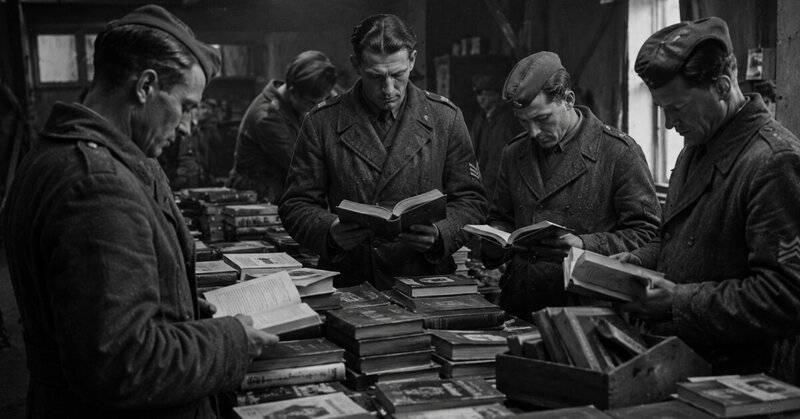
In Berlin, on the night of May 10, 1933, students and members of the SA filled the Opernplatz with the light of burning books. Among the titles they fed to the flames was All Quiet on the Western Front. The bonfire was not random vandalism — it was a calculated political act. Erich Maria Remarque’s novel had sold three million copies worldwide and had convinced an entire generation that the Great War had been an avoidable slaughter. That idea, the Nazis understood with perfect clarity, was incompatible with what they were planning next.
The Literary Peace Movement That Arrived Ten Years Too Late
The extraordinary outpouring of honest war literature that appeared between 1928 and 1933 — the memoirs, the novels, the poetry collections — represented something unprecedented in military history: a mass act of witness by the men who had actually fought. For a brief moment, it seemed as though literature might do what diplomacy had failed to accomplish. The war books dominated bestseller lists in Britain, Germany, France, and the United States simultaneously. Remarque appeared on the cover of Time magazine. Vera Brittain addressed packed lecture halls. Robert Graves’s Goodbye to All That went through multiple printings within months of publication.
The peace movement seized on this literature as evidence for the argument that modern industrial warfare was categorically different from anything that romantic nationalism had prepared populations to endure — and that if people truly understood what had happened in the trenches, they could never be persuaded to accept another such war. It was a reasonable argument. It was also, historically speaking, catastrophically wrong about the mechanism by which wars begin.
When Anti-War Literature Became a Recruitment Tool for Fascism
The German nationalist right read Remarque’s novel with a different set of eyes. Where pacifists saw a case against war, völkisch propagandists saw a case against the civilians, the Jews, and the internationalists who had allegedly prevented Germany from winning one. The “stab-in-the-back” mythology — the claim that the German Army had been betrayed from within rather than defeated in the field — was not weakened by the wave of anti-war literature. It was energized by it. If the war had been that terrible, that costly, that futile, then Germany’s failure to win it despite such sacrifice demanded an explanation — and the nationalist right supplied one with ruthless efficiency.
Joseph Goebbels, who held a doctorate in Romantic drama from Heidelberg University, understood precisely how literary emotion could be redirected. The same grief and betrayal that Remarque’s readers felt for the men who died in the mud was rechanneled, in Nazi propaganda, into fury at those who had wasted those deaths. The anti-war books did not create this response — but they created the emotional preconditions it required. Grief, in the hands of the right demagogue, can be transformed into something unrecognizable.
The British Paralysis That One Canon of Books Helped Create
In Britain, the effect of the war literature was different but equally consequential. By the early 1930s, the memoirs and novels of the Great War had created what the historian A.J.P. Taylor would later describe as a near-absolute political consensus that no future war could be worth its cost. This consensus was not irrational — it was, in fact, the sanest possible conclusion from the available evidence. But it produced a foreign policy so allergic to confrontation that Stanley Baldwin’s government and then Neville Chamberlain’s consistently misread Hitler’s intentions and capabilities, right up to Munich in September 1938.
The books had done their intended work too completely. They had made the previous war unthinkable — and in doing so, made it harder for British policymakers to think clearly about the different kind of war that was approaching. The generals of 1914 had been accused of fighting the last war; the politicians of the 1930s were, in a very real sense, reading it.
What the Burning Books Left Behind in the Ashes
Remarque survived the Nazi bonfires — though his sister Elfriede did not. She was arrested in 1943, tried for defeatism, and beheaded on November 16th of that year. The judge reportedly told her that her brother had escaped German justice, but that she would not. Remarque learned of her death after the war ended. He dedicated a later novel to her memory with a single line: They killed you in my place. No literary history of World War I is complete without that sentence, and what it cost to write it.
The Lesson That Outlasted Everyone Who Tried to Learn It
The World War I books that shaped the twentieth century were acts of profound moral courage — soldiers and nurses and diplomats refusing to let the machinery of official memory replace their own lived experience. But history is not a lesson that stays learned. The same texts that made millions weep for the waste of 1914-1918 were folded, twisted, and weaponized within a single generation into the emotional infrastructure of the catastrophe that followed.
Literature can bear witness. It cannot, by itself, compel the witnessed truth to be heard by those who need most urgently to hear it.
The books survived the fires. The world they were trying to protect did not — not quite, not entirely, not without burning first.

 English
 Arabic
 French
 Spanish
 Portuguese
 Deutsch
 Turkish
 Dutch
Dutch
 Italiano
 Russian
 Portuguese (Brazil)
 Greek
Greek