


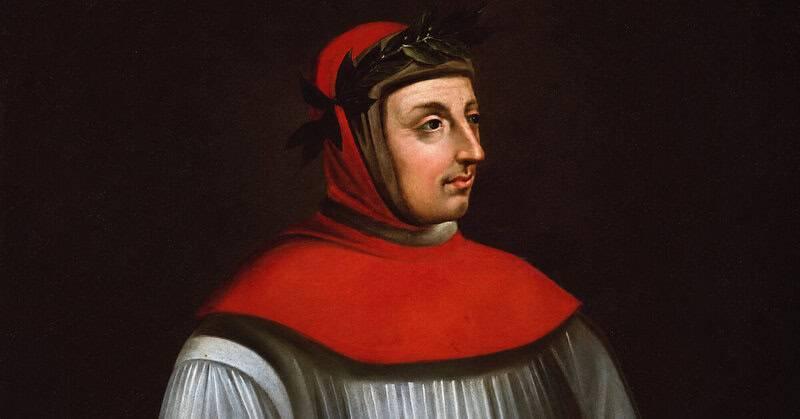
Sometime around 1330, the Italian poet Francesco Petrarch looked back at the thousand years between the fall of Rome and his own era and reached for a metaphor. What he saw — or chose to see — was darkness. A long, suffocating interval between the brilliance of antiquity and the reawakening he believed his own age represented. He was wrong about nearly every specific claim he made. But the metaphor proved so flattering to his own century, and so useful to subsequent centuries, that it survived long after the evidence against it had become overwhelming.
What Petrarch Needed the Dark Ages to Be
Petrarch was not a neutral observer. He was a humanist intellectual with a profound emotional investment in classical Rome — a man who wrote letters to Cicero as though the dead senator might one day write back. His “Dark Ages” was not a historical analysis; it was an aesthetic judgment rendered by someone who found medieval Latin barbaric compared to Cicero’s, medieval art crude compared to the Pantheon, and medieval institutions unworthy of serious attention. Renaissance scholars who followed him inherited both the framework and the bias, and by the 17th century the idea had hardened from poetic metaphor into something that claimed the authority of historical fact.
Edward Gibbon’s monumental Decline and Fall of the Roman Empire, published between 1776 and 1789, gave the darkness thesis its most sophisticated and influential articulation. Gibbon blamed Christianity and Germanic invasion in roughly equal measure for extinguishing the light of Roman civilization, and his elegant prose carried the argument into every library in the English-speaking world. The problem — as archaeologists, manuscript scholars, and historians spent the 20th century demonstrating — was that Gibbon was working from an extraordinarily incomplete picture of what the post-Roman world actually contained.
The Manuscripts That Were Being Written While Rome Allegedly Died
In 563 AD — barely a century after the traditional date of Rome’s fall — an Irish monk named Columba sailed with twelve companions to a small island off the western coast of Scotland and founded the monastery of Iona. Within two generations, Iona had become one of the most sophisticated centers of learning in the Western world, producing manuscripts of such technical and artistic complexity that modern conservators still study their pigment chemistry with genuine awe. The Book of Kells, almost certainly produced at Iona around 800 AD, contains interlace patterns of such mathematical precision that scholars in the 20th century debated whether their creators could have understood concepts approaching fractal geometry.
This was not an isolated case. Benedict Biscop founded the twin monasteries of Wearmouth and Jarrow in Northumbria between 674 and 682 AD, importing hundreds of books from Rome and building a library that supported the scholarship of the Venerable Bede — a man whose Ecclesiastical History of the English People, completed in 731 AD, demonstrated a command of classical sources, chronological methodology, and narrative sophistication that would not have embarrassed a Roman historian of the first century. The darkness was populated, it turned out, by men reading extraordinarily carefully in candlelight.
The Emperor Who Built a Renaissance Three Centuries Before the Renaissance
On Christmas Day, 800 AD, Pope Leo III crowned Charlemagne Emperor of the Romans in St. Peter’s Basilica in Rome. The political theater of that moment was deliberate and calculated — a declaration that the Roman imperial tradition had not died but transformed. What followed over the next decade was one of the most concentrated administrative, educational, and cultural programs in early medieval history. Charlemagne recruited scholars from across Europe: Alcuin of York from Britain, Theodulf from Visigothic Spain, Paul the Deacon from Lombardy. He established the Palace School at Aachen, standardized Latin script into the Carolingian minuscule that later Renaissance scholars — believing they had discovered an ancient Roman hand — would adopt as the foundation of modern typography.
The irony cuts deep. The very letterforms that Renaissance humanists used to proclaim their rediscovery of antiquity were invented by monks working in the supposedly dark centuries those humanists dismissed. Every time a reader opens a book printed in a Roman typeface — which is to say, almost every book printed in the Western world since Gutenberg — they are looking at a Carolingian creation filtered through a Renaissance misattribution.
What the Soil Has Been Saying Since Archaeologists Learned to Listen
The archaeological revolution of the late 20th century dealt the “Dark Ages” thesis its most decisive blows. Excavations at Sutton Hoo in Suffolk, England — begun in 1939 and continued in waves through the 1990s — revealed a 7th-century ship burial of staggering sophistication, containing gold and garnet cloisonné work of a quality that demanded trade networks stretching from Sweden to Byzantium to the steppes of Central Asia. The Staffordshire Hoard, discovered in 2009, yielded over 3,500 pieces of Anglo-Saxon gold and silver military equipment, the largest such hoard ever found — a material record of a warrior aristocracy with access to extraordinary craftsmanship and considerable resources.
The Name That Did Five Centuries of Damage in Three Syllables
Medieval historians largely abandoned the term “Dark Ages” as a scholarly category by the latter half of the 20th century. The period is now studied under its accurate designation — the Early Middle Ages — and the scholarship produced under that banner has transformed the field. What the evidence reveals is not darkness but difference: a world reorganizing itself after the collapse of a centralized imperial system, developing new political structures, new artistic vocabularies, new intellectual syntheses of classical and Christian traditions. Difficult, violent, and often brutal — but so was Rome.
The persistence of “Dark Ages” in popular culture is itself a historical phenomenon worth examining. Every civilization needs a nadir against which to measure its own progress, a before that makes the after feel earned. The medieval centuries filled that role for the Renaissance, and have been filling it ever since — regardless of what the evidence says.
The lights were never out; we simply stopped looking for them in the right places.

 Arabic
 French
 Spanish
 Portuguese
 Deutsch
 Turkish
 Dutch
Dutch
 Italiano
 Russian
 Romaian
 Portuguese (Brazil)
 Greek
Greek