


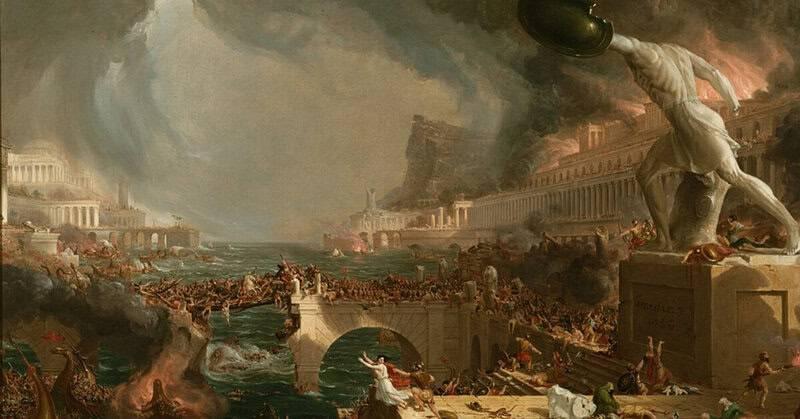
On September 4, 476 AD, a Germanic chieftain named Odoacer walked into the imperial palace at Ravenna and accepted the abdication of a teenage boy. Romulus Augustulus had held the title of Western Roman Emperor for less than a year. Odoacer sent him into comfortable exile near Naples with a pension, declined to appoint a successor, and forwarded the imperial regalia to Constantinople with a polite note. The Eastern Emperor Zeno was irritated by the presumption. He was not, by any recorded account, alarmed.
The Empire That Had Already Forgotten It Was Dying
By 476, the Western Roman Empire had been losing territory, population, and coherence for over a century. The Visigoths sacked Rome in 410 AD — a genuine shock that prompted Augustine of Hippo to write The City of God partly in response to the psychological crisis it caused. But Rome had been sacked before. What made the 5th century different was the cumulative weight of loss: the Rhine frontier permanently breached in 406 AD, the grain supply severed when the Vandals seized North Africa between 429 and 439 AD, and the imperial throne so thoroughly militarized that the emperor had become a figurehead managed by his own generals.
Romulus Augustulus was not even universally recognized as legitimate. His father Orestes — a former secretary to Attila the Hun — had seized power in 475 AD and elevated his teenage son to the purple, but Constantinople never acknowledged the arrangement. The Eastern court backed its own candidate, Julius Nepos, who claimed the Western title from exile in Dalmatia until his assassination in 480 AD. Some historians argue that date is a more honest endpoint than the famous 476. The symbolic tidiness of the traditional date is itself a product of retrospective selection, not contemporary significance.
The Man Who Ended Rome and Then Governed It Competently
Odoacer ruled Italy for thirteen years after 476, and his administration looked almost entirely Roman. He retained the Senate. He preserved Roman law. He kept the same bureaucratic machinery, staffed by the same aristocratic families who had served under Roman emperors. He called himself “King of Italy” — a title that acknowledged the new reality without entirely abandoning the old framework. Rome had changed management. It had not changed civilization.
The Roman aristocrat Cassiodorus served under Odoacer’s successor, Theodoric the Ostrogoth, writing administrative letters in impeccable classical Latin on behalf of a Gothic king who could not himself write at all. The 6th-century scholar Procopius, writing in Constantinople, still referred to the people of Italy under Gothic rule as “Romans” — because by culture, law, and self-identification, they still were. Whatever name sat on the throne changed very little about daily life for the people living beneath it.
The Historian Who Gave the Moment Its Drama — Thirteen Centuries Later
The world-historical weight now attached to 476 AD is largely the invention of Edward Gibbon. Writing in the 1770s, Gibbon selected the deposition of Romulus Augustulus as the terminal date for his Decline and Fall of the Roman Empire because it gave a thousand-year narrative a clean, symbolic endpoint. Gibbon was a great historian and a great dramatist in equal measure. He understood that his readers needed a final curtain — and a boy emperor bearing the ironic combination of Rome’s founder and its first king provided one with almost literary perfection.
Contemporary observers saw nothing of the kind. Jordanes and Cassiodorus, writing in the 6th century, did not treat 476 as a rupture. They were too busy living in the world that followed to perceive a clean break between before and after. The catastrophe was assembled later, carefully, by people who needed it to have happened.
What Outlasts the Name on the Throne
The Roman roads Odoacer’s soldiers marched on in 476 AD were still carrying traffic centuries later. The aqueducts still ran. Roman law still governed property and inheritance disputes across Italy, Gaul, and Spain. The bishops of Rome stepped into the administrative vacuum left by the departed imperial court and began performing governmental functions the emperors had once handled — in the same buildings, using the same Latin, inheriting the same institutional memory. The Eastern Empire, centered on Constantinople, did not fall for another 977 years, until May 29, 1453, when Ottoman forces under Mehmed II breached the Theodosian Walls and the last Roman emperor, Constantine XI Palaiologos, died fighting in the streets.
The civilization Petrarch called dead outlasted the civilization Petrarch believed he was reviving. History rarely ends on the date the calendar assigns it.
Empires do not fall like buildings — they dissolve like sugar in water, imperceptibly, until one day you taste the difference and realize the sweetness has been gone for years.

 English
 Arabic
 French
 Spanish
 Portuguese
 Turkish
 Dutch
Dutch
 Italiano
 Russian
 Romaian
 Portuguese (Brazil)
 Greek
Greek