


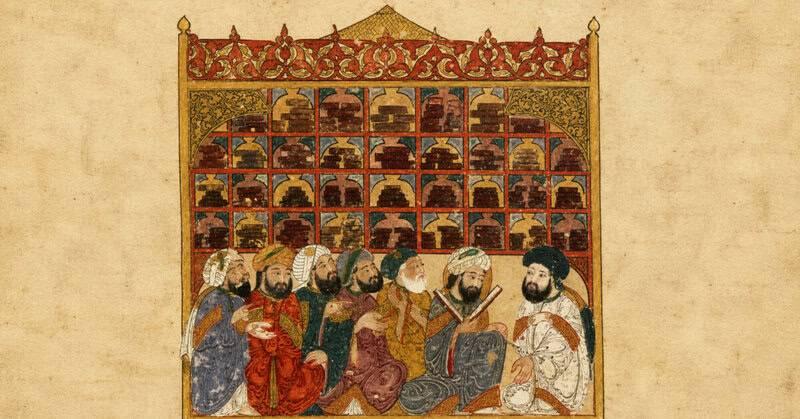
In 830 AD, the Abbasid Caliph al-Ma’mun founded an institution in Baghdad called Bayt al-Hikma — the House of Wisdom. It was not a library in the passive sense. It was an active translation factory, a research center, and an intellectual crucible where scholars from across the Islamic world and beyond worked systematically to acquire, translate, and extend every manuscript of Greek, Persian, Indian, and Syriac learning they could locate. At the moment when Charlemagne’s scholars were working heroically to preserve basic Latin literacy in Western Europe, Baghdad operated a scientific and philosophical enterprise of a sophistication that the West would not match for another four centuries.
The Manuscripts That Western Europe Could No Longer Read
By 600 AD, knowledge of classical Greek had effectively disappeared from Western Europe. The scholars who might have read Aristotle, Euclid, Galen, or Ptolemy in the original were gone, their institutions dismantled, their libraries scattered or burned. What survived did so in fragments — Latin translations of a fraction of the Greek corpus, preserved in monasteries by men who often did not fully understand what they were copying. The intellectual inheritance of Athens and Alexandria did not disappear from the world during those centuries. It migrated.
The migration had begun even before Rome’s fall. Nestorian Christians, expelled from the Byzantine Empire as heretics in 431 AD, carried Greek philosophical and medical texts into Persia, where they translated them first into Syriac and then into Persian. When Islamic armies swept across Persia in the 630s and 640s AD, they inherited not only the physical manuscripts but the scholarly tradition built around them. The Umayyad caliphs showed interest. The Abbasid caliphs, beginning with al-Mansur in the mid-8th century, turned that interest into an institutional project on a scale the ancient world itself had rarely attempted.
The Scholars Who Did Not Merely Copy — They Corrected and Surpassed
Al-Khawarizmi, working at the House of Wisdom in the early 9th century, did not simply translate Indian and Greek mathematics. He synthesized them into something new, producing the treatise that gave the world algebra — a word derived from the Arabic al-jabr in his title Al-Kitab al-mukhtasar fi hisab al-jabr wal-muqabala, completed around 820 AD. His name, Latinized as Algoritmi, gave the world the word “algorithm.” He was not preserving ancient knowledge. He was building on it.
Ibn Sina — known in Europe as Avicenna — completed his Canon of Medicine around 1025 AD. The work synthesized Galenic medicine, clinical observation, and Islamic pharmacological research into a text so comprehensive and rigorously organized that European medical schools used it as a primary textbook until the 17th century. Ibn al-Haytham, working in Cairo around 1011 AD, produced Book of Optics — a foundational work in the science of vision and light that directly influenced Roger Bacon in 13th-century Oxford and, through Bacon, the entire European scientific tradition. These were not acts of preservation. They were acts of intellectual creation that happened to be conducted in Arabic rather than Latin or Greek.
The Spanish City That Handed the Renaissance Its Raw Material
Córdoba in the 10th century was, by almost any measure, the most sophisticated city in Western Europe — a city of perhaps 500,000 people, with paved and lighted streets, public baths, an extraordinary library reportedly containing 400,000 volumes, and a court culture that patronized poetry, philosophy, music, and science simultaneously. Toledo, reconquered by Christian forces in 1085 AD, became the critical transmission point between the Islamic intellectual world and the Latin West. The Toledo School of Translators, working through the 12th and into the 13th century, produced Latin versions of Arabic translations of Greek texts — a double translation that brought Aristotle, Euclid, Ptolemy, and Galen back into the European intellectual bloodstream after an absence of five to seven centuries.
Thomas Aquinas built his 13th-century synthesis of Christian theology and Aristotelian philosophy on a text of Aristotle that had reached him through an Arabic translation made in Baghdad. The European university system, which emerged in the 12th and 13th centuries, constructed its curriculum around texts recovered through this channel. The Renaissance would not have had a classical tradition to rediscover if Islamic scholars had not kept it alive, extended it, and eventually handed it back.
The Debt That Western Civilization Has Never Properly Acknowledged
The standard narrative of Western intellectual history moves from Greece to Rome to the Renaissance, with the medieval centuries treated as an unfortunate interruption. That narrative requires the Islamic world to be invisible — a conduit, at most, not an author. But the mathematical notation Europeans use, the astronomical models they refined, the medical knowledge they built on, the Aristotle they read in the 13th century — all of it passed through Baghdad, Cairo, and Córdoba, and was transformed in the passage. The House of Wisdom was destroyed by the Mongols in 1258 AD, when Hulagu Khan’s forces sacked Baghdad and reportedly threw so many manuscripts into the Tigris that the river ran black with ink. What survived that catastrophe was already, by then, woven into the fabric of European thought.
The darkness of the Dark Ages was always, in large part, a matter of geography — what European observers could see from where they stood, and what they chose not to look for beyond the horizon of their own tradition.
The light that the Renaissance claimed to have rekindled had been burning without interruption in another part of the world all along.

 English
 French
 Spanish
 Portuguese
 Deutsch
 Turkish
 Dutch
Dutch
 Italiano
 Russian
 Romaian
 Portuguese (Brazil)
 Greek
Greek