


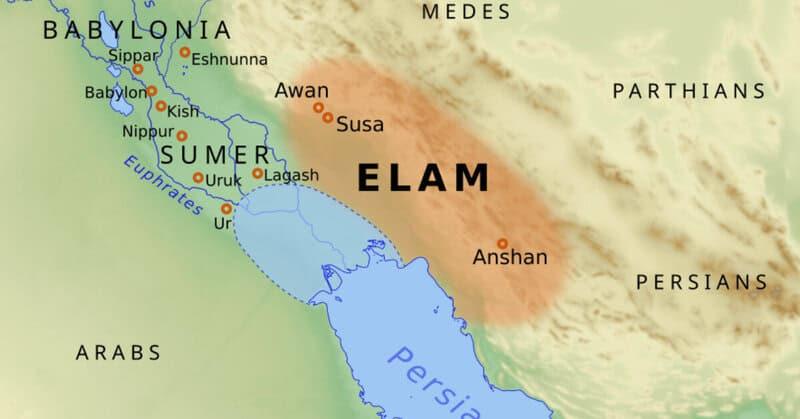
Susa was a city of monumental temples and administrative records when the founders of Babylon
were still herding livestock on an unmarked plain. The Elamites who built it left behind
ziggurats, legal codes, and a written language that predates most of what the ancient world
produced — and almost nobody outside a university library knows their name. That is not an
accident of history. It is a consequence of who survived to write it.
The Kingdom That Grew Where Three Worlds Collided
Elam occupied the southwestern corner of the Iranian plateau and the lowland plains stretching
toward the Persian Gulf — territory that placed it at the intersection of Mesopotamia to the
west, the Central Asian steppe to the north, and the Indus Valley trade networks to the east.
This geography was not merely convenient. It was generative. By 3200 BCE, proto-Elamite script
was being used across a trade network stretching from Susa to sites more than 1,500 kilometers
away, making it arguably the most geographically extensive writing system of the ancient world
at that moment — wider even than early Sumerian cuneiform.
The Elamites organized their state along lines that puzzled later scholars raised on
Mesopotamian models. Power rotated between a king, a viceroy, and a prince — a triumvirate
system called sukkalmah that distributed authority across regions rather than
concentrating it in a single dynastic line. Women held property rights, conducted business
independently, and appear in administrative tablets as economic actors in their own right.
For a civilization of the third millennium BCE, this was not unremarkable. It was exceptional.
The Day Elam Reached Into Babylon and Took What It Wanted
In approximately 1158 BCE, an Elamite king named Shutruk-Nahhunte led his army out of Susa
and into the heart of Babylonia. What he brought back redrew the cultural map of the ancient
Near East. Among the prizes carried to Susa: the Victory Stele of Naram-Sin, a 2.3-meter
monument celebrating an Akkadian king’s triumph over mountain peoples, carved around 2254 BCE.
Also seized: the Law Code of Hammurabi, the 2.25-meter black diorite stele inscribed with
282 legal provisions that modern textbooks still describe as the foundation of written law.
Shutruk-Nahhunte even added his own inscription to the Hammurabi stele, claiming the
monument as an Elamite trophy.
Both objects sat in Susa for centuries, until French archaeologists excavated them between
1901 and 1902 and shipped them to the Louvre, where they remain today. The irony is layered:
the most famous legal document of the ancient world was preserved not by the civilization
that created it, not by the scholars who later celebrated it, but by an Elamite king who
took it as a spoil of war. Elam saved Hammurabi’s code from the destruction that erased
nearly everything else Babylonian scribes had stored.
The Language That Has Defeated Every Scholar Who Tried to Own It
Proto-Elamite script, used from roughly 3200 to 2900 BCE, remains undeciphered. It is the
most numerically abundant undeciphered script in the ancient world, with over 10,000 known
tablets — and it has resisted every serious decipherment attempt for more than a century.
Linear Elamite, a later script used in royal inscriptions, was partially decoded only in 2022,
when French researcher François Desset and colleagues published a breakthrough analysis.
The contents, once readable, revealed hymns, royal dedications, and administrative records
that added texture to a civilization previously known almost entirely through the hostile
accounts of its enemies.
The Assyrian king Ashurbanipal, who sacked Susa in 647 BCE, boasted in his annals that he
had scattered Elamite bones to the wind and made their land a wasteland where even wild asses
no longer roamed. It is a vivid account. It is also, demonstrably, incomplete — because the
Elamites continued to exist as a cultural and political force for centuries after Ashurbanipal
declared them finished. Conquerors have always been unreliable historians of the people
they conquer.
The Ghost Inside the Persian Empire
When Cyrus the Great founded the Achaemenid Persian Empire in the 6th century BCE, he chose
Susa — the ancient Elamite capital — as one of his four imperial seats. The administrative
language of the early Achaemenid bureaucracy was not Old Persian. It was Elamite. The tens of
thousands of Persepolis Fortification Tablets, discovered in 1933 and still being studied,
are written predominantly in Elamite, recording the movement of workers, rations, and
commodities across the empire. The Elamites did not vanish into the Persian conquest.
They became its operating system.
Persian kings issued proclamations in three languages — Old Persian, Babylonian, and Elamite —
because Elamite carried the administrative weight the empire required. A civilization that
Ashurbanipal had declared extinct was, two generations later, running the paperwork for the
largest empire the ancient world had yet produced.
Three Thousand Years of a Civilization the Textbooks Skip in a Sentence
The standard ancient history survey gives Elam a paragraph, usually positioned as context
for something more famous — the Akkadian Empire, the Kassite Dynasty, the rise of Persia.
This is not proportional to the evidence. Elam endured as a coherent political and cultural
entity from roughly 3200 BCE to 539 BCE — a span of 2,600 years that exceeds the entire
distance from the fall of Rome to the present day. It produced original art, original
administrative systems, and a religious tradition whose animal-headed deities and mountain
gods fed directly into the visual vocabulary of early Persian and Mesopotamian iconography.
The excavations at Susa, Chogha Zanbil — whose ziggurat, built by King Untash-Napirisha
around 1250 BCE, is the best-preserved in the world — and the still-ongoing digs at sites
across Khuzestan province in modern Iran continue to recover a civilization that was never
actually lost, only ignored. Each season’s findings push the story further back, deeper,
and more complex than the paragraph in the textbook allows.
A civilization that ran the Persian Empire’s accounts deserves more than a
footnote in someone else’s story.

 English
 Arabic
 French
 Spanish
 Portuguese
 Deutsch
 Turkish
 Dutch
Dutch
 Italiano
 Russian
 Portuguese (Brazil)
 Greek
Greek