


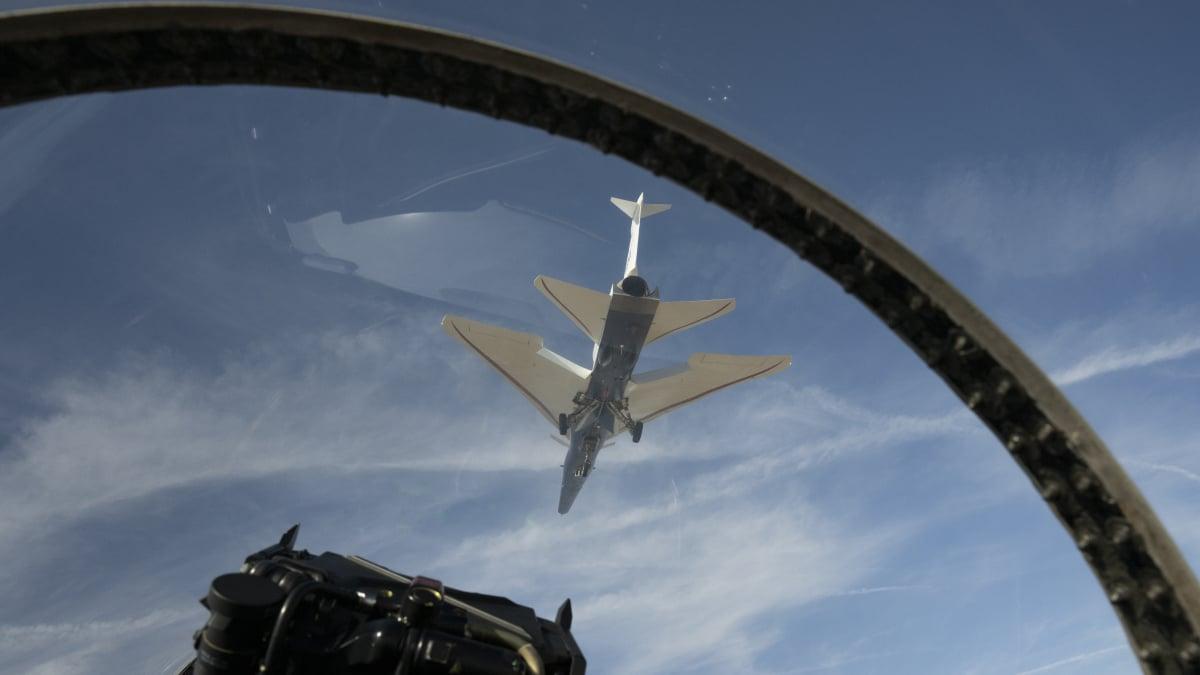
NASA's X-59 jet has broken the sound barrier for the first time, a major milestone in the effort to build a quiet supersonic aircraft for civilians.
The sleek, needle-nosed airplane exceeded the speed of sound for the first time on Friday, June 5. NASA test pilot Jim "Clue" Less took off in the plane at 11:08 a.m. PT and landed at Edwards Air Force Base in California about 81 minutes later. At the aircraft's top speed, it went Mach 1.1 — about 713 mph — at an altitude of 43,400 feet.
The X-59 is experimental, part of the so-called QUESST mission to transform passenger air travel over land. Because existing supersonic aircraft produce loud sonic booms at high speed, the U.S. government bans routine supersonic flights over populated areas. But the X-59, designed by NASA and its contractor Lockheed Martin, is expected to tame the boom into a mere thump.
NASA captured the achievement from the vantage point of a chase plane, which kept pace with the speedy experimental jet to monitor the test. You can watch the historic moment when it clocked supersonic speed in the video below.
"X-59 goes through the number!" NASA administrator Jared Isaacman said on X. "We are rebuilding our X-plane portfolio and getting NASA back in the business of radical airframe and engine flight test!"
An X‑plane is a U.S. aircraft designed to test new flight technologies and ideas. The goal of the X-59 is to provide regulators and the airline industry with the evidence needed to reconsider restrictions on supersonic aircraft.
Most people think of NASA as the gateway to space, but the organization is first and foremost the nation's civil aeronautics agency (quite literally, the A comes before the S). The U.S. government legally requires NASA to lead such research — the kind private companies can't do.
Mashable Light Speed
Future tests will see the X-59 go even faster. NASA wants the plane to ramp up to 925 mph. At that rate, a nonstop flight from New York to L.A. would take less than three hours. That would cut current flight times in half. Today's commercial airlines typically cruise at 550 mph, getting their passengers across the country in about 5 to 6 hours.
If you were expecting to see the X-59 zip through the sky, the video might feel underwhelming. Because the chase plane, a NASA F-15, followed the flight at the same speed, the jet didn't rush headlong out of frame. Instead, it appeared to serenely revel in the clouds.
Thanks to the chase plane, the video also didn't capture the X-59's signature thump. The F-15 filled the air with a cacophony of its own sonic booms.
Reaching supersonic speed is a crucial milestone, but the most critical test has yet to come. Soon the aircraft will surge to Mach 1.4, which should get it up to that 925 mph goal while flying at 55,000 feet. After crossing that hurdle, the test campaign will shift to a new phase focused on validating the shushed boom.
A sonic boom happens when a plane flies faster than sound because pressure waves condense into a single shock that hits the ground like a sudden air explosion. To mitigate the sound, engineers designed the X-59's long spear-like nose to spread out the pressure shifts along the aircraft. The concept should turn the single shock into a series of smaller pulses.
This Tweet is currently unavailable. It might be loading or has been removed.
One tradeoff in the new silhouette is that the slim nose doesn't allow room for a traditional cockpit window. Instead, the pilot flies with a high-definition display screen that combines images from cameras. Test pilot Less spent hundreds of hours in a simulator using the unconventional vision system before flying the actual plane.
After Less made his first flight at the controls of the X-59 in March, he said the lack of a windscreen didn't make him feel like he was flying blind. If anything, he felt he had better "visibility" because the image processing on his display reduces glare and improves contrast.
"It really felt comfortable," he said during a news conference after the March flight. "Even though I wasn't seeing out the front, I could see out the sides and match that up."

 English
 French
 Spanish
 Portuguese
 Deutsch
 Turkish
 Dutch
Dutch
 Italiano
 Russian
 Romaian
 Portuguese (Brazil)
 Greek
Greek