


Apple Intelligence for the rest of America, not Wall Street.
By

Chris is a veteran tech, entertainment and culture journalist, author of 'How Star Wars Conquered the Universe,' and co-host of the Doctor Who podcast 'Pull to Open.' Hailing from the U.K., Chris got his start as a sub editor on national newspapers. He moved to the U.S. in 1996, and became senior news writer for Time.com a year later. In 2000, he was named San Francisco bureau chief for Time magazine. He has served as senior editor for Business 2.0, and West Coast editor for Fortune Small Business and Fast Company. Chris is a graduate of Merton College, Oxford and the Columbia University Graduate School of Journalism. He is also a long-time volunteer at 826 Valencia, the nationwide after-school program co-founded by author Dave Eggers. His book on the history of Star Wars is an international bestseller and has been translated into 11 languages.
on

Credit: Apple screenshot
To understand how Tim Cook has transformed Apple — and why the launch of Siri AI was designed to entice Main Street more than Wall Street (or techies, for that matter) — compare Monday's WWDC 2026 keynote, Cook's last, to his very first.
Cook delivered his first keynote Oct. 4, 2011, weeks after he became CEO and one day before Steve Jobs died. Cook, at this point, dressed like Jobs (black shirt replacing black turtleneck), tried to talk in the same authoritative, conversational way as Jobs, and delivered a very Jobsian message of Apple Stores and Apple products (iPod included; Cook and the audience were squeezed into the intimate Infinite Loop campus theater where Jobs unveiled his hit MP3 player 10 years earlier).
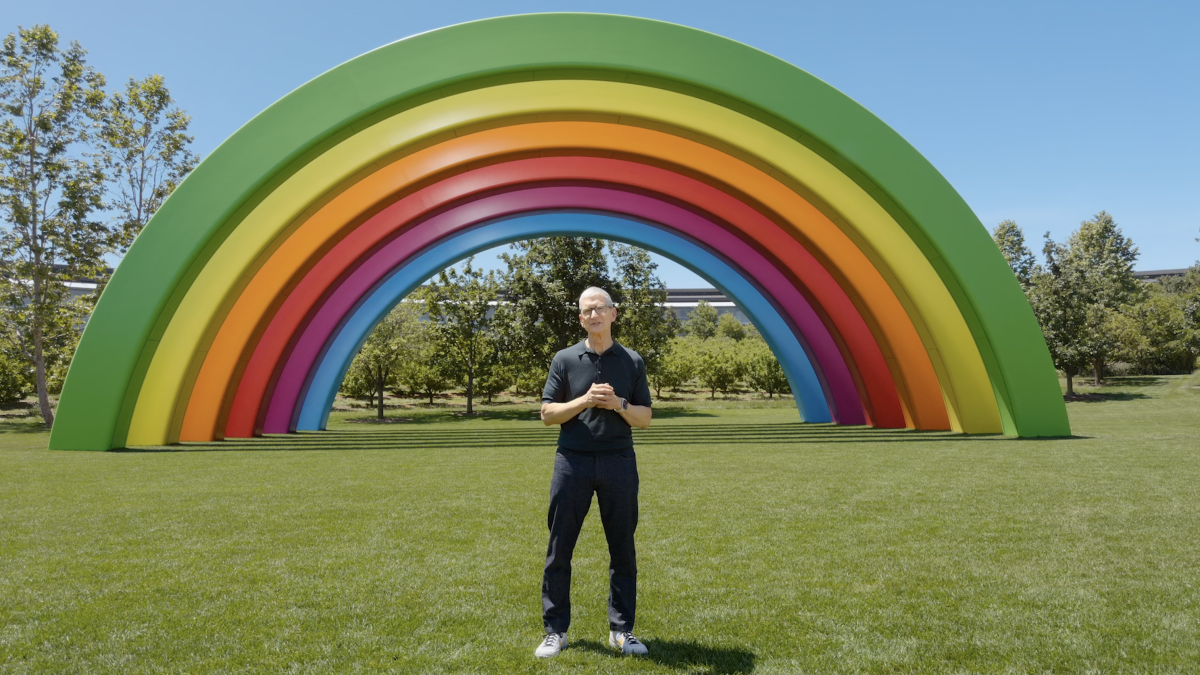
By June 8, 2026, everything has changed. For one thing, the keynote was outdoors, in the Spaceship campus that Jobs fought to break ground on in his last year of life. For another, it was pre-recorded instead of live. Cook made Apple keynotes virtual during the pandemic, and even when audiences came back to Apple's campus, he only appeared before those audiences once (for the original launch of Apple Intelligence).
Clearly never comfortable on stage or in the spotlight, Cook had ceded the majority of his keynote to other executive presenters even before the pandemic. A smart move in more ways than one — not only did Cook quit the hopeless task of sounding conversational (he could just about muster authoritative), this can also be seen in retrospect as a 15-year audition for a CEO with good (but not too outlandish) keynote charisma.
John Ternus, the winner of that contest, didn't even appear during Cook's keynote. Weirdly, Apple employees (or were they extras?) populated the background of every scene for the first time in a keynote — particularly distracting when they sat still as automatons during scenes at Apple's real-life coffee bar. You'd be forgiven for thinking everyone on campus except Ternus was on screen.
Ultimately, this too seems a sensible move from Cook — let the new guy keep his powder dry, and don't implicate him in what may count as Cook's riskiest keynote maneuver since he took the stage in 2011.
The Tim Cook school of Apple Intelligence
It's no secret that Cook is Silicon Valley's biggest skeptic when it comes to AI hype.
Mashable Light Speed
It's not just that Apple has (mercifully) never approached the kind of technobabble or dubious AGI predictions on display at Google I/O or Microsoft Build. You could make a drinking game out of an Apple keynote, but it might involve taking a shot for every Craig Federighi joke rather than every mention of "tokens" or "superintelligence."
Notably, Cook tapped Federighi, veteran Apple daddy and the joker in the executive announcement pack, to officially unveil the highly anticipated Siri AI. Federighi did this right after unveiling the new MacOS name, Golden Gate, via an incense-filled VW bus that featured his bobblehead on the dash.
In case that order of business didn't make it clear, Federighi delivered Apple's clearest take on AI yet: "Some appear to be racing forward, seemingly pursuing AI for the sake of AI, without clear regard for the people — all of us — that it’s ultimately meant to serve."
This was not a line designed to appease consensus investors on Wall Street, for whom no level of AI technobabble is too much. But Cook's company is a $4 trillion behemoth now, 16 times the size it was in 2011, so Wall Street can go whistle. Apple made its trillions pleasing customers as many times as possible, not bilking investors for a short-term stock bump.
And in case you're inside the AI bubble and haven't gotten the memo, the backlash out there in America — against AI in everything, as well as against data centers — is getting intense. Cracks are starting to show even within the bubble. Federighi's "AI for the sake of AI" line was almost word-for-word what an Amazon executive wrote last month in an email begging employees to stop spending so many tokens: "don't use AI just for the sake of using AI."
The Siri AI demos that followed were pretty basic as far as AI-heads are concerned. But Apple customers were repeatedly reassured about the privacy and security of Apple Intelligence (translation: the other guys make money capturing your data). They were also assured that every use case made sense. Searching for World Cup fixture details is a pain in the ass, and Siri's instantly returned lineup looked pretty appealing to this soccer fan.
Meanwhile, the Visual Intelligence feature called Spatial Reframing, which allows users to move a photo around as if it were in a 3D space, may not thrill the technically proficient, but it is exactly the sort of thing you can imagine parents or grandparents playing around with for hours.
This, in short, is your mom's AI. Apple is betting that boomers, Gen Xers, and at this stage even most 40-plus millennial iPhone customers, don't want to have to think about prompts, hallucinations, or tokens. They don't care if they're using ChatGPT or Gemini, or what the model number is. They just want to pick up the phone, press a button, ask Siri a question, and trust that they'll be pleasantly surprised by the ease of the answer.
And this is the sense in which Tim Cook has carried forward Steve Jobs' legacy from that dark day in October 2011. Apple, then and now, is at its best when it makes products that follow Jobs' mantra and just work.
This article reflects the opinion of the author.

Chris is a veteran tech, entertainment and culture journalist, author of 'How Star Wars Conquered the Universe,' and co-host of the Doctor Who podcast 'Pull to Open.' Hailing from the U.K., Chris got his start as a sub editor on national newspapers. He moved to the U.S. in 1996, and became senior news writer for Time.com a year later. In 2000, he was named San Francisco bureau chief for Time magazine. He has served as senior editor for Business 2.0, and West Coast editor for Fortune Small Business and Fast Company. Chris is a graduate of Merton College, Oxford and the Columbia University Graduate School of Journalism. He is also a long-time volunteer at 826 Valencia, the nationwide after-school program co-founded by author Dave Eggers. His book on the history of Star Wars is an international bestseller and has been translated into 11 languages.


 English
 Arabic
 French
 Spanish
 Portuguese
 Deutsch
 Dutch
Dutch
 Italiano
 Russian
 Romaian
 Portuguese (Brazil)
 Greek
Greek