


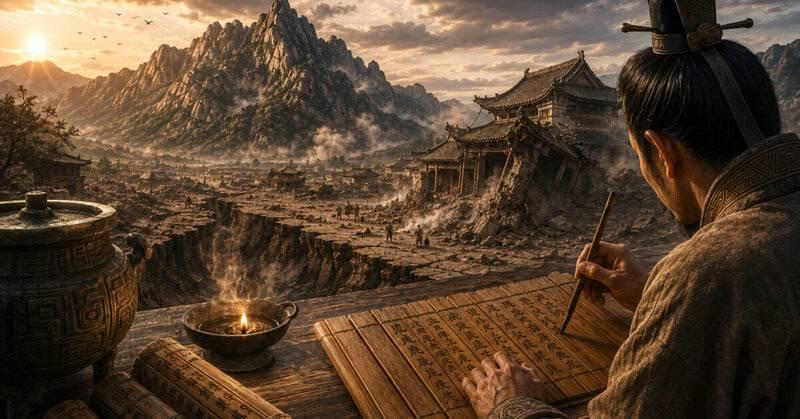
King Fa of the Xia dynasty was dead, and the earth was moving. Somewhere in what is now Shandong province in eastern China, the ground beneath the sacred slopes of Mount Tai shook hard enough for a court scribe to consider it worth recording alongside the death of a king. That single line, preserved in a text known as the Bamboo Annals, is the oldest written account of an earthquake anywhere on Earth.
A Sacred Mountain in a Dynasty That Was Already Dying
The Xia dynasty, which ruled China from roughly 2070 to 1600 BCE, was in long decline by the time King Fa came to power. His reign — the fifteenth of the dynasty — lasted only seven years before he died, and the court chronicles noted his passing in the same breath as a geological event: “In the seventh year, the king died and there was an earthquake in Mount Tai.” Nine words, in what scholars later translated from ancient Chinese. No death toll. No description of damage. Just the fact of it — recorded as something that mattered, placed beside a royal death as though the two events belonged in the same sentence.
Mount Tai was not chosen arbitrarily. The mountain was among the most sacred sites in Chinese cosmology — one of the Five Great Mountains, believed to connect heaven and earth, associated with sunrise, birth, and the judgment of souls. When it shook, a scribe noticed. That act of noticing, and then writing, is what separates this earthquake from the thousands that preceded it in human prehistory and left no record at all.
The Text That Survived by Accident — for 2,500 Years
The Bamboo Annals did not survive through deliberate preservation. In 279 CE, a tomb was robbed in the state of Wei — a tomb that turned out to belong to a king of the Warring States period, sealed around 296 BCE. Among the grave goods were bundles of bamboo strips covered in writing. Court scholars carefully transcribed and arranged them. What they had stumbled upon was a royal chronicle dating back to the beginning of the Xia dynasty — a continuous record of Chinese history that had been buried in a grave for nearly six centuries.
The strips were written on bamboo because that was the standard writing material of the period. They were fragile, prone to decay, and would not have survived above ground. The accidental burial that seemed to end them was actually what kept them. The earthquake at Mount Tai — which occurred perhaps two thousand years before those strips were placed in the tomb — survived only because someone thought it important enough to copy, and then re-copy, across generations of court scribes who probably had no idea they were preserving the oldest seismic record in human history.
What the Earth Was Actually Doing Beneath Shandong
Modern seismologists who have studied the Mount Tai earthquake estimate it reached a surface-wave magnitude of around 7.0, with an epicentral intensity of roughly IX on the Modified Mercalli scale — sufficient to collapse structures, rupture fault lines visibly at the surface, and cause widespread landslides. The likely epicenter was not directly beneath the mountain but approximately 200 kilometers to the east, in the Anqiu area along the Yishu fault zone, a segment of the massive Tan-Lu fault system that runs for thousands of kilometers through eastern China. That same fault zone produced the 1976 Tangshan earthquake, one of the deadliest in recorded history. The ground beneath Shandong has never fully settled.
The Gap Between Feeling the Ground Move and Writing It Down
Humans had been experiencing earthquakes for hundreds of thousands of years before King Fa’s scribe picked up a stylus. What changed around the second millennium BCE was not the earthquakes — it was the infrastructure of memory. Writing systems had developed independently across several civilizations, and with them came the capacity to record not just harvests and royal lineages but natural disruptions that seemed to carry meaning. The Chinese court interpreted the earthquake at Mount Tai as a cosmic sign, tied to the death of their king. That interpretive impulse — the need to explain why the earth moved — is precisely what made it worth writing down.
Ancient Greek historians eventually developed their own earthquake records, including Thucydides’ account of the 426 BCE tremor in the Euboic Gulf, where he became the first writer to explicitly connect a large wave with seismic activity on land. The Aztec Codex Telleriano-Remensis recorded earthquakes in the Americas from 1460 onward, using pictograms that combined the Nahuatl symbols for “movement” and “earth.” Every civilization that developed writing eventually developed earthquake records — because the ground shaking was too significant, too frightening, and too theologically loaded to leave unrecorded.
The Nine Words That Started 4,000 Years of Seismology
Zhang Heng, the Chinese polymath, built the world’s first seismoscope in 132 CE — a bronze instrument that could detect distant earthquakes and indicate their direction. It was an extraordinary invention, but it did not emerge from nowhere. It emerged from a civilization with nearly two thousand years of written earthquake records behind it, a culture that had been systematically noting when the earth moved since the reign of a king who died the same year Mount Tai shook. The instrument followed the habit. The habit began with a scribe.
Today, the Philippines absorbs a magnitude 7.8 earthquake and the world knows within minutes — seismographs trigger, algorithms fire, tsunami warnings reach coastal communities before the water does. That entire architecture of detection and response traces an unbroken line back through centuries of instrumentation, centuries of systematic record-keeping, and ultimately to a court official somewhere in ancient Shandong who decided that what happened to the mountain deserved to be written beside what happened to the king.
The earthquake at Mount Tai was not the largest in history, nor the deadliest, nor even particularly well described — but it was the one someone bothered to remember, and that act of remembering is the reason we know anything about how the ground behaved before we had instruments to measure it.

 English
 Arabic
 French
 Spanish
 Portuguese
 Deutsch
 Turkish
 Italiano
 Russian
 Romaian
 Portuguese (Brazil)
 Greek
Greek