


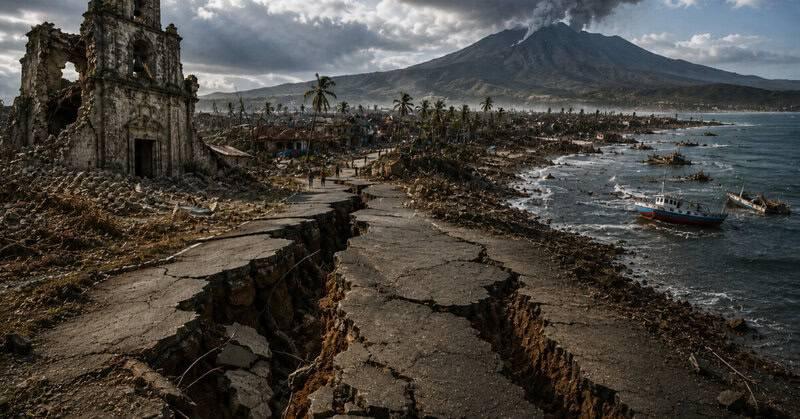
At ten minutes past midnight on August 17, 1976, a magnitude 8.0 earthquake split open the floor of the Cotabato Trench beneath Mindanao. Most people along the Moro Gulf coastline were asleep. The tsunami reached shore before they could run. It swept across 700 kilometers of coastline in minutes, pulling entire villages back into the sea. Between five thousand and eight thousand people were never found.
An Archipelago Built on the Edge of Everything
The Philippines did not end up where it is by accident. The archipelago sits at one of the most geologically violent intersections on earth — the point where the Philippine Sea Plate, the Eurasian Plate, and the Pacific Plate have been grinding against each other for millions of years. The Philippine Sea Plate alone moves against its neighbors at roughly ten centimeters per year, fast by the standards of subduction zones. Running the full length of the country, from the northwestern tip of Luzon down to the southeastern edge of Mindanao, the Philippine Fault Zone stretches 1,200 kilometers — a fracture so vast it is visible in the landscape, a scar written into the islands themselves.
The archipelago was not built despite this violence. It was built by it. The collision of plates, played out over geological time, pushed the islands up from the ocean floor. Every volcano, every mountain range, every deepwater trench surrounding the chain is a product of the same forces that, on June 8, 2026, sent a magnitude 7.8 earthquake through General Santos City before breakfast. The ground beneath the Philippines has never been still. It never will be.
November 30, 1645: The Night Stone Buildings Became the Enemy
The Spanish colonial administration had spent decades rebuilding Manila in stone after fire destroyed the original wooden city twice. It seemed like a rational decision. Stone did not burn. By 1645, the colonial capital gleamed with stone cathedrals, stone palaces, stone churches rising along the banks of the Pasig River — proof of Spanish permanence in the archipelago. Then, on the night of November 30, 1645, the Philippine Fault ruptured in Nueva Ecija and the shaking reached Manila with an intensity later classified as MMI X — extreme. Ten cathedrals collapsed. The stone that was supposed to protect the city became the instrument of its destruction. Chronicles written in the aftermath called it simply “the most terrible earthquake recorded in the annals of the Archipelago.”
The Spanish rebuilt. But they rebuilt differently. Architects and clergy, absorbing the lesson of 1645, began designing structures with massive buttresses, squat bell towers, and low load-bearing walls. Grace of line was sacrificed for survival. The resulting style — thick, heavy, almost crouching against the earth — became so distinctively Filipino that architectural historians gave it its own name: earthquake baroque. It is still visible in provincial churches across Luzon today. The fault shaped not just the ground but the art.
1990: The Earthquake That Baguio City Never Finished Mourning
On July 16, 1990, at 4:26 in the afternoon, a magnitude 7.8 earthquake struck Luzon along the Philippine Fault. The shaking lasted forty-five seconds — long enough to bring down the Nevada Hotel in Baguio City while it was full of guests, to collapse the Hyatt Terraces, to kill 2,412 people across an affected area of 20,000 square kilometers. Baguio, the summer capital, was built on a mountain. The mountain sat directly above the fault. The city had known this for decades. When the Hyatt fell, it fell on tourists who had come for the cool air and the pine trees, not expecting to die there.
What the 1990 earthquake exposed was not just geological reality but institutional failure. Buildings had been constructed on known fault lines. Warning systems were inadequate. The response was slow. Within a generation, the same arguments — about building codes, about fault mapping, about evacuation preparedness — would be repeated after the 2013 Bohol earthquake, which killed more than 200 people and damaged centuries-old colonial churches that had survived every previous tremor. The arguments are still being had today.
The Architecture of Warning That Nobody Wanted to Build
There is a document that Philippine seismologists and disaster officials have been updating and revising since the 1990s. It models what would happen if the Valley Fault System — the fault running directly beneath Metro Manila, a metropolitan area of roughly 14 million people — produced its maximum credible earthquake. The projections are not ambiguous. They estimate tens of thousands of deaths, the collapse of hundreds of thousands of structures, and a city whose emergency infrastructure would be overwhelmed within the first hour. The document is called the Metro Manila Earthquake Impact Reduction Study. It is not a secret. Politicians cite it at press conferences. Then the conferences end.
The pattern is older than the document. After 1645, Manila rebuilt in stone that fell again. After 1976, the Moro Gulf coastline was repopulated by communities with no tsunami warning infrastructure. After 1990, Baguio rebuilt its hotels. The Philippines is not a country that ignores its earthquake history — its people know it intimately, live inside it, carry it in family memory. What has proved harder to sustain is the institutional will to act on that knowledge before the next event makes it urgent again.
The 7.8 that struck Mindanao on June 8, 2026 was not a surprise to any seismologist who has spent a career studying the Cotabato Trench — the same trench that generated the 1976 disaster, the same water, the same fault geometry, the same math.
The Philippines has not been unlucky. It has been exactly where the geology said it would be — and the earth, as it has done reliably for four centuries of recorded history, simply kept its appointment.
What to read next: The First Earthquake Ever Recorded in Writing Had Only Nine Words

 English
 Arabic
 French
 Spanish
 Portuguese
 Turkish
 Dutch
Dutch
 Italiano
 Russian
 Romaian
 Portuguese (Brazil)
 Greek
Greek