


Alcibiades of Athens and Gnaeus Marcius Coriolanus of Rome never met, never knew of each other, and died in separate centuries on opposite ends of the Mediterranean. Plutarch introduced them to each other in the 1st century AD, and the introduction was devastating for both.
The Parallel Lives were not biography as the ancient world understood it. They were moral anatomy. Plutarch, a Greek writing under Roman imperial rule, chose pairings that quietly interrogated the mythology of Greco-Roman civilization — pairing not equals in achievement but mirrors in failure, fault, and the terrible clarity of hindsight.
The Golden Boy Who Burned His Own City’s Fleet
Alcibiades was the most beautiful, most brilliant, and most dangerous man in Athens in the final decades of the 5th century BC. He was Socrates’s student and Socrates’s obsession — the philosopher who could see exactly where the young man’s genius would take him and could not stop it. In 415 BC, Alcibiades convinced Athens to launch the Sicily Expedition, one of the most catastrophic military adventures in Greek history. Then, before it set sail, he was accused of mutilating sacred Herms — stone statues at Athens’s doorways — on the night of a drunken party. He fled before he could be tried. Athens condemned him to death in absentia.
What happened next defined him: he went straight to Sparta, Athens’s mortal enemy, and told the Spartans exactly how to destroy the Sicily Expedition. They followed his advice. The Athenian fleet was annihilated. Roughly 40,000 men died or were enslaved. Alcibiades attended the aftermath from the enemy camp, dressed in a Spartan cloak.
The Roman Who Marched His Own Army to Rome’s Gates
Coriolanus was a Roman war hero of the early 5th century BC whose contempt for the plebeian class was so undisguised that Rome eventually put him on trial for it. Exiled in 491 BC, he did exactly what Alcibiades had done: he walked to the enemy. He found the Volscians, Rome’s longtime adversaries, and offered them his knowledge, his name, and his fury. He led a Volscian army to within five miles of Rome’s walls — close enough that the city could see the dust of his approach.
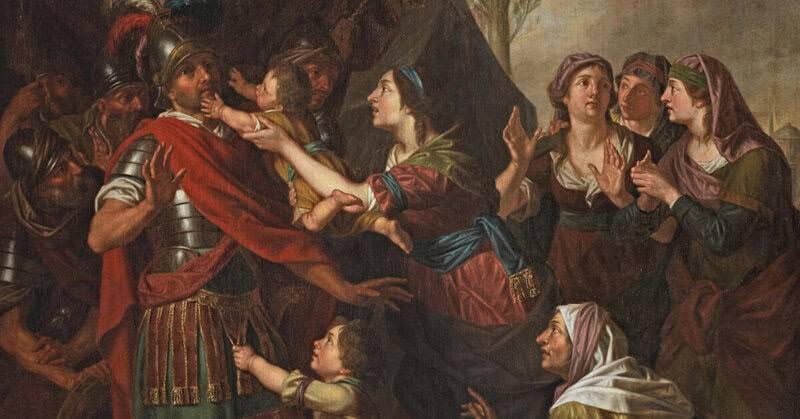
Rome sent embassies. Coriolanus rejected them all. Then his mother came. Plutarch lingers here: Volumnia walked out of the gates with his wife and children and stood before him in the enemy camp. He wept. He withdrew the army. He never returned to Rome. The Volscians, feeling cheated of their conquest, killed him.
What Plutarch Saw That Both Cities Refused To
Plutarch’s comparative essay on these two men is one of the most psychologically exact documents in ancient literature. He notes that both men possessed extraordinary gifts that their cities had nurtured and then turned against when those gifts became inconvenient. He asks — carefully, as he always did — whether the fault was in the men or in the democratic machinery that could not absorb them. He does not answer definitively. But he notes that both cities survived, and both men did not.
The Question That Has Kept Scholars Arguing for 2,000 Years
Shakespeare read Plutarch — in Thomas North’s 1579 English translation — and turned the Coriolanus story into one of his most politically uncomfortable plays. The play refuses to let the audience settle into comfortable condemnation. So did Plutarch’s original. The biographer from Chaeronea was not interested in heroes or villains; he was interested in the specific machinery by which greatness and catastrophe so often arrive in the same body.
What makes the Alcibiades-Coriolanus pairing so enduring is that Plutarch understood something both men shared: not arrogance exactly, but a fundamental inability to perform smallness. In democracies, that inability is not a private flaw. It becomes a public emergency.
Greatness that cannot bend does not slowly soften — it finds the nearest enemy camp and offers directions to the capital.

 English
 Arabic
 French
 Spanish
 Portuguese
 Deutsch
 Turkish
 Dutch
Dutch
 Italiano
 Romaian
 Portuguese (Brazil)
 Greek
Greek