


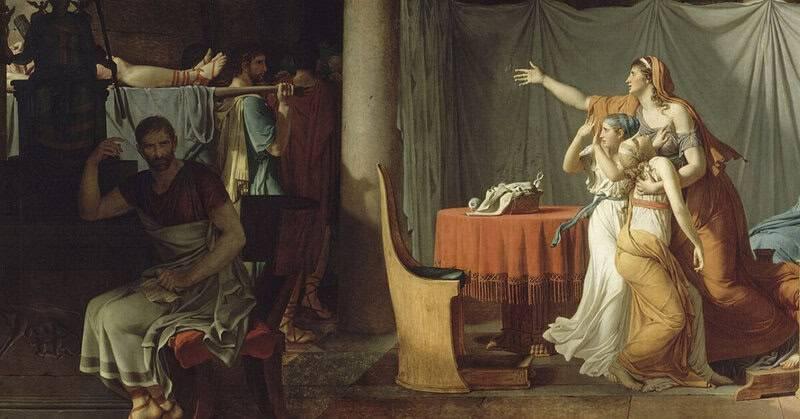
In 509 BC, the man who had just liberated Rome from its last king sat in the curule chair of the consul and ordered his own sons brought before him in chains. They had been caught plotting to restore the Tarquin monarchy. He did not flinch. He watched the lictors execute them.
Plutarch tells this story not as a footnote but as the defining axis of Lucius Junius Brutus’s entire existence — the moment that proved whether Rome’s new republic was real or theater. Brutus had spent years pretending to be a fool, enduring humiliation under King Tarquinius Superbus because that pretense was the only thing keeping him alive. He had watched the king murder his own brother. He had bided his time with the patience of a man who had decided that survival was a tool, not a goal.
How a Feigned Idiot Brought Down a Dynasty
His name meant “the dull one.” He wore it like armor. While the Tarquin court amused itself at his expense, Brutus studied its weaknesses, cultivated its enemies, and waited for the crack. It came in 509 BC when the king’s son Sextus raped the noblewoman Lucretia, who then killed herself rather than live in dishonor. Brutus took her bloody dagger, held it before Rome, and delivered an oration that ended the monarchy in a single afternoon.
He and Lucius Tarquinius Collatinus became Rome’s first two consuls — rulers of the world’s most radical new political experiment. But power, Plutarch understood, is most revealing not in how a man seizes it, but in what it demands of him when the cost is something he cannot get back.
The Conspiracy That Cost a Father Everything
The deposed Tarquins had not accepted exile quietly. They sent agents into Rome, and those agents found willing ears among young aristocrats who missed the comforts of monarchy. Among the conspirators: Titus and Tiberius Brutus, the consul’s own sons. When the plot unraveled, the evidence was unambiguous. The law was clear. As consul, Lucius Junius Brutus held imperium — the absolute authority of the Roman state.
Plutarch writes that Brutus’s face, throughout the trial and the execution, showed no softening. No tears, no trembling. He allowed the process to move at the law’s own pace, and when it was done, he rose and conducted the remaining business of the day. Ancient sources disagreed on whether this was superhuman virtue or something colder — the complete subordination of the self to an idea. Plutarch, characteristically, refused to settle the question. He presented both readings and let the reader sit with the discomfort.
The Paired Life Plutarch Chose — and Why It Still Stings
Plutarch paired Brutus with Publicola, his fellow consul and the man who gave Rome many of its earliest laws. The pairing is instructive: both men shaped the republic in its infancy, but Brutus shaped it through sacrifice while Publicola shaped it through legislation. One man gave Rome a constitution; the other gave it proof that the constitution would be enforced against everyone, including the enforcer’s own blood. Plutarch’s moral comparison favors neither. He was not grading men. He was illuminating the costs of the virtues we claim to admire.
The Legacy That the Later Brutus Inherited — and Crushed Under Its Weight
Five centuries after Lucius Junius Brutus died in battle — still serving as consul in the very year he had expelled the Tarquins — his name became the most potent political inheritance in Roman history. When Marcus Junius Brutus drove a dagger into Julius Caesar on March 15, 44 BC, he did so in part because the ghost of his ancestor demanded it. The name Brutus had come to mean a specific, terrible thing: the willingness to kill what you love for what you believe.
What Plutarch saw, and what his readers across two millennia have not stopped seeing, is that republics do not survive on constitutions alone. They survive on the willingness of their custodians to hold the line even when the line runs directly through the heart.
The dagger Lucretia used on herself became the dagger Rome used on monarchy — and the blade never fully went back into its sheath.

 English
 Arabic
 French
 Spanish
 Portuguese
 Deutsch
 Turkish
 Dutch
Dutch
 Italiano
 Russian
 Romaian
 Greek
Greek