


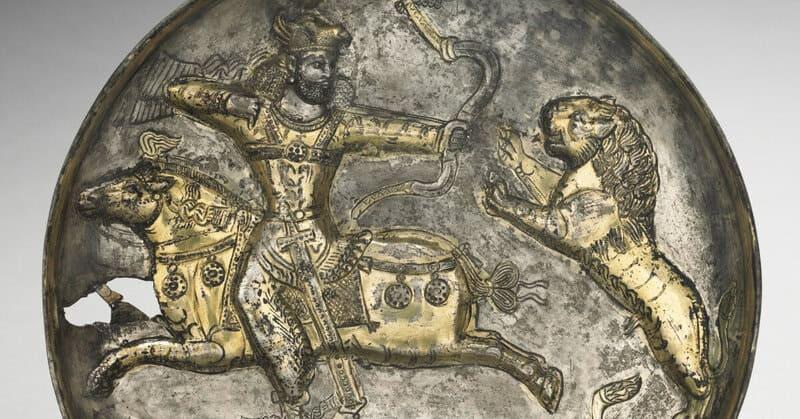
You have almost certainly used it. Not the bow, not the horse, but the idea — the sharp, final remark thrown back over your shoulder as you leave. The English phrase “parting shot,” and its older form “Parthian shot,” entered the language because a cavalry archer on the Iranian plateau in the first century BC figured out how to kill men while appearing to flee from them. The phrase outlived the empire by two thousand years. The empire itself barely survived its own reputation.
The Steppe Gave Them Something Rome Could Never Buy
The Parthians descended from the Parni, a semi-nomadic people of the Dahae confederacy from the region east of the Caspian Sea. When Arsaces I broke away from Seleucid rule around 247 BC and founded what would become the Arsacid dynasty, he brought with him a military culture forged entirely on horseback. The steppe taught a specific lesson: mobility is survival. A warrior who cannot ride, shoot, and maneuver simultaneously is already dead.
Parthian cavalry came in two devastating forms. The cataphract was a heavily armored shock trooper — horse and rider both encased in scale armor, armed with a kontus lance long enough to skewer two men at once. The lighter horse archer carried a composite bow, a weapon of laminated wood, horn, and sinew that could drive an arrow through Roman legionary armor at 100 meters. Together, these two forces constituted a combined-arms system that Roman tactical doctrine, built around the heavy infantry legion, had no natural answer for. Rome was a hammer. Parthia was water.
The Feigned Retreat Was Not a Trick — It Was a System
At Carrhae in 53 BC, the general Surena deployed what Roman survivors described with a kind of traumatized bewilderment: cavalry that ran away and killed you while running. The Parthian horse archers would charge close enough to provoke a Roman advance, then wheel their horses sharply and gallop away — firing backward with full accuracy at full speed, the archer’s body rotating at the hip, the bow drawn to the ear, the release timed to the horse’s stride between footfalls to minimize vibration. This was not improvisation. This required years of training so deep the movement became reflex.
The Romans called it, with grudging precision, the “Parthian shot.” They had no tactical counter that fully worked. Charging the cavalry left the infantry exposed and exhausted in the heat. Holding formation meant absorbing arrow fire until morale or bodies gave out. Surena had also solved the logistical problem that had always limited horse-archer armies: ammunition. A train of camels carrying reserve arrows followed the cavalry, allowing the archers to sustain fire indefinitely. The seven legions of Crassus were not defeated by superior numbers. They were defeated by a system.
The General Who Saved the Empire and Paid for It With His Life
Surena was perhaps the greatest military mind the Parthian Empire produced, and Orodes II, the Parthian king he served, had him executed within a year of the victory at Carrhae. The reason, most accounts suggest, was fear: Surena’s personal retinue numbered ten thousand men, his family prestige rivaled the royal house, and a general who humiliates Rome has a dangerous amount of public goodwill. Orodes gave him no triumph, no monument, no written legacy. The man who shattered Rome’s eastern ambitions vanished from the historical record almost immediately after his greatest achievement — a pattern that would define Parthian history as a whole.
A Phrase Is All That Walks Among Us Now
The Parthian shot evolved linguistically in a slow drift across centuries. Latin writers used “Parthica sagittae” — Parthian arrows — as a metaphor for cutting remarks. The concept migrated through medieval European literature, arrived in English by the seventeenth century as “Parthian shot,” and then, through a gradual phonetic blur, became “parting shot” in the nineteenth century, the connection to Parthia finally severed. Most people who use the phrase today have no idea they are quoting a cavalry manual from 200 BC.
The Parthian Empire lasted from 247 BC to 224 AD — 471 years of continuous rule across one of the most strategically vital territories on earth. It checked Roman expansion at the Euphrates for three centuries, facilitated the first economic connections between the Mediterranean and China, and produced architectural and artistic achievements that the Sasanians who replaced them were careful to build upon. And yet it occupies perhaps two pages in a standard world history textbook, if it appears at all.
An empire that held Rome to a draw for 300 years deserves more than a footnote — but it settled, in the end, for a phrase, and phrases, unlike empires, cannot be sacked.

 English
 Arabic
 French
 Spanish
 Deutsch
 Turkish
 Dutch
Dutch
 Italiano
 Russian
 Romaian
 Portuguese (Brazil)
 Greek
Greek