


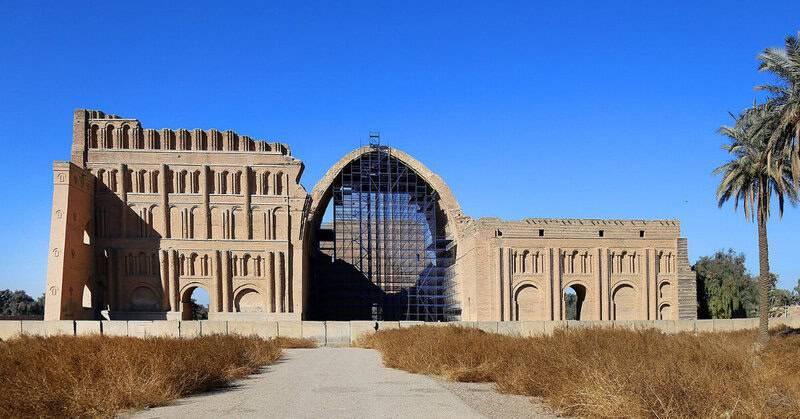
The arch has stood for fifteen centuries. It rises nearly 37 meters from the Iraqi plain south of Baghdad — a single unreinforced brick vault, the largest of its kind ever built in the ancient world, still defying the sky with the quiet arrogance of something that was never meant to fall. It is all that remains of Ctesiphon, the capital of the Parthian Empire, a city that may have been home to more than half a million people and stood at the center of the known world for eight hundred years.
Where the Tigris Made Kings and Kings Made History
Ctesiphon grew on the eastern bank of the Tigris River in what is now central Iraq, directly across from the older Hellenistic city of Seleucia. The Parthians seized the region around 141 BC under Mithridates I and recognized immediately what the geography offered: a river crossing point on the main overland route between the Mediterranean world and the Persian plateau, with the Silk Road trade flowing through it like blood through an artery. They did not build Ctesiphon so much as they accumulated it — quarter by quarter, palace by palace, over two centuries of Arsacid rule.
By the first century AD, the greater metropolitan area — Ctesiphon and its surrounding cities collectively known as al-Madain, “the Cities” — rivaled Alexandria and Rome in population and surpassed most of the ancient world in commercial volume. The markets sold Chinese silk alongside Indian pepper, Parthian silver alongside Roman glassware. The court spoke Greek in diplomatic correspondence and Parthian in ceremony. This was not a provincial backwater. This was the hinge of the ancient world.
Seven Times Conquered, Seven Times It Rose Again
Rome sacked Ctesiphon at least six times. Trajan took it in 116 AD. Lucius Verus’s generals sacked it in 165 AD. Septimius Severus burned the royal palace in 197 AD. Each time, Roman emperors celebrated with coins, triumphal arches, and titles like “Parthicus Maximus.” Each time, the city recovered, rebuilt, and resumed its function as the commercial and political heart of an empire that Rome could wound but never kill. The Parthians understood that a capital city is not a symbol — it is an engine. Destroy it, and another engine rises.
When the Sasanian dynasty overthrew the Parthians in 224 AD, they kept Ctesiphon. They understood its value too well to abandon it. Under the Sasanians, the city reached its architectural apex: the Taq Kasra, the great throne room arch built by Khosrow I in the sixth century AD, announced to every visitor that the empire they were entering had mastered physics, statecraft, and spectacle simultaneously. The interior of that hall could seat thousands. Its acoustics alone were a statement of imperial power.
The Night the Caliphate Walked Through Those Doors
In 637 AD, Arab Muslim forces under Sa’d ibn Abi Waqqas defeated the Sasanian army at the Battle of al-Qadisiyyah and marched on Ctesiphon. The last Sasanian emperor, Yazdegerd III, fled. The Arab soldiers who entered the treasury reportedly wept — not from grief, but from the sheer scale of what they found. The city’s legendary White Palace contained gold, silver, and textiles in quantities that seemed impossible. One account describes Arab soldiers who had never seen camphor mistaking it for salt and using it to season their food.
The new Islamic caliphate built its early administrative center nearby at Kufa, and later at Baghdad — founded in 762 AD just forty kilometers from Ctesiphon’s ruins. Baghdad became the Abbasid capital, the City of Peace, the new center of civilization. Ctesiphon was quietly cannibalized. Its bricks were pulled from its walls to build Baghdad’s houses and mosques. Its memory dissolved into the name of the surrounding region: al-Madain, now a quiet suburb south of the Iraqi capital.
What One Arch Refuses to Let the World Forget
The Taq Kasra survived — partially. The western facade collapsed in a flood in 1888; the eastern half still stands. It has survived two Gulf Wars, neglect, looting, and the indifference of a world that no longer knows what it is looking at. Archaeologists who have studied the site describe layers of occupation going back to the Parthian period, a stratigraphic record of eight centuries of continuous urban life that has barely been touched by systematic excavation.
Ctesiphon’s obscurity is not an accident of history — it is an artifact of whose stories get told. The city sat in territory that became contested, colonized, and ultimately written about primarily by its conquerors. Rome celebrated its own raids. The Islamic chronicles focused forward, not backward. The Parthians themselves left no Virgil, no Livy, no great self-mythologizing literature in a language that survived the centuries intact.
The arch does not need a myth. It has physics, and physics, unlike empires, does not negotiate.

 Arabic
 French
 Spanish
 Portuguese
 Deutsch
 Turkish
 Dutch
Dutch
 Italiano
 Russian
 Romaian
 Portuguese (Brazil)
 Greek
Greek