


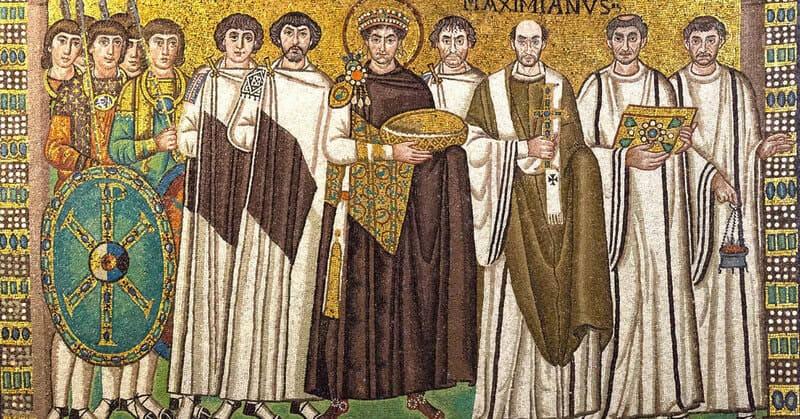
Procopius of Caesarea served as personal secretary and legal advisor to Belisarius on campaign — present at the siege of Carthage, at the Gothic wars in Italy, at the desperate defense of Rome. He wrote everything down. The official version of those events, the Wars and the Buildings, portrays Justinian as a visionary emperor and Belisarius as his brilliant instrument. There was another version. Procopius kept it locked away until after the emperor was dead.
The Historian Who Traveled with the Finest General of His Age
Procopius arrived on campaign with Belisarius around 527 AD, embedded in the inner circle of a man who would become the most consequential soldier of the century. He witnessed the North African campaign firsthand, crossed into Sicily, watched Belisarius negotiate the surrender of Ravenna. His access was extraordinary. His History of the Wars — eight books covering the Persian, Vandal, and Gothic campaigns — remains the primary historical source for Justinian’s entire military program. Without Procopius, the 6th century goes nearly dark.
The Wars reads with a reporter’s precision and a courtier’s careful admiration. Belisarius emerges as cool, brilliant, and almost supernaturally controlled. Justinian appears as the architect of a grand restoration. The Buildings, completed later, goes further — lavishing praise on Justinian’s construction projects across the empire in prose that becomes, in places, almost ritualistic in its flattery. It is the work of a man who understood survival.
The Manuscript No One Was Supposed to Find
The Anekdota — translated as the Secret History or Unpublished Things — was almost certainly composed around 550 AD, during Justinian’s lifetime, and circulated (if at all) only in private. The Secret History circulated far less widely than Procopius’s official works and survives today through a relatively fragile manuscript tradition. Scholars argued for generations about its authenticity, because nothing in it resembles the careful diplomat of the Wars. Procopius describes Justinian as a man whose face would occasionally go blank, his features dissolving into empty flesh, before returning to normal — a detail offered as evidence that the emperor was literally not human.
Theodora fares worse. Procopius, who had watched her hold the court together and refuse to flee during the Nika Riots, fills pages with accusations of sexual degradation, tyranny, and casual cruelty. Belisarius’s wife Antonina receives similar treatment. The text thrums with personal animosity, old wounds, and the rage of a man who spent decades performing admiration he did not feel.
What He Knew About Belisarius That He Never Published
The Secret History is also where Procopius unburies his true account of Belisarius — not as a spotless hero but as a man undermined by a faithless wife and psychologically dominated by Antonina’s relationship with Theodora. He describes Belisarius as willfully blind to humiliations that the entire court witnessed, a giant reduced by domestic entanglement. The portrait is more complex and more painful than anything in the official histories. It reads like grief — the disillusionment of a man who admired Belisarius genuinely and could not reconcile the battlefield commander with the diminished figure of the Constantinople court.
What Survives When the Official Story Breaks Down
The coexistence of both texts — the official Wars and the buried Secret History — is itself the most revealing document of Justinian’s reign. It shows an empire in which intelligent men understood exactly what they were permitted to say, wrote the required version with professional skill, and then kept the true account somewhere private, waiting for a safer moment that might never come. Procopius never saw that moment. He died, likely in the 560s AD, still officially the man who celebrated Justinian’s glory.
The Secret History survived by accident, or close to it. Had the Vatican copy been lost — as countless manuscripts from the period were — Justinian’s reign would exist only in the version Procopius was permitted to write. History is full of official records. What it rarely preserves is the drawer where the truth was kept.
Every empire produces two archives: the one it intended and the one it could not quite destroy.

 English
 Arabic
 French
 Spanish
 Portuguese
 Turkish
 Dutch
Dutch
 Italiano
 Russian
 Romaian
 Portuguese (Brazil)
 Greek
Greek