


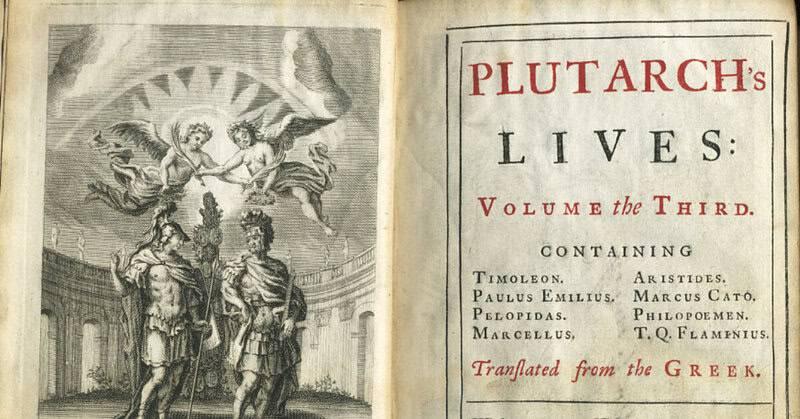
The Man Who Taught the Renaissance How to Read Ambition
Sometime around AD 100, a Greek philosopher named Plutarch sat in the mountain town of Chaeronea, in central Greece, and began writing the most influential set of biographies in Western history. He was not trying to write history. He said so directly: he was writing to improve the reader’s soul.
The Parallel Lives — forty-eight biographies arranged in twenty-three pairs, each Greek matched with a Roman counterpart — were not popular entertainment. They were moral philosophy in narrative clothing. Plutarch wanted his readers to encounter great men the way they might encounter a painting: not to document what was there, but to feel what it meant.
How One Town in Rural Greece Changed the Way Power Gets Written
Chaeronea was the site of Philip II of Macedon’s decisive victory over the Greeks in 338 BC — a battle that effectively ended the age of the independent city-state. It was, in other words, a town that had lost. Plutarch was born there around AD 46, almost four centuries after that defeat, and he spent most of his life there, serving as a priest at the Oracle of Delphi and writing at a pace and depth that still staggers specialists. He knew Rome intimately — he visited, lectured, and cultivated Roman patrons — but he chose to live in Chaeronea, to be a Greek man who understood the Roman world without being consumed by it.
That position, culturally peripheral but intellectually central, is the key to what makes the Parallel Lives so structurally unusual. Plutarch was not a Roman celebrating Roman greatness, nor a Greek mourning Greek decline. He was something rarer: a comparatist. He believed that virtue was not the property of one civilization, and that the most interesting thing you could do with a great Roman was stand him next to a great Greek and watch what each one illuminated in the other.
Lost for Centuries, Then Rediscovered Just in Time to Fuel a Renaissance
Plutarch’s works were copied in Byzantine monasteries through the medieval centuries, largely unknown to Western Europe. Then, in the 1400s, as Greek manuscripts began flowing westward ahead of the Ottoman conquest, Plutarch arrived in Italy. The response was immediate and transformative. Humanist scholars — men who were trying to reconstruct what greatness looked like, and how it could be cultivated — found in the Parallel Lives exactly the textbook they needed. By 1470, the Lives had been printed in multiple Latin editions. By 1559, Jacques Amyot’s French translation had made Plutarch the most widely read prose writer in France. By 1579, Thomas North’s English version had placed him in the hands of a young playwright from Stratford-upon-Avon.
Shakespeare lifted Antony and Cleopatra, Coriolanus, Julius Caesar, and Timon of Athens almost directly from Plutarch’s pages. Not just the plots — the speeches, the character beats, the moral weight. The most performed playwright in the English language is, in substantial measure, a relay station for a Greek biographer from a small Roman provincial town who died around AD 120.
The Irony Plutarch Would Have Appreciated
When the leaders of the French Revolution and the American founding generation reached for role models, they reached for Plutarch. Brutus, Cato, Lycurgus, Solon — these were the names on their lips, the templates against which they measured their own decisions. John Adams read Plutarch obsessively. So did Maximilien Robespierre. The biographer who wanted only to improve private virtue had produced the handbook of republican revolution.
What a Priest at Delphi Understood That Modern Biographers Still Chase
Plutarch’s method — finding the revealing anecdote, the small gesture that unlocks the whole character — is so thoroughly internalized by modern biographical writing that most readers no longer know where it came from. The scene at the dinner table that reveals the general. The letter written on the night before the decisive battle. The one moment of hesitation that cost an empire. These are Plutarchan techniques, two thousand years old, as natural now as breathing.
He served as a priest at Delphi, tending the oracle that told individuals to “know thyself.” His biographies are, in their deepest intention, an attempt to make great men knowable — to extract from the noise of conquest and legislation the single human frequency underneath. He largely succeeded. Forty-six of his subjects are the prism through which we still see the ancient world.
The oracle said: know thyself — and Plutarch spent a lifetime proving that the fastest way to do that is to study someone else.

 English
 Arabic
 French
 Spanish
 Portuguese
 Deutsch
 Turkish
 Dutch
Dutch
 Italiano
 Romaian
 Portuguese (Brazil)
 Greek
Greek