


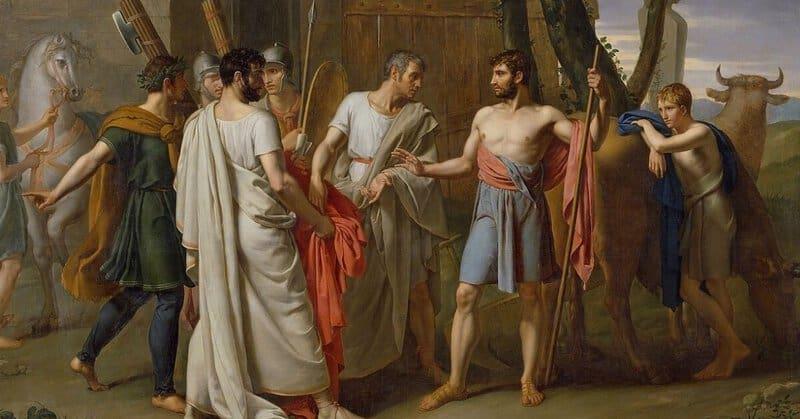
The senators found him plowing. It was 458 BC, and a Roman army was surrounded and besieged in the hills southeast of the city, trapped by the Aequi tribe in a hollow near Mount Algidus, unable to advance or retreat without being cut down. The Republic needed a dictator — a magistrate with absolute, unappealable, total authority over every civilian and military function of the Roman state. The Senate had chosen Lucius Quinctius Cincinnatus. He was across the Tiber on a four-acre farm, working the field himself because he could not afford hired hands. When the envoys arrived, they asked him to put on his toga before they delivered the Senate’s message.
He called to his wife to bring it from the house. Then he crossed the river and accepted the fate of Rome.
The Office Designed to Save the State by Suspending It
The Roman dictatorship was one of the most intellectually sophisticated political inventions of the ancient world, and one of the most dangerous. The Republic was built on the principle of collegiality — shared power, mutual vetoes, annual terms — precisely to prevent the tyranny that the Romans believed had corrupted the Etruscan kings they expelled in 509 BC. But the founders understood that a committee cannot fight a war at crisis speed. So they engineered an emergency exception: a dictator, nominated by a consul and ratified by the Senate, who held for a maximum of six months the power that normally required two consuls, two censors, eight praetors, and a Senate of three hundred to exercise.
No veto applied to a dictator. No tribune could obstruct him. No appeal to the people could reverse his orders. Every other magistracy was technically suspended beneath his authority. The office was genuine absolute power — and it was built into a republic that philosophically despised absolute power, because the Romans were pragmatic enough to know that principles alone do not defeat encircling armies.
Fifteen Days That Embarrassed Every Later Roman General
Cincinnatus was sixty years old in 458 BC and had been consul six years earlier — a term marked by political controversy and the near-exile of his son Caeso. He was not a popular figure in the city. None of that mattered. He crossed the Tiber, assumed the fasces, levied an army, and marched to Mount Algidus in a single day. That night, he ordered his soldiers to surround the Aequi camp with a continuous line of fortifications — an encirclement of the encirclers. By morning, the Aequi were trapped between the Roman force they had been besieging and the new Roman line closing behind them. They sued for terms. Cincinnatus forced their commanders to pass under a yoke of Roman spears — the ultimate Roman humiliation — and released them.
He was back in Rome celebrating a triumph within days. The entire dictatorship lasted fifteen days. He resigned on the sixteenth, returned his authority to the consuls, and went back across the Tiber to finish his plowing.
The Farm That Made the Founding Fathers Weep
The story of Cincinnatus was so foundational to Roman civic identity that it was retold in nearly every major work of Roman historiography — Livy devotes careful attention to it, and later Roman moralists used it as the gold standard against which every ambitious general was measured and found wanting. The underlying message was not about farming or simplicity. It was about the relationship between power and virtue: that the only man truly safe to hold absolute authority was the man who genuinely did not want it and would surrender it the moment necessity ended.
When the veterans of the American Revolution searched for a name for their officers’ fraternal organization in 1783, they chose the Society of the Cincinnati. When they needed a symbol for George Washington’s voluntary resignation of his military commission — an act that stunned European monarchies accustomed to generals who became kings — they reached for the same Roman farmer. King George III, told that Washington intended to resign his command and return to his plantation, reportedly said: “If he does that, he will be the greatest man in the world.” He was describing Cincinnatus, whether he knew it or not.
The Precedent That Held — Until the Day It Didn’t
For nearly five centuries after Cincinnatus, the Roman dictatorship functioned more or less as designed. Dictators were appointed, crises were resolved, and the office was surrendered. Then, in 82 BC, a general named Lucius Cornelius Sulla marched on Rome with his legions — the first Roman commander to do so — and had himself appointed dictator with no six-month limit and no defined purpose. He held the office for three years, rewrote the constitution to consolidate senatorial power, proscribed his enemies by the hundreds, and then — in the most chilling echo of Cincinnatus imaginable — voluntarily resigned and retired to his country estate in Puteoli, where he died the following year.
Sulla’s resignation proved the Cincinnatean ideal was not quite dead. But his dictatorship had demonstrated something irreversible: the office could be seized, not merely granted. Julius Caesar watched Sulla’s career with intense attention and drew the obvious conclusion. When Caesar crossed the Rubicon in 49 BC and was eventually appointed dictator perpetuo — dictator in perpetuity, which was not a dictatorship at all but a monarchy wearing a Republican mask — the system that Cincinnatus had honored so completely finally broke under the weight of men who admired the precedent but could not match the man.
The plow was still in the field when they carried Caesar out of the Senate on the Ides of March — and no one thought to go back for it.

 English
 Arabic
 French
 Spanish
 Portuguese
 Deutsch
 Dutch
Dutch
 Italiano
 Russian
 Romaian
 Portuguese (Brazil)
 Greek
Greek