


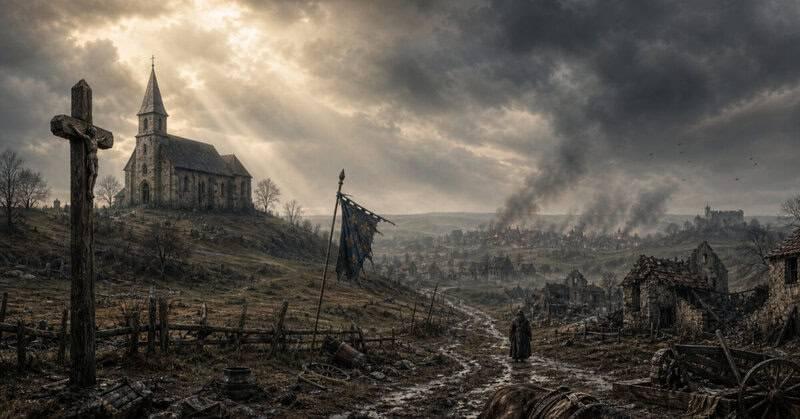
In the 14th and 15th centuries, France was embroiled in the Hundred Years’ War, a protracted conflict with England that devastated the nation. The war, which began in 1337, was rooted in territorial disputes and claims to the French throne. (britannica.com)
The French countryside was ravaged by English invasions, leading to widespread destruction and economic hardship. The Black Death further exacerbated the suffering, decimating the population and leaving villages in despair. (britannica.com)
Amidst this turmoil, the French people were gripped by a fervent religious climate. Visions, prophecies, and signs from God were interpreted as divine messages, leading to a climate of suspicion and accusations of heresy. This environment set the stage for the emergence of figures like Joan of Arc, whose faith and leadership would inspire a nation on the brink of collapse.
A Teenage Visionary Emerges

At the age of 13, Joan of Arc began experiencing vivid visions and hearing voices, which she identified as Saint Michael, Saint Catherine, and Saint Margaret. These divine messengers instructed her to support Charles VII, the rightful king of France, and to drive the English invaders from the country. (encyclopedia.com)
Despite her humble beginnings as a peasant in Domrémy, Joan’s unwavering faith and determination led her to seek an audience with Charles VII. In 1429, she journeyed to Chinon, where she convinced the skeptical king and his court of her divine mission. Dressed in men’s clothing for safety, Joan’s arrival at the court was met with astonishment, but her conviction and knowledge of events she could not have known impressed Charles VII. (medievalchronicles.com)
Joan’s courage and the mystery surrounding her rise from an unassuming peasant girl to a leader of armies at just 17 captivated the French people. Her journey to meet the future king and her bold claims of a divine mission to save France marked the beginning of a remarkable chapter in French history.
Daring to Lead Armies
Joan’s transformation from a humble peasant to a military commander was nothing short of extraordinary. At the age of 17, she donned men’s clothing and armor, a bold move that defied societal norms and signified her commitment to her divine mission. Her presence inspired the French troops, who, despite initial skepticism, began to rally behind her leadership. (jeanne-darc.info)
In April 1429, Joan led the French forces to the besieged city of Orléans, which had been under English siege since October 1428. Her arrival marked a turning point; within days, the French launched successful offensives, culminating in the capture of key English fortifications. On May 8, 1429, the English forces lifted the siege, a victory that revitalized French morale and signaled a shift in the tide of the Hundred Years’ War. (britannica.com)
Joan’s leadership at Orléans was pivotal. She not only provided strategic guidance but also embodied the hope and resilience of a nation on the brink of despair. Her victory at Orléans was a beacon of hope for the French people, demonstrating that even in the darkest times, courage and faith could lead to triumph. (nationalgeographic.com)
Enemies Within and Without

Joan of Arc’s meteoric rise from peasant to military leader not only drew the ire of the English but also ignited tensions among French nobility and the Church. Her direct communication with divine figures and her unconventional leadership style challenged established hierarchies, leading to suspicion and jealousy. (britannica.com)
French nobles, particularly those aligned with the Burgundians, viewed Joan as a threat to their political ambitions. Her influence over King Charles VII and the French army undermined their power, prompting them to seek her capture. In 1430, during the siege of Compiègne, Joan was captured by Burgundian forces and handed over to the English. (britannica.com)
The Church, too, became wary of Joan’s growing influence. Her claims of divine guidance and her defiance of traditional ecclesiastical authority were perceived as challenges to the Church’s control. In 1431, an ecclesiastical court in Rouen, under the direction of Bishop Pierre Cauchon, tried Joan for heresy. The trial was politically motivated, aiming to discredit her and, by extension, the legitimacy of Charles VII’s reign. (britannica.com)
These internal and external pressures converged, leading to Joan’s condemnation and execution. Her death not only silenced a formidable leader but also highlighted the complex interplay of politics, religion, and power during a tumultuous period in French history. (britannica.com)
Betrayed, Captured, and Condemned

In May 1430, during the siege of Compiègne, Joan of Arc led a sortie against Burgundian forces. Outflanked by English reinforcements, she was unhorsed and captured. The Burgundians sold her to the English for 10,000 francs. (britannica.com)
Joan was imprisoned in Rouen, where an ecclesiastical court, led by Bishop Pierre Cauchon, charged her with heresy, claiming her visions were demonic and her actions blasphemous. (britannica.com)
Throughout the trial, Joan’s unwavering faith and defiance of the court’s accusations highlighted the political motivations behind her prosecution. Despite the court’s efforts to coerce her into abjuring her beliefs, Joan remained steadfast, leading to her condemnation and execution by burning at the stake on May 30, 1431. (britannica.com)
The Flame That Won’t Die

On May 30, 1431, Joan of Arc was executed by burning at the stake in Rouen, France, at the age of 19. Her death sent shockwaves through the nation, leaving a void that was felt deeply by the French populace. Despite her execution, the momentum she had ignited continued to propel France toward victory in the Hundred Years’ War. Charles VII remained king, and the English were eventually expelled from France. (britannica.com)
In 1456, a posthumous trial, known as the Rehabilitation Trial, was conducted to examine the fairness of her original trial. The court found that Joan had been unjustly condemned, and her name was cleared. (en.wikipedia.org)
Joan’s canonization as a saint in 1920 further solidified her status as a national heroine. Her story of courage, unwavering faith, and the ultimate betrayal continues to captivate and inspire. It serves as a testament to the enduring human spirit and the quest for justice, resonating with audiences across generations and cultures. (britannica.com)

 English
 Arabic
 French
 Portuguese
 Deutsch
 Turkish
 Dutch
Dutch
 Italiano
 Russian
 Romaian
 Portuguese (Brazil)
 Greek
Greek