


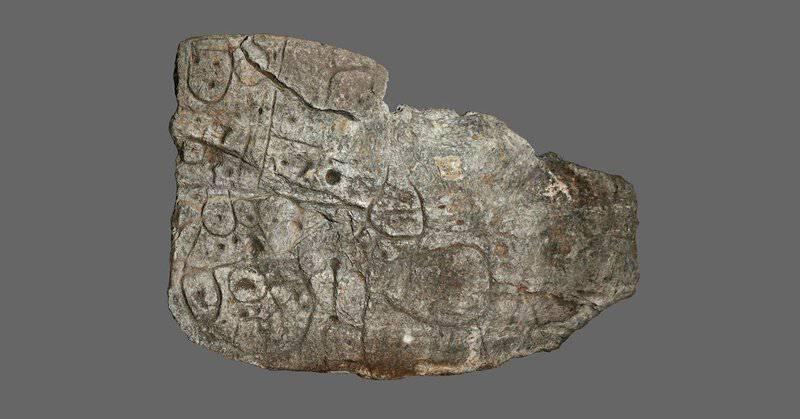
A Stone Pulled from a Bronze Age Tomb in 1900 — Then Lost for a Century
In June 1900, a French archaeologist named Paul du Châtellier was excavating a burial mound in the Finistère region of Brittany when his crew unearthed something unusual. The stone had been reused as a wall inside a stone cist — a prehistoric burial chamber — and it was covered in strange geometric engravings. Du Châtellier photographed it, noted it in his records, and then had it transported to his home, Château de Kernuz. There it sat. Decades passed. The man died. His collection moved on. And the stone, one of the most important archaeological objects ever found in Europe, spent the next century forgotten in a castle cellar.
The Markings Nobody Could Explain
The Saint-Bélec slab — named after the area where it was found — is made of grey-blue schist, measures nearly 4 meters long, and is etched with lines, circles, and geometric shapes that researchers could not initially interpret. To early 20th-century eyes, it looked like abstract decoration, perhaps ceremonial. No framework existed yet for reading it as something functional. So it was catalogued, archived, and eventually misplaced inside the very institution meant to preserve it.
After du Châtellier’s excavation, the slab was moved to Kernuz Castle. His collection was later acquired in 1924 by the Musée des Antiquités Nationales, but the slab was not registered at the time — and there was no assurance it had followed the rest of the collection. It had, in fact, ended up stored in a niche in the castle moat, before being moved to a cellar. It remained there until its rediscovery in 2014.
The Moment Archaeologists Realized What They Were Looking At
When researchers from Bournemouth University and the French CNRS institute finally pulled the slab back into the light, they did something du Châtellier never could: they ran it through high-resolution 3D scanning and photogrammetry. What emerged from that analysis stopped them cold. The map represents an area along an 18-mile stretch of the River Odet with 80 percent accuracy. :antCitation[]{citations=”2d5dbb8d-a976-4963-8b20-d32808f0231d” injected=”space”} The lines weren’t decorative. They were rivers. The hollows and circles weren’t abstract. They were landmarks — settlements, burial mounds, territorial boundaries.
Clément Nicolas from the CNRS research institute explained that the precise 3D depiction of the Odet Valley and further rivers, especially the meanders of the Aulne River, had been compared to modern maps through network analyses. :antCitation[]{citations=”64fc9cac-d1d4-47d1-a226-9a8f251beba7″ injected=”space”} The match was undeniable. Someone in the early Bronze Age, roughly around 1875 BC, had looked at the landscape around them and decided to carve it into stone — not as art, but as a record of territory and power.
A Kingdom Carved in Rock — Then Deliberately Destroyed
Researchers believe the slab may have depicted the territory of a strongly hierarchical political entity that tightly controlled its region during the early Bronze Age. Breaking the slab may have indicated condemnation and deconsecration — a deliberate act of erasure when that political order collapsed. The pieces were not discarded. They were repurposed as tomb walls, which carried its own symbolic weight. A map of power, broken apart and buried. The area covered by the map probably corresponds to an ancient kingdom, perhaps one that collapsed in revolts and rebellions.
A 4,000-Year-Old Guide to What Is Still Hidden
Today the Saint-Bélec slab is doing something no modern radar or aerial survey was designed to do: it is telling archaeologists exactly where to dig. The slab is pocked with tiny hollows which researchers believe could point to burial mounds, dwellings, or geological deposits. :antCitation[]{citations=”13878424-b1ee-43ee-bbbf-8df256cdea09″ injected=”space”} Each one is a potential site. Professor Yvan Pailler of the University of Western Brittany called it simply a “treasure map” — and meant it literally. Surveying and cross-referencing the entire territory indicated by the slab is a task that could take 15 years or more.
The implications stretch beyond Brittany. Studies confirmed that the stone depicts the Odet valley during the Bronze Age, making it the oldest known map of any European territory — and possibly the oldest territorial map anywhere on Earth. It rewrites assumptions about Bronze Age cognitive sophistication, political organization, and the very origins of cartography. The people who made it were not recording landscape out of curiosity. They were asserting dominion. They were drawing a border.
A stone carved before Rome existed, before the Greeks built their temples, before written history covered Europe — and it was a map all along, waiting in a cellar for someone to finally know how to read it.
Read Next: Where Are Biblical Lands Today? 37 Ancient Sites on Modern Maps

 English
 Arabic
 Spanish
 Portuguese
 Deutsch
 Turkish
 Dutch
Dutch
 Italiano
 Russian
 Romaian
 Portuguese (Brazil)
 Greek
Greek