


Where Birds Sleep is a game about control. Or, well, your lack of control

Where Birds Sleep is a game about control. Or, well, your lack of control
The very essence of videogame design is giving the player control. You choose where your character goes; you choose what your character does. In Where Birds Sleep, however, you don't get to choose. You don't get to be the good guy, yet you don't get to be the bad guy. You live by the consequences of your actions; consequences that cannot be changed. Where Birds Sleep makes you feel helpless; it breaks your heart, and forces you to question your morality. It's unlike any videogame I've ever played.
It's a game where you're not in control.
You are Cormo, who, to borrow Quiet Little Feet Co-Founder Martin Suchter's words, "sucks." A rugged pirate smuggler with a bloodstained past and the roughened vocals of Neil Newbon (Baldur's Gate 3's Astarion), you've awoken on a mysterious island, and you're not best pleased about it. The aim of the game is simple: explore, point-and-click style. There are various dialog options leading to different plot trees, with visual novel-esque text boxes helping narrate your journey. From this very barebones description, you'd be forgiven for assuming that Where Birds Sleep is a Disco Elysium-like, but in Disco Elysium, you make your own choices, determined by the roll of the die. In Where Birds Sleep, the dice still play a part, but Cormo is the one in control; sometimes, you're just along for the ride.

Where Birds Sleep's headliner mechanic is Cormo's ability to override your requests. Depending on how you play the character, you'll level up a series of different, opposite attributes. During a sequence with a young, green-eyed girl who claims she wants to be a pirate, you can either be sincere and tell her that she'll never make it, or tell her to go and live her dreams. The former will earn you points in both sincerity and cruelty, while the latter rewards you with empathy, but increases your insincerity. Depending on your stats, new pathways will open, while others will close. Being mean has its bonuses, while playing nice has its drawbacks. It's an interesting take on the 'good, bad, neutral, humorous' options that we see in the likes of the Dragon Age games or, laterally, Baldur's Gate 3; it proves that shades of gray exist, despite your best intentions.
All of these choices, even if they're seemingly minor, contribute to your unique version of Cormo. I fish a fez-style hat off of a hanging corpse, and give it to my bald 'friend' Dunlin as a somewhat insincere gift. He's not keen; "this hat isn't suited to me," he says. I press him, telling him he looks great in it, lying to his face, upping my insincerity. I wasn't trying to be mean; I genuinely wanted him to feel better, but Where Birds Sleep had me doubting myself - is there kindness in cruelty, and cruelty in kindness? That encounter comes back to bite me further down the line.

As I head off to explore, I'm greeted with a Slay the Spire-esque map, which offers various pathways through the nearby forest. Illustrated to look like an old war table, the air shimmers with mysterious fog, necessitating a gas mask. As we progress, Suchter and fellow Co-Founder Veronika Suchterova point out the 'notice' system, where prompts within the written dialog can allow me to inspect things further. Early on, they're relatively obvious - "you notice something on the ground" - but as the game progresses, they're harder to spot. As we journey, I take notice of the moon that hangs above the map itself, as well as the name on the side of a shipwreck. The latter rewards me with the cutscene of the green-eyed girl; the former informs me of her grisly fate.
Cormo, as it so happens, was a people smuggler amid other things. The child - and myriad others like her - are being transported to auction. As we arrive, she pleads and pleads, before managing to wrangle free of her captor's grip, rushing into the back alleys. Cormo gives chase, and with the right set of choices, eventually catches up to her. You're given the option: let her go, or bring her back. My heart screams; I want to let her go. But I've expended all my bonus dice, and my previous choices have locked that option off. There is a 100% chance that Cormo will return her to the slavers, and that's the only choice I have.
I'd be a liar if I said my stomach didn't twist; I had attempted to play nicely, and this is where I had ended up. "While a white lie might seem like the empathetic choice in the moment, it might make Cormo more insincere long-term," Suchter and Suchterova warn me. In this instance, the consequences outweighed the lie. "We expect people will be challenged by this approach."
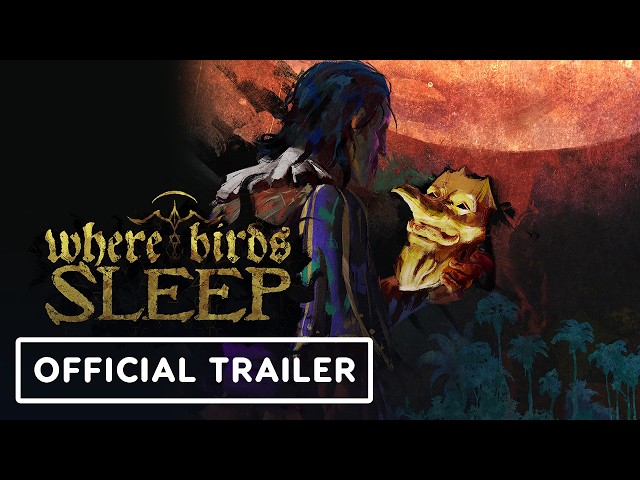
Despite the negative consequences for my 'good' actions, the aim of Where Birds Sleep isn't to be an 'evil simulator.' We've seen Baldur's Gate 3's Dark Urge swell in popularity, but while Cormo is inherently "incompetent," he's not purely malevolent. "The evil in Where Birds Sleep is very subtle," the duo tells me. "It is invisible but ever-present, always the 'easier' option. Cormo doesn't go around murdering or assaulting people because he's 'evil.' The violence is psychological, the acts are small, but feel devastating because Cormo aims them at himself just as much as at other characters.
"The player is almost always in 'control' through the choices they make, but they are not in control of the consequences. Cormo can and will override your choices, which the player will find challenging." In BG3, or even the Dragon Age games, "the fantasy of being the 'villain' is very alluring and powerful, but in the end, we as players care about the characters, the story, and the potential rewards so we can't commit, and if we do, we disassociate. Here we don't get that option."
"We make this struggle for control and agency a core thematic and gameplay pillar. It's a difficult thing to balance. We are trying to make sure the player has enough control but not too much."

I can actively say I've never fought for control in a videogame. Nor have I ever successfully managed to complete an 'evil' playthrough; I wimp out when my favorite characters have to die, or, as with Baldur's Gate 3, when I returned to the Druid's Grove and found it silent, barren, and bloodstained. Where Birds Sleep doesn't give me that option; it's jarring, in some ways frightening. It's a completely unique approach to the point-and-click genre; an innovation on the foundations ZA/UM set down with Disco Elysium and later Zero Parades: For Dead Spies. Where Birds Sleep challenged me, not in the difficulty sense, but at my very core.
There are some games that feel truly unique: this Where Birds Sleep is one of them. While I'm excited for more, I'm apprehensive about the next chapter of Cormo's story. I don't think my bleeding heart can handle it.

 English
 Arabic
 French
 Spanish
 Portuguese
 Deutsch
 Dutch
Dutch
 Italiano
 Russian
 Romaian
 Portuguese (Brazil)
 Greek
Greek