


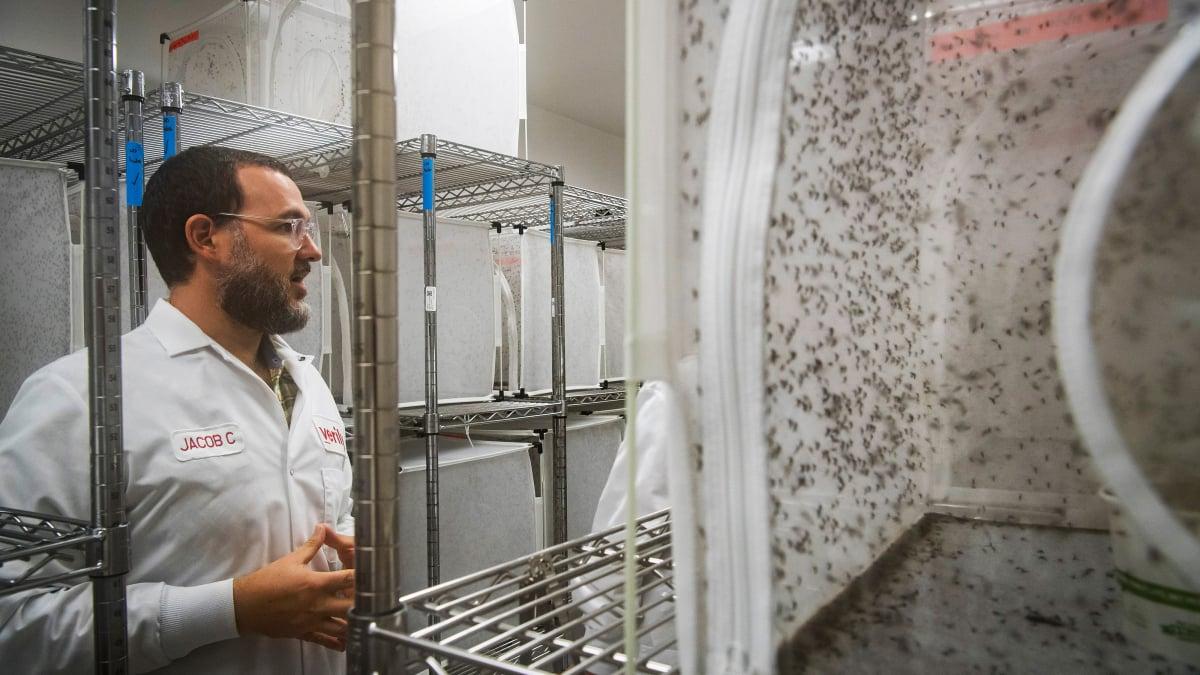
Billion dollar tech company Google is embracing bugs. Literally. Not digital ones, but real, living insects that the Silicon Valley giant plans to release into the air.
It's an initiative known humorously as the "Debug Project." First announced a decade ago, the latest iteration of the project aims to introduce 64 million mosquitoes — male mosquitoes, to be clear, entirely sterilized by the miracle of a naturally occurring bacteria — across California and Florida in the near future.
The Environmental Protection Agency (EPA) is in the midst of reviewing the proposed release, according to a new filing in the Federal Register. Google's plan is to use these selectively infected bugs to curb the spread of dangerous diseases, including dengue, which have been introduced to U.S. areas primarily by non-native mosquito populations. The hoard of non-reproductive bugs would reduce spawning rates and shrink the population over several generations, and, as Google explains, male mosquitoes cannot bite or spread disease themselves.
Google calls them the "good bugs."
Mashable Light Speed
"Mosquitoes kill more people than every other animal combined," the company explains on the Debug Project homepage. "One species, Aedes aegypti, carries diseases such as dengue, Zika, yellow fever, and chikungunya, which make hundreds of millions of people sick every year. And these diseases are spreading faster than ever."
Controlling the spread of mosquito-transmitted diseases has been a global goal for decades. Scientists and vector control specialists have successfully introduced male bugs sterilized by radiation in the past. Other methods to reduce mosquito populations, such as draining standing water and using pesticides, have been in place for even longer. But the bugs are outpacing human efforts.
Google has already completed field trials of their bug army, including a 2018 Fresno, California study that resulted in a 95 percent drop in the wild female mosquito population during peak season. The company has collaborated with outside partners on the project, including the Centers for Disease Control and Prevention (CDC), the Commonwealth Scientific and Industrial Research Organisation (CSIRO), and National Environment Agency (NEA) of Singapore.
More in line with its reputation as a tech leader, Google is also designing new software and monitoring tools to aid the project, the Los Angeles Times reported, like sensors and traps to track releases and pinpoint treatment areas.

 Arabic
 French
 Spanish
 Portuguese
 Deutsch
 Turkish
 Dutch
Dutch
 Italiano
 Russian
 Romaian
 Portuguese (Brazil)
 Greek
Greek